Soulmate-Halo/heterogeneous-gpu-pd-lab
Your RTX 3080 can pull prefill duty for a DGX Spark
A lab of real-hardware experiments pairing cheap dense compute cards with big-memory hosts to split prefill and decode across mismatched GPUs.
Collecting fresh signals — velocity needs a few days of history.
collecting data…
star history
What it does
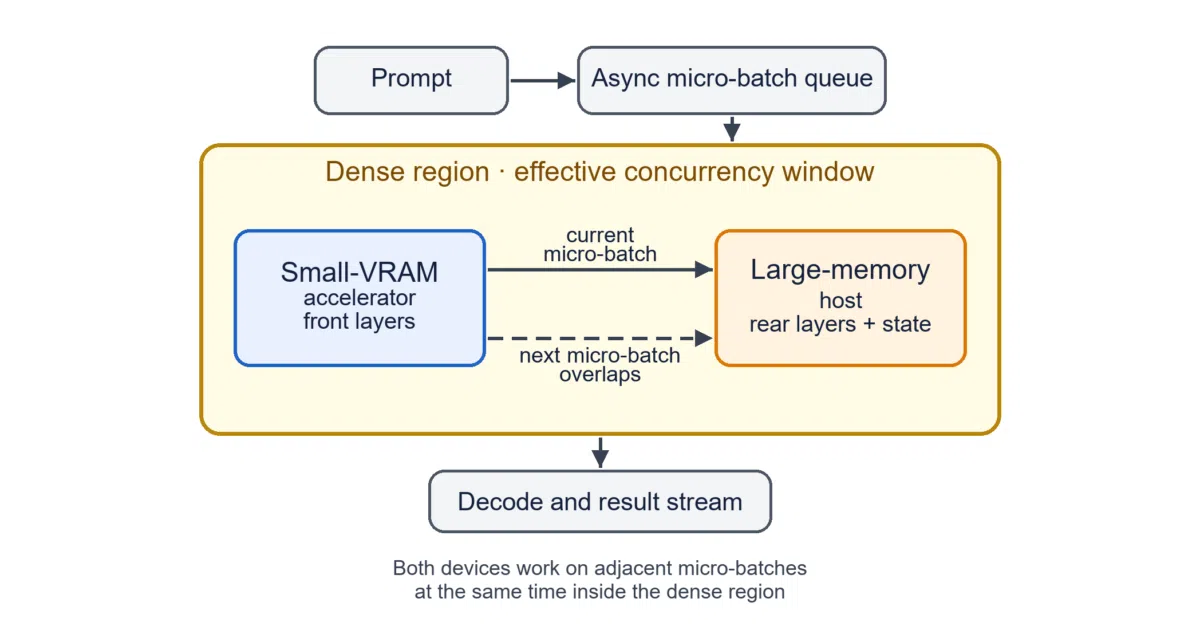
This repo documents heterogeneous GPU deployments where a fast, small-VRAM “dense” card (RTX 3080, RTX 6000D) accelerates a large-memory but slower host (DGX Spark, AI Max+ 395, M3 512G). The core trick is prefill/decode separation plus MoE expert placement: hot experts and the dense main path run on the fast card, cold experts run on the big-memory side, with KV and expert traffic crossing hosts over RDMA/NIXL. It’s a bundle of deployment configs, patches, Docker images, and benchmark evidence rather than a single library.
The interesting bit
The benchmarks are refreshingly honest: all numbers are untuned raw measurements, and the README explicitly warns against comparing them to tuned figures from other projects. It also openly discloses reproduction limits — e.g., the frozen HTTP router can’t hand a single request from Spark prefill to 3080 decode, so joint decode is RDMA expert cooperation, not a true PD handoff.
Key highlights
- Qwen3.8 Flash on RTX 3080 + AI Max 395: prefill jumps ~3.1x (273 → 844 tok/s); decode stays flat since it runs on the 395 either way.
- Qwen3.8 Flash V2 on 3080 + DGX Spark: reported ~2.25x aggregate and ~2.78x single-stream decode gains over Spark solo.
- DS4.1 Flash V8: two RTX 6000D cards in vLLM TP2 fronting four Spark nodes in SGLang TP4/EP4, sustaining 16,000+ tok/s batch prefill at C16–C32.
- DS4.1 Flash V10: a single 6000D handles all prefill for four Spark decode nodes, with KV crossing hosts over NIXL/RoCE.
- Docker images ship configs, patches, and verification scripts — but deliberately exclude the multi-hundred-GB weights and private role images.
Caveats
- Several benchmark comparisons are apples-to-oranges: different input lengths, concurrency, and workloads across setups; the README itself says treat them as order-of-magnitude references only.
- The V2 decode results came without raw logs, concurrency, or workload details in that revision.
- Reproducing anything here requires serious hardware (multiple hosts, RDMA, specific GPUs) plus separately-sourced weights — this is a lab, not a turnkey product.
Verdict
Worth a close read if you’re building multi-GPU or MoE inference on mixed hardware and want real, unpolished numbers. If you were hoping for a drop-in inference server, this isn’t it — it’s an evidence trail for people who like wiring GPUs together.
Frequently asked
- What is Soulmate-Halo/heterogeneous-gpu-pd-lab?
- A lab of real-hardware experiments pairing cheap dense compute cards with big-memory hosts to split prefill and decode across mismatched GPUs.
- Is heterogeneous-gpu-pd-lab open source?
- Yes — Soulmate-Halo/heterogeneous-gpu-pd-lab is an open-source project tracked on heatdrop.
- What language is heterogeneous-gpu-pd-lab written in?
- Soulmate-Halo/heterogeneous-gpu-pd-lab is primarily written in C++.
- How popular is heterogeneous-gpu-pd-lab?
- Soulmate-Halo/heterogeneous-gpu-pd-lab has 1.1k stars on GitHub.
- Where can I find heterogeneous-gpu-pd-lab?
- Soulmate-Halo/heterogeneous-gpu-pd-lab is on GitHub at https://github.com/Soulmate-Halo/heterogeneous-gpu-pd-lab.