Rubikplayer/flame-fitting
A parametric face model that actually moves its jaw
Reference implementation for FLAME, a 3D head model with articulated neck, jaw, and eyeballs—not just a static mesh.
Not currently ranked — collecting fresh signals.
star history
What it does
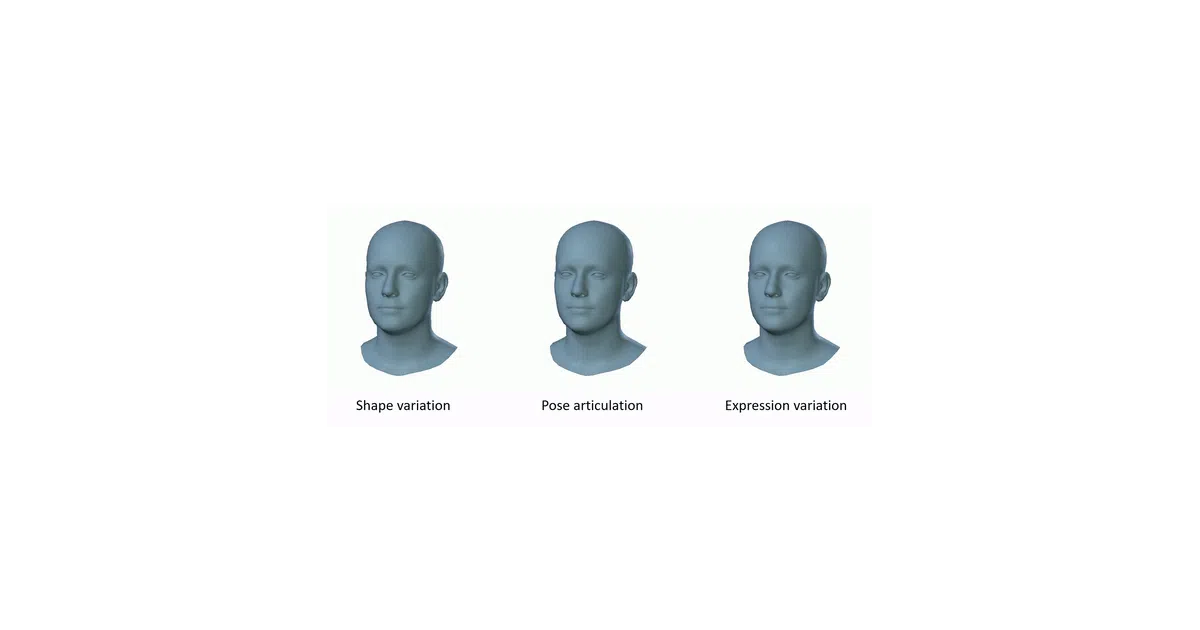
This repo holds the official Python implementation of FLAME, a learned 3D head model built from 33,000+ aligned scans. It ships with three demos: sample random heads, fit the model to 51 3D facial landmarks, or fit it to a full 3D scan. The code is essentially a teaching tool and baseline—you bring your own data and do your own optimization.
The interesting bit
Most morphable face models are just shape and expression sliders. FLAME adds an articulated skeleton: neck, jaw, and eyeballs actually rotate, with pose-dependent corrective blendshapes to keep things from looking rubbery. That makes it the face counterpart to SMPL-X’s body model, which is why you’ll see it powering everything from voice-driven animation (VOCA) to single-image face reconstruction (DECA, RingNet).
Key highlights
- Trained identity space on 3,800 subjects; expression space from 4D scan sequences
- Three working demos:
hello_world.py,fit_lmk3d.py,fit_scan.py - 51-landmark protocol with annotated reference image; landmarks must be in exact order
- Supports unit conversion (m, cm, mm, or unknown) when fitting raw scans
- Model download requires license agreement via MPI-IS website
Caveats
- Depends on
chumpy(NumPy-autograd hybrid) and a C++ mesh-distance module requiring manual Eigen path editing andmake - Python 3.6.9 tested; no claims about modern Python compatibility
- Scan fitting needs scan and model in the same local coordinate system—no automatic alignment magic
Verdict
Grab this if you’re building a face pipeline and need a principled, cited baseline with anatomically plausible jaw motion. Skip it if you want a batteries-included, one-click face reconstructor; the TensorFlow and PyTorch forks linked in the README are likely kinder to modern workflows.
Frequently asked
- What is Rubikplayer/flame-fitting?
- Reference implementation for FLAME, a 3D head model with articulated neck, jaw, and eyeballs—not just a static mesh.
- Is flame-fitting open source?
- Yes — Rubikplayer/flame-fitting is an open-source project tracked on heatdrop.
- What language is flame-fitting written in?
- Rubikplayer/flame-fitting is primarily written in Python.
- How popular is flame-fitting?
- Rubikplayer/flame-fitting has 824 stars on GitHub.
- Where can I find flame-fitting?
- Rubikplayer/flame-fitting is on GitHub at https://github.com/Rubikplayer/flame-fitting.