RayVentura/ShortGPT
An LLM assembly line for TikTok and YouTube Shorts
ShortGPT automates the entire pipeline for AI-generated YouTube Shorts and TikToks, from script writing and voiceover to footage sourcing and final render.
Not currently ranked — collecting fresh signals.
star history
What it does
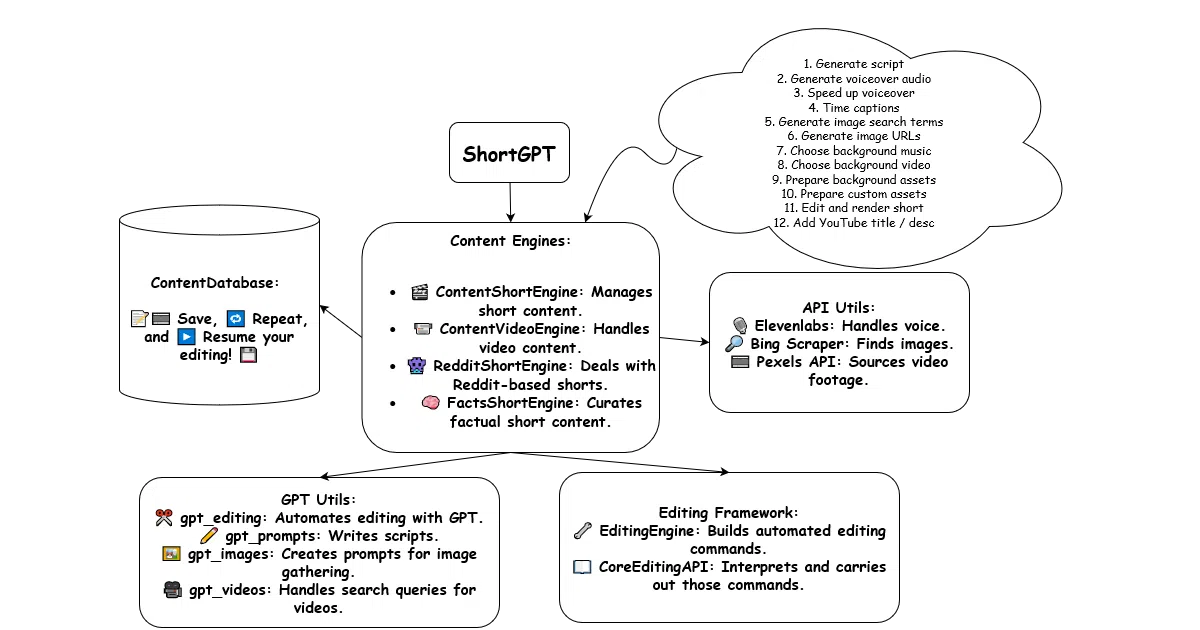
This Python framework automates short-form video production end-to-end. It generates scripts via OpenAI, synthesizes voiceovers in dozens of languages, sources background footage from Pexels and Bing, burns in captions, and renders the final cut. The package exposes three main engines: one for YouTube Shorts and TikToks, one for longer videos, and one that dubs existing content into other languages.
The interesting bit
The framework treats video editing as an LLM-readable task by expressing edits in a custom JSON-based “Editing Markup Language.” Instead of manually cutting timelines, you describe the assembly in structured text, and MoviePy executes it. That abstraction keeps the entire pipeline programmable and automatable.
Key highlights
- Three engines:
ContentShortEngine,ContentVideoEngine, andContentTranslationEnginefor dubbing and translation - Voice synthesis via both ElevenLabs and free Microsoft EdgeTTS, supporting 30+ languages
- Automatic asset sourcing from the web, Pexels, and Bing Images
- Persistent state managed through TinyDB
- Ships with a Gradio web UI and a ready-to-run Google Colab notebook
Caveats
- Explicitly labeled “experimental,” and the README admits more documentation is incoming
- Local deployment requires Docker; setup details are offloaded to a separate
installation-notes.md - Heavy reliance on external services: OpenAI for scripting, ElevenLabs/EdgeTTS for voice, and Pexels/Bing for assets
Verdict
Content creators and developers building automated short-form channels should look here. Anyone seeking fine-grained, human-in-the-loop video editing will likely find the LLM abstraction layer limiting.
Frequently asked
- What is RayVentura/ShortGPT?
- ShortGPT automates the entire pipeline for AI-generated YouTube Shorts and TikToks, from script writing and voiceover to footage sourcing and final render.
- Is ShortGPT open source?
- Yes — RayVentura/ShortGPT is open source, released under the MIT license.
- What language is ShortGPT written in?
- RayVentura/ShortGPT is primarily written in Python.
- How popular is ShortGPT?
- RayVentura/ShortGPT has 8.1k stars on GitHub.
- Where can I find ShortGPT?
- RayVentura/ShortGPT is on GitHub at https://github.com/RayVentura/ShortGPT.