RLinf/RPent
Orchestration layer for physical agents that refuse to stay frozen
RPent wraps frozen vision-language-action models in a recursive agent loop so robots can reflect, remember, and improve without retraining.
Collecting fresh signals — velocity needs a few days of history.
collecting data…
star history
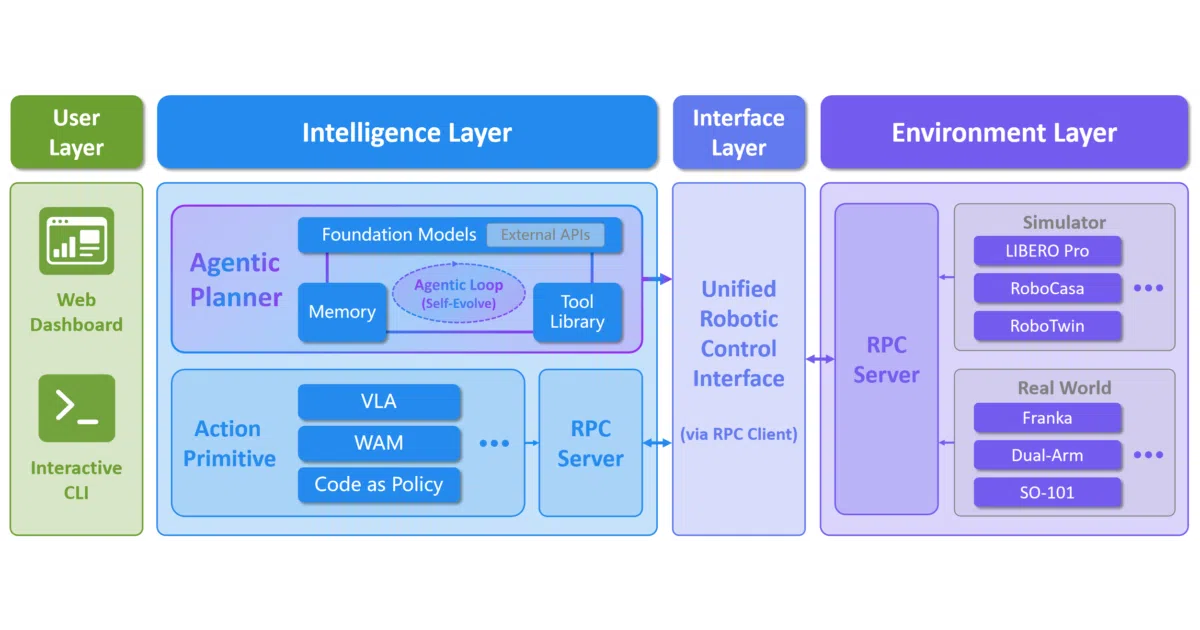
What it does RPent is an open framework for embodied agents that interact with the physical world through a recursive loop of perception, reasoning, memory, execution, and self-evolution. Instead of replacing the underlying vision-language-action model, it orchestrates heterogeneous components—planners such as Claude Code or Codex, VLA primitives including Pi0.5 and RLDX-1, and simulators or real Franka hardware—into a single agent that adapts through reflection and memory distillation. The stated goal is to lift long-horizon manipulation success rates beyond what a frozen VLA achieves in isolation.
The interesting bit The framework treats the VLA as a fixed muscle and adds an agentic nervous system around it: a planner reasons about the task, the VLA proposes actions, and a memory module distills failures into reusable guidance for future attempts. This service-oriented, composable architecture means you can swap planners or action primitives without rewiring the entire stack.
Key highlights
- Supports both simulated environments (LIBERO-PRO, RoboCasa, RoboTwin) and real hardware (Franka single and dual-arm).
- Pluggable planners include Claude Code, OpenAI Codex, and custom options; supported VLAs include Pi0.5, RLDX-1, and LingBot-VLA.
- A non-reasoning mode cuts average execution time by roughly 40%, according to the project’s release notes.
- Includes an interactive CLI and a live dashboard for monitoring agent reasoning, camera feeds, and action timelines.
- Backed by a published paper, Harness VLA, exploring memory-guided agentic composition.
Caveats
- SO-101 hardware support appears in the feature matrix but is not yet marked complete, unlike the Franka integrations.
- The README describes the recursive self-evolution loop in broad strokes; the underlying implementation details of how memory distillation actually updates agent behavior are not spelled out.
Verdict Worth a look if you are a robotics researcher or application developer trying to squeeze more reliability out of existing VLAs without retraining, or if you need a standardized bridge between simulators and real arms. Skip it if you want a single monolithic model that handles perception, planning, and control end-to-end.
Frequently asked
- What is RLinf/RPent?
- RPent wraps frozen vision-language-action models in a recursive agent loop so robots can reflect, remember, and improve without retraining.
- Is RPent open source?
- Yes — RLinf/RPent is open source, released under the Apache-2.0 license.
- What language is RPent written in?
- RLinf/RPent is primarily written in Python.
- How popular is RPent?
- RLinf/RPent has 511 stars on GitHub.
- Where can I find RPent?
- RLinf/RPent is on GitHub at https://github.com/RLinf/RPent.