PrismML-Eng/Bonsai-Image-Demo
Image generation with 1.58-bit weights, no cloud or WSL2 required
This demo squeezes a 4B-parameter diffusion model into binary and ternary weights so you can generate images offline on macOS, Linux, or native Windows.
Not currently ranked — collecting fresh signals.
star history
What it does
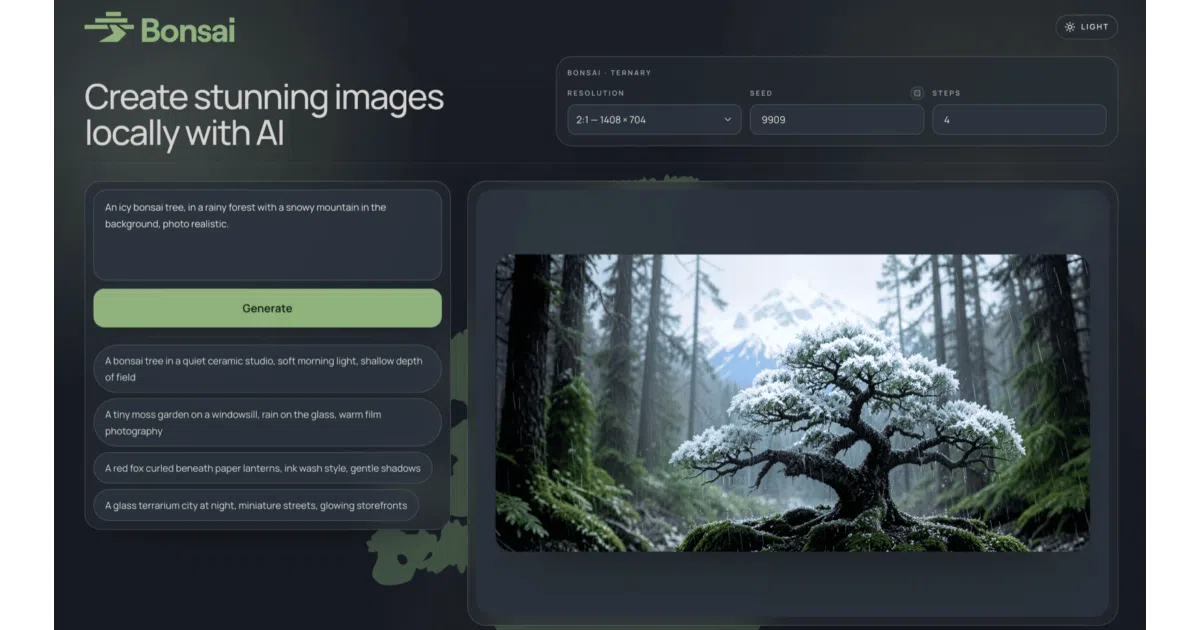
This repository is largely glue code around a heavily quantized 4B-parameter diffusion model. Shell and PowerShell scripts download 1-bit or 1.58-bit (ternary) weights, vendor in a FastAPI backend with a Next.js studio UI, and dispatch to platform-specific inference: MLX on Apple Silicon, gemlite/HQQ on Linux, and—unusually—native triton-windows on NVIDIA GPUs without WSL2. You get a local studio on :8000/:3000 or one-shot CLI generation against the downloaded models/ tree.
The interesting bit
The setup scripts default to a supply-chain security posture that would make most CI pipelines blush: they refuse to install any Python or npm package published less than seven days ago, as a hedge against undetected compromises. On the model side, the ternary (1.58-bit) variant is the recommended sweet spot between the extreme compression of 1-bit weights and usable output quality.
Key highlights
- Supports 1-bit and 1.58-bit (ternary) quantized model variants, with ternary recommended for better quality
- Runs on Apple Silicon (MLX), Linux NVIDIA GPUs (gemlite/HQQ), and native Windows NVIDIA GPUs (triton-windows, no WSL2)
- Includes a full local studio: FastAPI backend plus Next.js frontend, plus CLI wrappers for one-shot or warm-server generation
- Setup scripts block packages newer than 7 days by default (
BONSAI_PACKAGE_MIN_AGE_DAYS=7) as a supply-chain guardrail - 503 stars, actively documented with platform-specific setup notes and a Windows FAQ for common failure modes
Caveats
- Windows setup has documented rough edges: PowerShell execution policies, vcredist dependencies, old NVIDIA drivers, and OOM errors at 1024×1024 are all listed in the known-failure FAQ
- The one-shot
generate.shpays a cold-start penalty (model load plus JIT compilation) on every invocation; the docs explicitly recommend using the studio server andsend_request.shinstead
Verdict
Worth a look if you want private, local image generation on consumer hardware—especially if you are on Windows and tired of WSL2 gymnastics. Skip it if you need production-grade image quality or a mature, battle-tested ecosystem; this is a demo built around an experimental, heavily compressed 4B model.
Frequently asked
- What is PrismML-Eng/Bonsai-Image-Demo?
- This demo squeezes a 4B-parameter diffusion model into binary and ternary weights so you can generate images offline on macOS, Linux, or native Windows.
- Is Bonsai-Image-Demo open source?
- Yes — PrismML-Eng/Bonsai-Image-Demo is open source, released under the Apache-2.0 license.
- What language is Bonsai-Image-Demo written in?
- PrismML-Eng/Bonsai-Image-Demo is primarily written in PowerShell.
- How popular is Bonsai-Image-Demo?
- PrismML-Eng/Bonsai-Image-Demo has 558 stars on GitHub.
- Where can I find Bonsai-Image-Demo?
- PrismML-Eng/Bonsai-Image-Demo is on GitHub at https://github.com/PrismML-Eng/Bonsai-Image-Demo.