PhyAgentOS-Dev/PhyAgentOS
Swap Robots Without Rewriting the AI
PhyAgentOS treats robot hardware like pluggable drivers so the same agentic session can run in simulation or on a real arm without rewriting the control stack.
Velocity · 7d
+49
★ / day
Trend
↗accelerating
star history
What it does
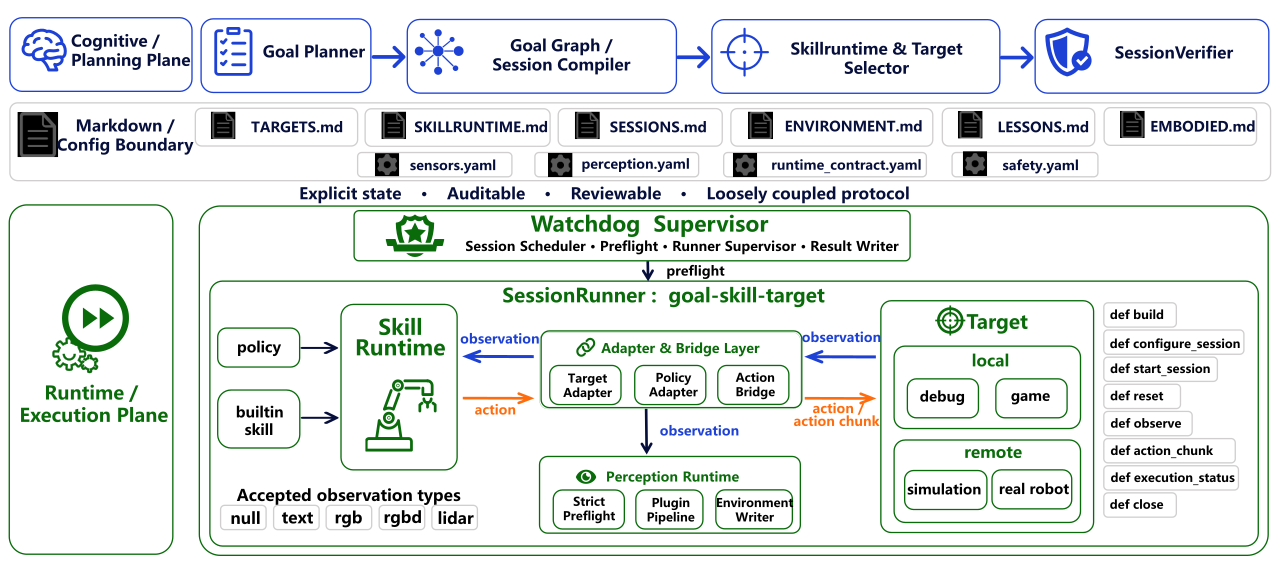
PhyAgentOS is a Python runtime for embodied AI agents that sits between high-level reasoning and physical hardware. It replaces direct LLM-to-robot pipelines with a session-centered execution model: an agent writes tasks to Markdown protocol files (SESSIONS.md, TARGETS.md, etc.), a watchdog supervises validation, and a runtime dispatches actions through small hardware-specific adapters. The goal is one codebase that moves frictionlessly between debug mocks, simulators like LIBERO, and real robots such as Franka or Go2.
The interesting bit
Instead of treating the robot as a remote API, PhyAgentOS structures the entire loop—perception, policy, action, audit—as a file-based protocol matrix. State and lessons accumulate in Markdown and YAML, making the system externally auditable and weirdly reminiscent of a very obsessive lab notebook. The “self-evolving” part mostly means the agent replans from failures recorded in LESSONS.md; the README does not describe autonomous code or weight modification.
Key highlights
- Cognitive-physical decoupling: swap hardware by writing a ~100-line
TargetAdapter, leaving scheduling and skills untouched. - Three-layer safety stack: Critic validation, runtime preflight checks, and target-side
SafetyGuardbefore any real motor moves. - Dual runtimes:
PolicySkillRuntimefor closed-loop policies andBuiltinSkillRuntimefor interactive agent loops. - Fleet mode for multi-robot coordination with priority-based serial scheduling.
- Everything is auditable: perception results, actions, and replanning evidence are written to Markdown/YAML artifacts.
Caveats
- Still early days at v0.1.x; the project emerged from a hackathon baseline and the API is actively shifting.
- “Self-evolving” is aspirational: the current mechanism is semantic verification and replanning against
LESSONS.md, not autonomous self-modification. - Agent-side semantic verification is disabled by default, suggesting the end-to-end autonomous loop is still being hardened.
Verdict
Worth a look if you’re building embodied AI and tired of rewriting control glue for every new robot arm or simulator. Skip it if you need a mature, drop-in ROS replacement today.
Frequently asked
- What is PhyAgentOS-Dev/PhyAgentOS?
- PhyAgentOS treats robot hardware like pluggable drivers so the same agentic session can run in simulation or on a real arm without rewriting the control stack.
- Is PhyAgentOS open source?
- Yes — PhyAgentOS-Dev/PhyAgentOS is open source, released under the MIT license.
- What language is PhyAgentOS written in?
- PhyAgentOS-Dev/PhyAgentOS is primarily written in Python.
- How popular is PhyAgentOS?
- PhyAgentOS-Dev/PhyAgentOS has 1.6k stars on GitHub and is currently accelerating.
- Where can I find PhyAgentOS?
- PhyAgentOS-Dev/PhyAgentOS is on GitHub at https://github.com/PhyAgentOS-Dev/PhyAgentOS.