PhiloLabs/fable51-worlds
AI agent committees that build and audit 3D worlds
fable51-worlds turns a brief—text, image, or film clip—into a walkable, fully procedural Three.js world, then sends reviewer agents to check the builders’ work.
Collecting fresh signals — velocity needs a few days of history.
collecting data…
star history
What it does
Feed it a sentence, a photograph, or a movie clip and a swarm of Claude Fable 5.1 agents researches the location, models the geometry, and emits a plain Three.js app that opens in a browser. Every building, tree, storefront, and traffic light is generated by code in the repo; there is no game engine, no proprietary 3D tileset, and no downloaded meshes. The result is a walkable world assembled from JSON specs and procedural scripts.
The interesting bit
The pipeline includes an explicit QA stage where Playwright screenshots fixed viewpoints and diffs them against real photographs, while independent reviewer agents file reports on the builders’ work. The repo ships those QA reports with the defects included, which is a rare admission that generated worlds are usually wrong somewhere.
Key highlights
- Input agnostic: the same pipeline consumes text, images, or video briefs.
- Pure code output: worlds are compositional Three.js modules, not frozen pixel dumps, so “make the shopfront recesses deeper” is a diff rather than a re-roll.
- Ground-truth sourcing: reconnaissance agents pull OpenStreetMap geometry, USGS elevation, and street-level census data, tagging each fact with provenance and confidence.
- Self-hosted verification: Playwright drives the built app, compares renders to reference photos, and independent agents grade the output—builders never grade their own work.
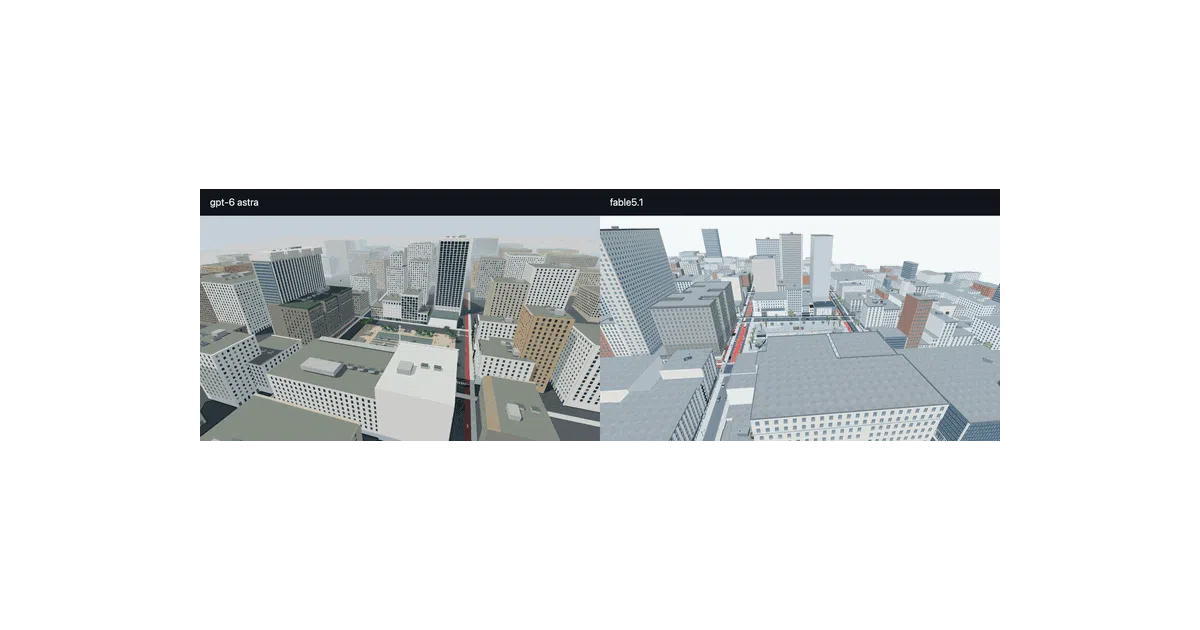
- Side-by-side benchmarks: the repo includes head-to-head comparisons against GPT-6 Astra for Union Square, Kyoto, and a Death Star trench run.
Caveats
- The README is upfront that every world ships with its own QA report including defects, so expect rough edges rather than polished game levels.
- The ambitious roadmap—animation, agent environments, 4D/robotics—is entirely upcoming; right now the repo is interactive browser scenes only.
- Real-world locations are reconstructed from actual survey and map data, meaning the pipeline inherits the resolution and coverage of those sources.
Verdict
Study this if you need accountable, compositional 3D generation with verifiable ground truth instead of black-box diffusion. Pass if you want a finished game engine or drop-in asset library—the project treats worlds as a substrate, not a shipped product.
Frequently asked
- What is PhiloLabs/fable51-worlds?
- fable51-worlds turns a brief—text, image, or film clip—into a walkable, fully procedural Three.js world, then sends reviewer agents to check the builders’ work.
- Is fable51-worlds open source?
- Yes — PhiloLabs/fable51-worlds is open source, released under the MIT license.
- What language is fable51-worlds written in?
- PhiloLabs/fable51-worlds is primarily written in JavaScript.
- How popular is fable51-worlds?
- PhiloLabs/fable51-worlds has 504 stars on GitHub.
- Where can I find fable51-worlds?
- PhiloLabs/fable51-worlds is on GitHub at https://github.com/PhiloLabs/fable51-worlds.