PennyLaneAI/pennylane
Quantum ML that actually talks to PyTorch
A Python framework that treats quantum circuits as differentiable functions you can drop into normal neural-network training loops.
Not currently ranked — collecting fresh signals.
star history
What it does
PennyLane is a Python framework for building quantum algorithms with an eye toward machine learning, chemistry, and optimization. It wraps quantum circuits into differentiable functions that slot into familiar ML workflows — gradients flow back through both classical and quantum layers. The project bundles a large demo library, interactive tutorials, and simulators that scale from laptops up to GPU clusters.
The interesting bit
The hook is “hardware agnostic, hardware ready.” PennyLane abstracts over superconducting qubits, trapped ions, neutral atoms, and photonic devices, then compiles circuits toward specific backends. It also ships with Catalyst, an MLIR-based compiler, and Lightning simulators for performance-critical paths. The pitch is less “quantum computer in a box” and more “quantum as another accelerator you program like a GPU.”
Key highlights
- Differentiable quantum-classical hybrid computations via autograd, JAX, PyTorch, or TensorFlow
- Pluggable device ecosystem spanning simulators and multiple quantum hardware vendors
- Catalyst compiler for ahead-of-time quantum circuit compilation
- Lightning simulators with GPU and distributed support
- Extensive educational resources: codebook, challenges, research demos, and discussion forum
Caveats
- Requires Python 3.11+, which may nudge some older environments
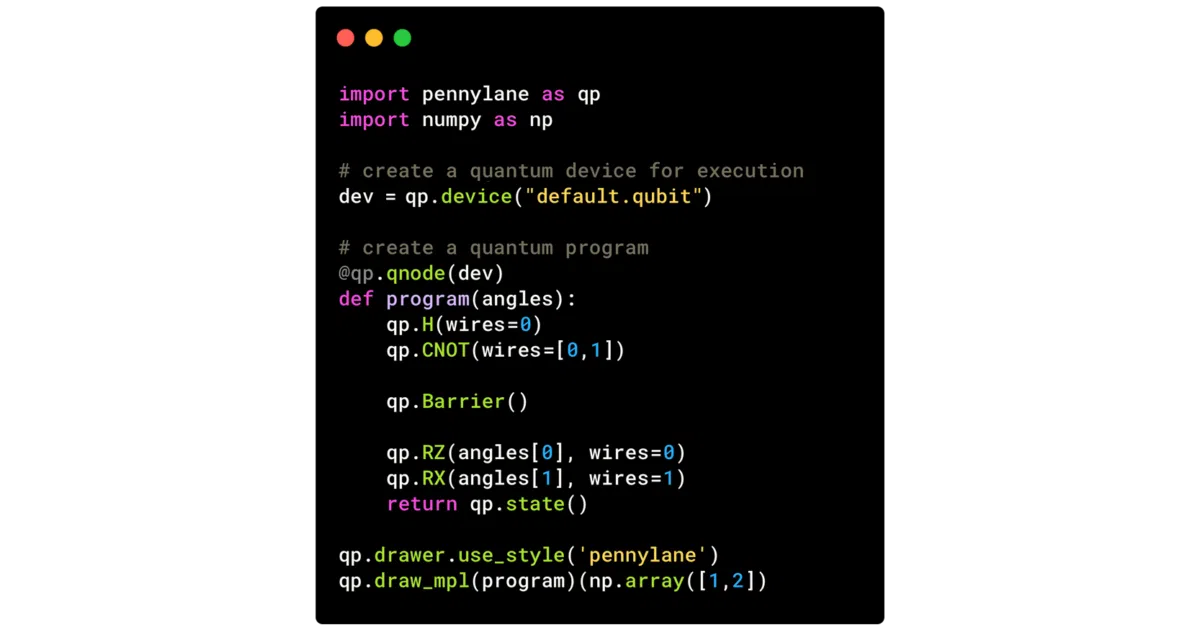
- The README is heavy on ecosystem marketing and light on concrete API examples
- Performance claims reference external tools (Catalyst, Lightning) that live in separate repositories
Verdict
Worth a look if you’re doing variational quantum algorithms or need to prototype quantum-classical models without leaving PyTorch. Pure quantum information theorists may find the ML framing adds abstraction weight they don’t need.
Frequently asked
- What is PennyLaneAI/pennylane?
- A Python framework that treats quantum circuits as differentiable functions you can drop into normal neural-network training loops.
- Is pennylane open source?
- Yes — PennyLaneAI/pennylane is open source, released under the Apache-2.0 license.
- What language is pennylane written in?
- PennyLaneAI/pennylane is primarily written in Python.
- How popular is pennylane?
- PennyLaneAI/pennylane has 3.5k stars on GitHub.
- Where can I find pennylane?
- PennyLaneAI/pennylane is on GitHub at https://github.com/PennyLaneAI/pennylane.