PenglongHuang/chinese-novelist-skill
Claude Code skill that ghostwrites Chinese novels end-to-end
It exists because the hardest part of writing a novel is finishing it.
Velocity · 7d
+48
★ / day
Trend
↘cooling
star history
What it does
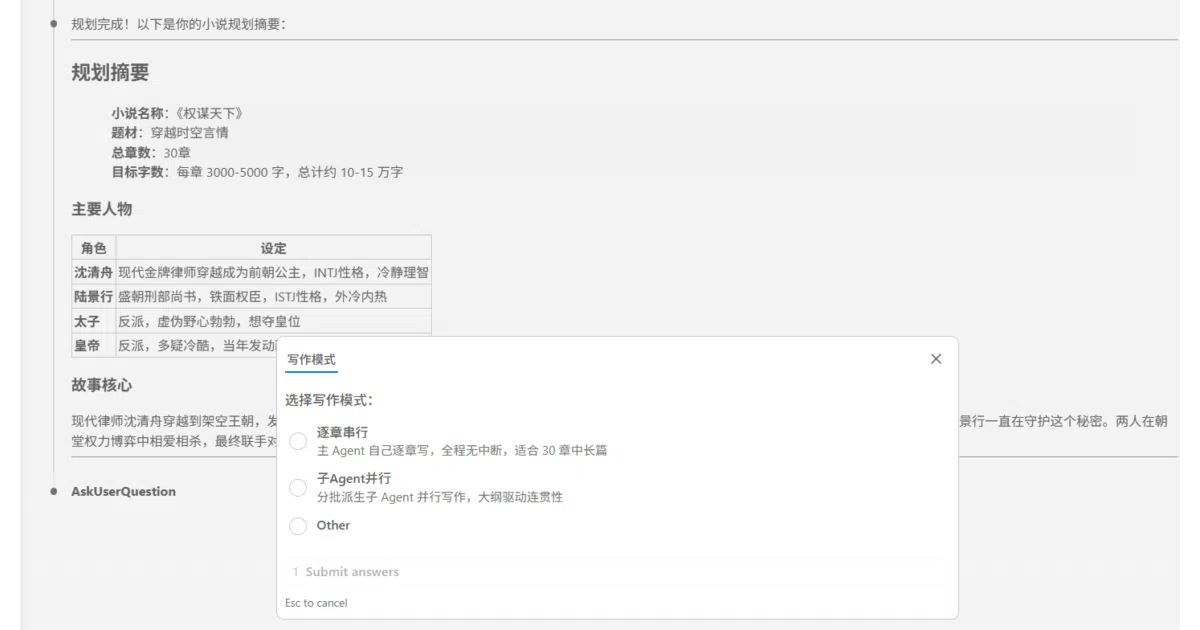
chinese-novelist-skill is a Claude Code Skill—a structured prompt workflow and reference library—that automates the creation of complete Chinese-language novels. It runs a four-phase pipeline: interactive onboarding via a three-layer Q&A, automated planning that emits an outline, character sheets, and a machine-readable writing plan JSON, hands-off chapter generation targeting 3,000–5,000 words per chapter with a polish pass to strip generic AI phrasing, and post-draft validation that checks word counts and coherence, auto-rewriting up to three times if a chapter fails. User preferences and unfinished drafts persist across sessions in user-preferences.json.
The interesting bit
The project treats fiction as an industrial process. It ships fifteen reference documents—ranging from a catalog of 13 hook types to dialogue power-dynamics guides—that constrain Claude’s output like a pulp-magazine style manual. The mandatory “de-AI flavor” pass and cliffhanger rules are telling: the skill assumes raw model output is too bland and too tidy, and explicitly instructs Claude to be less predictable.
Key highlights
- Three writing modes: serial, parallel sub-agents, or Claude Code Agent Teams for large projects.
- Cross-session memory tracks genre taste, narrative voice, chapter-count preference, and text density.
- Interrupt/resume detection picks up abandoned drafts without manual bookmarking.
- Built-in validation enforces per-chapter word counts and coherence; failures trigger automatic rewrites.
- Reference library includes plot-structure templates, character-building techniques, and a “show, don’t tell” mandate.
Caveats
- Tightly bound to Claude Code; installation lands in
~/.claude/skills/and multi-agent features rely on proprietary Claude Code capabilities. - Entirely Chinese-language output; templates, dialogue guides, and examples are culturally and linguistically specific.
- Quality ceiling is that of the underlying model; the skill orchestrates prompts but does not replace Claude.
Verdict
A solid choice if you write Chinese web fiction or need a reproducible long-form generative pipeline inside Claude Code. Non-Chinese speakers and users of other AI coding assistants will find little use for it.
Frequently asked
- What is PenglongHuang/chinese-novelist-skill?
- It exists because the hardest part of writing a novel is finishing it.
- Is chinese-novelist-skill open source?
- Yes — PenglongHuang/chinese-novelist-skill is open source, released under the MIT license.
- What language is chinese-novelist-skill written in?
- PenglongHuang/chinese-novelist-skill is primarily written in Python.
- How popular is chinese-novelist-skill?
- PenglongHuang/chinese-novelist-skill has 4.3k stars on GitHub and is currently cooling off.
- Where can I find chinese-novelist-skill?
- PenglongHuang/chinese-novelist-skill is on GitHub at https://github.com/PenglongHuang/chinese-novelist-skill.