Parcha-ai/agentrun
Agents that stop re-learning the same job every run
AgentRun wraps your existing agent harness with durable execution, a control plane, and a learning loop that turns repeated work into cheap, reusable notes and workflows.
Too new to rank. Velocity needs a few days of history.
not enough history yet
star history
What it does AgentRun is an open-source platform that sits on top of agent harnesses you already use — Claude Code, Codex, OpenCode, or pi — and handles everything around them: run tracking, recovery, approvals, spend caps, and a single console. Runs are durable: kill the server mid-run and it picks up where it left off. Each agent gets the compute it needs, from a Docker sandbox to a Linux desktop, Android phone, or browser.
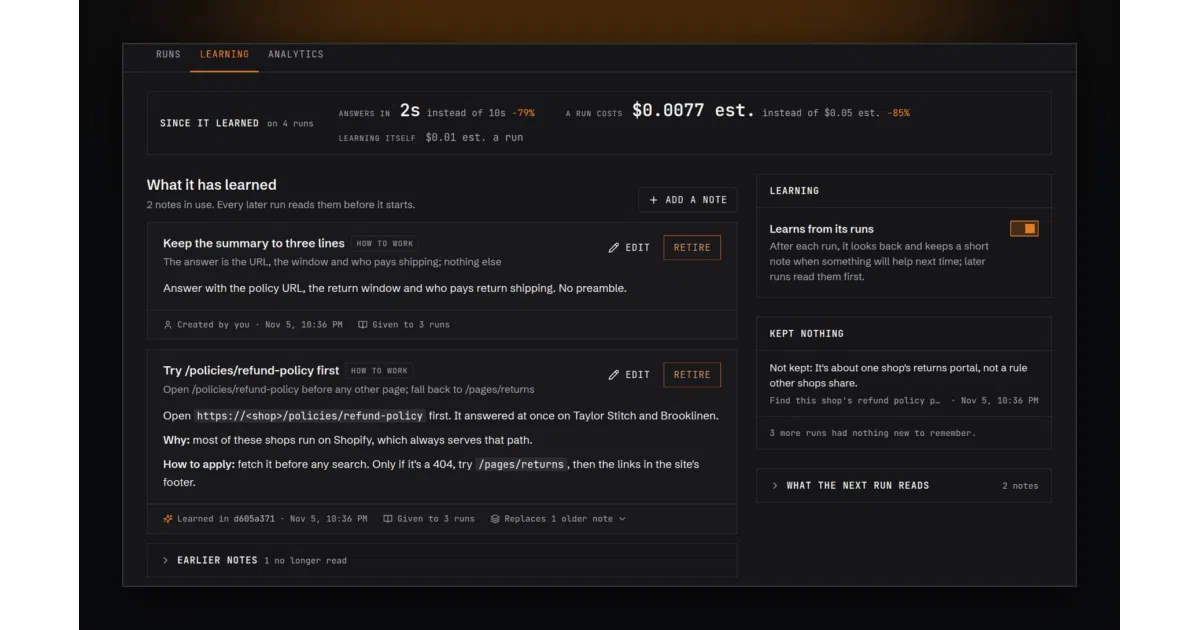
The interesting bit The learning loop. After each run, the agent gets one extra turn to propose what it would keep — a note, a skill, or a workflow. Proposals are code-checked (secrets, stray files, and oversized items get dropped), graded, then committed to the agent’s own git folder. The next run starts from that accumulated knowledge instead of rediscovering the same API for the hundredth time. The payoff is in their case studies: a code reviewer tuned on their own PRs costs 18 cents a review and caught 1.6x the bugs Greptile did on unseen PRs; a merchant classification job went from $0.89 to $0.12 per item by letting Opus learn the job and handing it to a cheap model.
Key highlights
- Learning is versioned in plain git — one branch per agent, with a Learning tab to inspect, retire, or restore anything
- Learned skills that serve 3 runs get promoted to typed workflow drafts, dry-run before being kept
- Workflows are JSON documents of typed steps with confidence-scored decisions, pausable and inspectable node by node
- Every agent is an API: what you run in the Playground is the same request you copy into your code
- Runs fully locally (state in
~/.agentrun), self-hostable in one container, or available as hosted AgentRun Cloud; Apache-2.0
Caveats
- Local runs need Node 24.22.3+ on macOS or Linux; without Docker, agents get file access but no shell
- The case-study numbers are the vendor’s own measurements on their own workloads, not independent benchmarks
Verdict Worth a look if you run recurring agent jobs and are tired of paying for the same reasoning twice. If your agents do genuinely novel work every run, the learning loop has less to bite on — but the durable execution and control plane still earn their keep.
Frequently asked
- What is Parcha-ai/agentrun?
- AgentRun wraps your existing agent harness with durable execution, a control plane, and a learning loop that turns repeated work into cheap, reusable notes and workflows.
- Is agentrun open source?
- Yes — Parcha-ai/agentrun is open source, released under the Apache-2.0 license.
- What language is agentrun written in?
- Parcha-ai/agentrun is primarily written in JavaScript.
- How popular is agentrun?
- Parcha-ai/agentrun has 1.2k stars on GitHub.
- Where can I find agentrun?
- Parcha-ai/agentrun is on GitHub at https://github.com/Parcha-ai/agentrun.