POSTECH-CVLab/PyTorch-StudioGAN
A PyTorch proving ground that makes GANs play fair
It corrals 30+ GAN variants into one standardized PyTorch environment so researchers can compare ideas instead of chasing hidden hyperparameters.
Not currently ranked — collecting fresh signals.
star history
What it does
StudioGAN is a PyTorch library that corrals three decades of GAN research into one standardized training and evaluation environment. It implements 30 representative architectures—from DCGAN to StyleGAN3 and ReACGAN—behind a modular YAML configuration system that swaps conditioning methods, losses, and regularizers like interchangeable parts. Beyond GANs, the project maintains a broad generative-model benchmark that also tracks diffusion and auto-regressive baselines, complete with pre-trained checkpoints and reproducibility reports.
The interesting bit
The real value is the bureaucracy. By locking every model into the same compute environment, data pipelines, and evaluation backbones—from InceptionV3 to Swin Transformer and DINO—StudioGAN turns GAN research from a contact sport into a controlled experiment. You are not just downloading code; you are downloading an argument about how fair comparison should work.
Key highlights
- Implements 30 GANs across 7 architectures, mix-and-matched via
YAMLconfigs covering 9 conditioning methods, 4 adversarial losses, and 13 regularization modules. - Evaluation suite supports both “clean” and architecture-friendly metrics (
IS,FID,PRDC,IFID) using backbones fromInceptionV3toDINOandSwin Transformer. - Includes a TPAMI-accepted benchmark that pits GANs against diffusion (
ADM-G-U,LSGM++) and auto-regressive models (MaskGIT). - Reproducibility audits verify
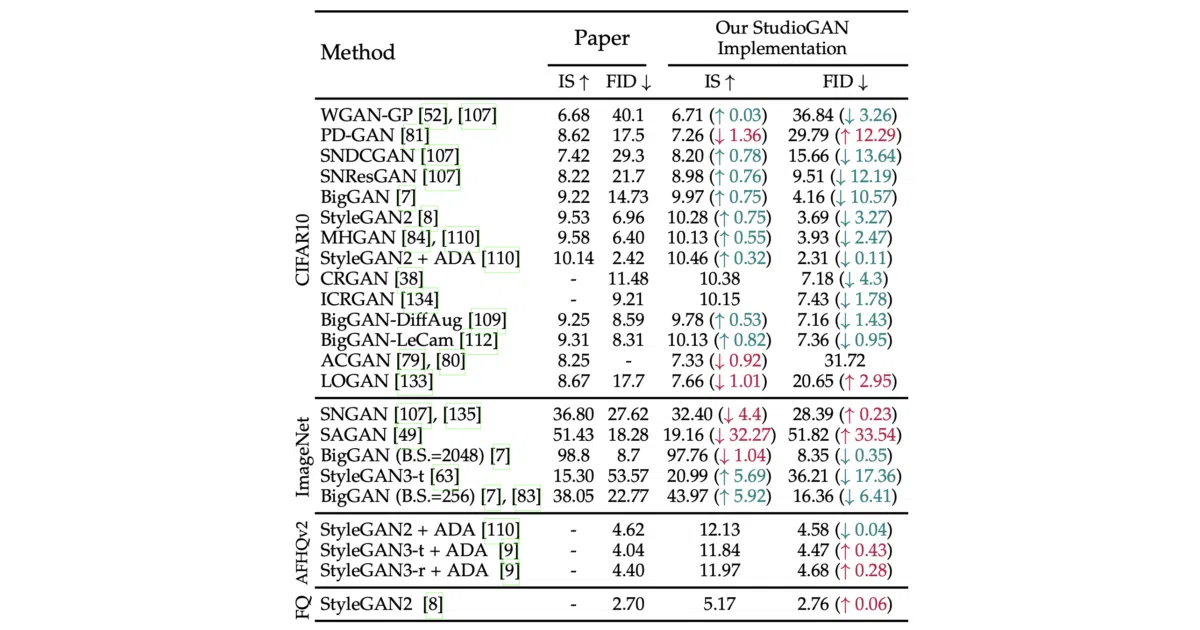
IS/FIDscores against original papers, and the authors openly flag which five methods do not line up. - Supports distributed training (
DP,DDP,MDDP) and mixed precision out of the box.
Caveats
- Reproducibility is explicitly broken for five implementations: PD-GAN, ACGAN, LOGAN, SAGAN, and BigGAN-Deep.
- The
READMEcontains a minor contradiction about whether pre-trained models are currently available or “coming soon.”
Verdict
Grab this if you need to baseline a new generative model against a stable, well-measured GAN landscape. Skip it if you want a lightweight, single-model training script—the overhead here is the point, but it is still overhead.
Frequently asked
- What is POSTECH-CVLab/PyTorch-StudioGAN?
- It corrals 30+ GAN variants into one standardized PyTorch environment so researchers can compare ideas instead of chasing hidden hyperparameters.
- Is PyTorch-StudioGAN open source?
- Yes — POSTECH-CVLab/PyTorch-StudioGAN is an open-source project tracked on heatdrop.
- What language is PyTorch-StudioGAN written in?
- POSTECH-CVLab/PyTorch-StudioGAN is primarily written in Python.
- How popular is PyTorch-StudioGAN?
- POSTECH-CVLab/PyTorch-StudioGAN has 3.5k stars on GitHub.
- Where can I find PyTorch-StudioGAN?
- POSTECH-CVLab/PyTorch-StudioGAN is on GitHub at https://github.com/POSTECH-CVLab/PyTorch-StudioGAN.