OpenSenseNova/SenseNova-RoboRSI
A harness that improves the agent, not just the model
SenseNova's RoboRSI pairs a shared robot runtime with a loop that uses execution traces to refine both the harness and the model behind it.
Too new to rank. Velocity needs a few days of history.
not enough history yet
star history
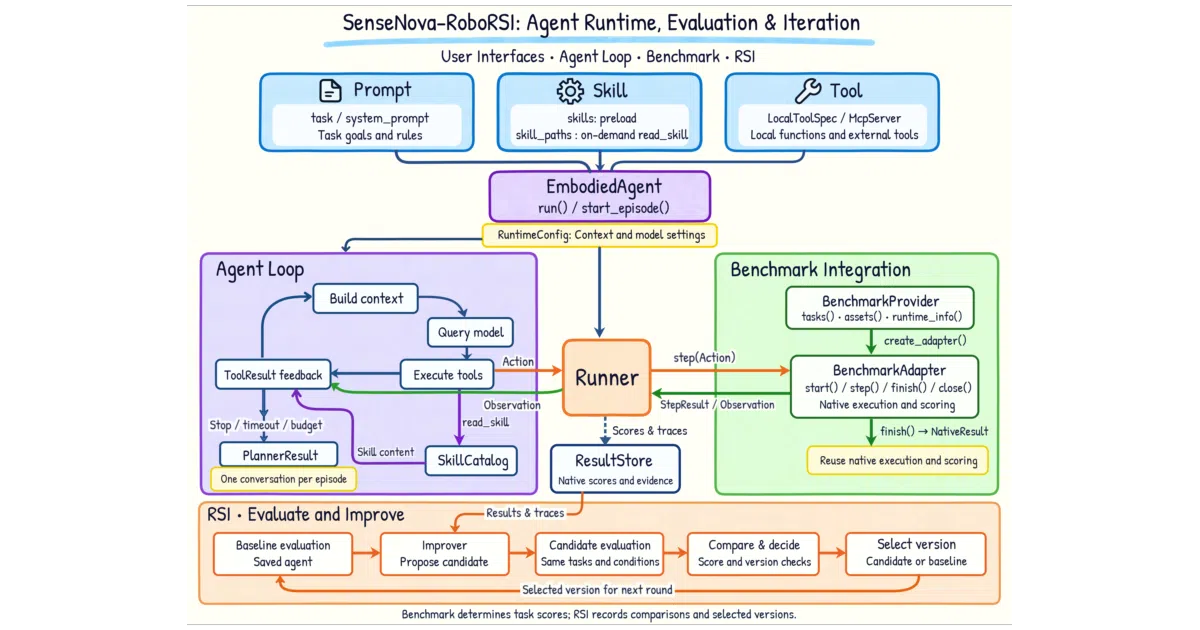
What it does: RoboRSI is a Python framework for building, running, and evaluating embodied agents across a zoo of robot benchmarks (LIBERO variants, RoboCasa365, BEHAVIOR-1K, Bench2Dex, DexJoCo, VLN suites, and more). A shared runtime connects models, prompts, skills, and tools/MCP, and runs policies in environments that keep their native scoring logic. On top sits recursive self-improvement: execution traces and task feedback drive changes to the agent system, which are retested and carried forward if they validate.
The interesting bit: The RSI loop splits improvement into two stages. Harness optimization refines planning, feedback, and memory while model weights stay frozen; then validated interaction traces are collected and used to fine-tune the model to fit the updated harness. The repo also ships a 27B vision-language model, SenseNova-RoboRSI-27B, that mixes VLA skills with Code as Policy, for example grasping a bowl with a VLA skill and then correcting its position with code before release.
Key highlights
- Same 27B weights control physical robots after simulation-only post-training: 60% pick-and-place success on Piper, 90% block stacking on Piper X, and a 2×2 cube solved with both arms.
- VLA2Agent converts open VLA demonstrations into agent training examples; end-effector predictions within 50 mm of target rose from 24.9% to 49.2%.
- Ranked No. 1 on the RoboLab leaderboard and on Papers With Code for LIBERO-PRO (98.25% success rate).
- RoboDojo Agent-track average of 57.10 with 49.17% success under Avg. (w/o Open), versus a GPT-6 Astra baseline of 28.97 in the team’s original evaluation.
- Prebuilt benchmark Docker images on GHCR plus versioned ICL experience packages on Hugging Face; 336 harness ablation trajectory records across 42 tasks and 8 methods are public.
Caveats
- The project labels itself pre-alpha, so expect the surface to keep moving.
- RoboDojo integration is listed as coming soon, despite the leaderboard results.
- Requires Linux/WSL, Python 3.10–3.12, Docker, and GPU support where needed, so the environment footprint is nontrivial.
Verdict: Worth a look if you work on embodied agents and want a benchmark-spanning runtime with a principled improvement loop, or if you want a strong VLM for manipulation. Skip it if you wanted a lightweight eval harness; this one brings a model, a benchmark zoo, and a research agenda with it.
Frequently asked
- What is OpenSenseNova/SenseNova-RoboRSI?
- SenseNova's RoboRSI pairs a shared robot runtime with a loop that uses execution traces to refine both the harness and the model behind it.
- Is SenseNova-RoboRSI open source?
- Yes — OpenSenseNova/SenseNova-RoboRSI is open source, released under the Apache-2.0 license.
- What language is SenseNova-RoboRSI written in?
- OpenSenseNova/SenseNova-RoboRSI is primarily written in Python.
- How popular is SenseNova-RoboRSI?
- OpenSenseNova/SenseNova-RoboRSI has 1k stars on GitHub.
- Where can I find SenseNova-RoboRSI?
- OpenSenseNova/SenseNova-RoboRSI is on GitHub at https://github.com/OpenSenseNova/SenseNova-RoboRSI.