OpenBMB/VisCPM
A bilingual multimodal model that learned Chinese vision skills from English data
VisCPM shows how a strong bilingual LLM base can bootstrap multimodal capabilities across languages without parallel training data.
Not currently ranked — collecting fresh signals.
star history
What it does
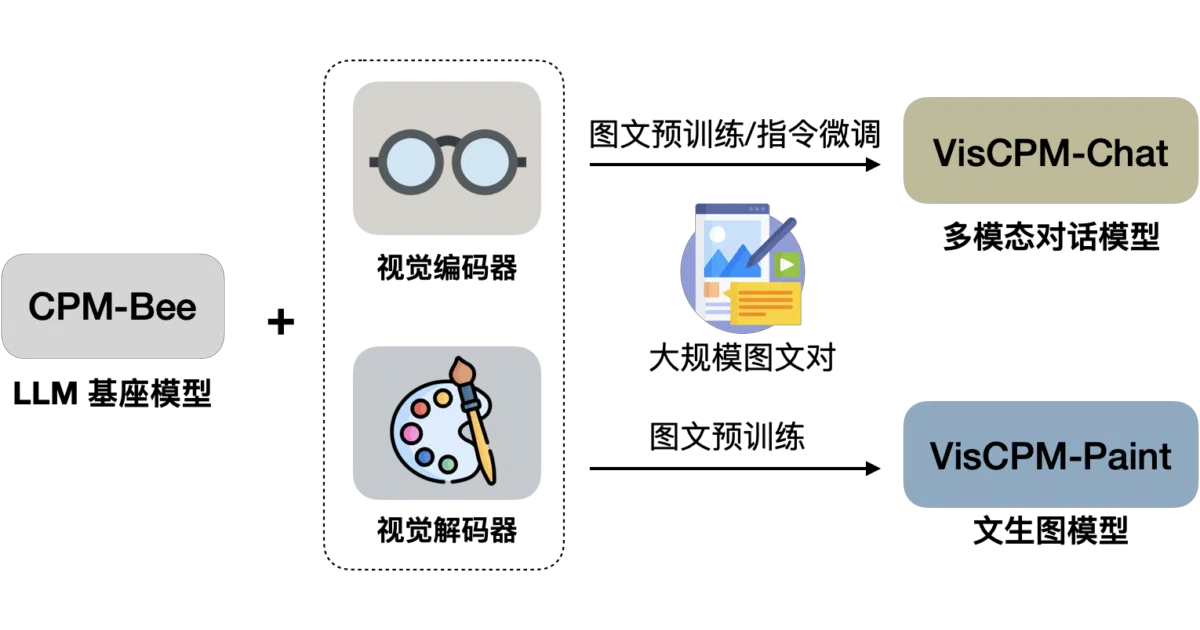
VisCPM is a family of open-source multimodal models built on the 10B-parameter CPM-Bee language model. It comes in two flavors: VisCPM-Chat for image-to-text conversation, and VisCPM-Paint for text-to-image generation. Both handle Chinese and English, and the project claims state-of-the-art results among Chinese open-source multimodal models on LLaVA-style benchmarks.
The interesting bit
The project demonstrates cross-lingual transfer for multimodal tasks. Because CPM-Bee is already bilingual, VisCPM can be pre-trained on English image-text pairs only, then generalize to Chinese multimodal capabilities with minimal translated instruction data. The README notes that even English-only instruction tuning produced a model that understood Chinese questions but answered in English — a neat diagnostic of where capabilities live in the stack.
Key highlights
- Two model variants:
VisCPM-Chat-balance(balanced bilingual) andVisCPM-Chat-zhplus(Chinese-optimized, with extra native and translated Chinese pre-training data) - Low-resource inference down to 5GB VRAM for the chat model
- HuggingFace integration, local web demo deployment, and an API for VisCPM-Chat
- ICLR 2024 spotlight paper (top 5%)
- Predecessor to the newer OmniLMM and MiniCPM-V model families from the same team
Caveats
- The project appears to be in maintenance mode; the README prominently directs users to newer successors (OmniLMM, MiniCPM-V 2.0)
- Benchmark tables in the README are truncated, so full comparative claims are hard to verify from the source alone
Verdict
Worth studying if you’re researching cross-lingual multimodal transfer or need a working Chinese-English vision-language baseline. Skip if you want the latest hardware — the team has already shipped smaller, more capable successors.
Frequently asked
- What is OpenBMB/VisCPM?
- VisCPM shows how a strong bilingual LLM base can bootstrap multimodal capabilities across languages without parallel training data.
- Is VisCPM open source?
- Yes — OpenBMB/VisCPM is an open-source project tracked on heatdrop.
- What language is VisCPM written in?
- OpenBMB/VisCPM is primarily written in Python.
- How popular is VisCPM?
- OpenBMB/VisCPM has 1.1k stars on GitHub.
- Where can I find VisCPM?
- OpenBMB/VisCPM is on GitHub at https://github.com/OpenBMB/VisCPM.