Nutlope/hallmark
A style guide that bullies your LLM into having taste
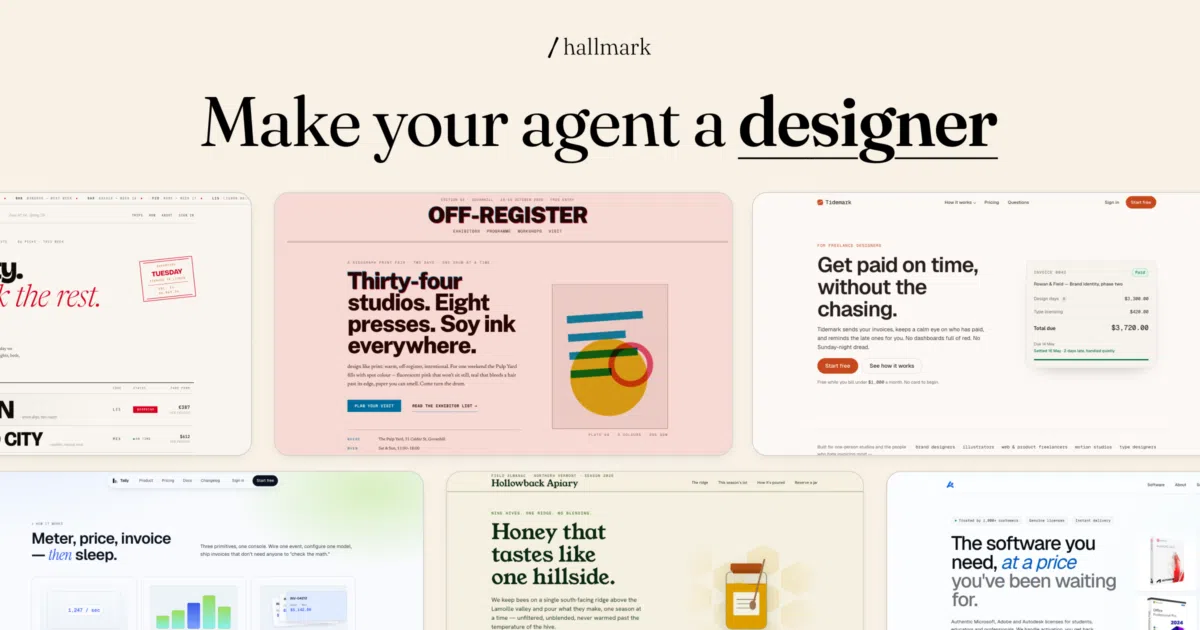
Hallmark is a design skill that stops Claude, Cursor, and Codex from producing the same generic AI slop.
Feature · 18 Aug 2026
Hallmark Wants to Cure AI-Generated Design Sameness
A rule set for AI coding agents that treats generic frontend output as a quality failure to be caught before commit.
Read the in-depth article →
Velocity · 7d
+521
★ / day
Trend
↗accelerating
star history
What it does
Hallmark is a prompt-and-ruleset package you install into Claude Code, Cursor, or Codex. It generates self-contained HTML/CSS pages, but first it forces the model through 65 “slop-test” gates and a self-critique loop. The goal: two different briefs should produce two genuinely different sites, not the same template with swapped hex codes.
The interesting bit
The “study” verb is the clever part. Feed it a screenshot or URL you admire and it extracts the design DNA—macrostructure, type pairing, colour anchor—without pixel-cloning or ripping off paid templates. It can even emit a portable design.md for handoff to other AI tools. That’s a rare bit of tooling for a problem usually solved by yelling “be more creative” at a chat window.
Key highlights
- 22 built-in themes, each run through anti-pattern checks before the model is allowed to emit code
- Four verbs: build (default),
audit(score existing code),redesign(new structure, same content),study(extract design DNA from references) - Self-contained HTML + CSS output, stamped with the chosen macrostructure in a CSS comment
- Install via
npx skills add nutlope/hallmarkor dropSKILL.mdinto your agent’s rules directory - MIT licensed; made by Together AI
Caveats
- The README is confident about the 65 slop-test gates but doesn’t show what they actually are—you’re trusting the black box
- No evidence yet of how well the “study” mode avoids overfitting to popular Dribbble shots; the refusal mechanism is described but not demonstrated
Verdict
Grab this if you’re tired of your AI assistant generating the same hero-section-plus-three-feature-cards layout for every project. Skip it if you already have a design system you enforce manually, or if you need component-level output (React/Vue) rather than flat HTML/CSS.
Frequently asked
- What is Nutlope/hallmark?
- Hallmark is a design skill that stops Claude, Cursor, and Codex from producing the same generic AI slop.
- Is hallmark open source?
- Yes — Nutlope/hallmark is open source, released under the MIT license.
- What language is hallmark written in?
- Nutlope/hallmark is primarily written in CSS.
- How popular is hallmark?
- Nutlope/hallmark has 34k stars on GitHub and is currently accelerating.
- Where can I find hallmark?
- Nutlope/hallmark is on GitHub at https://github.com/Nutlope/hallmark.