NirAharon/BoT-SORT
A tracker for when the camera itself is on the move
It fuses motion prediction, appearance matching, and camera-motion compensation to keep consistent IDs on pedestrians even when the footage is shaky or crowded.
Not currently ranked — collecting fresh signals.
star history
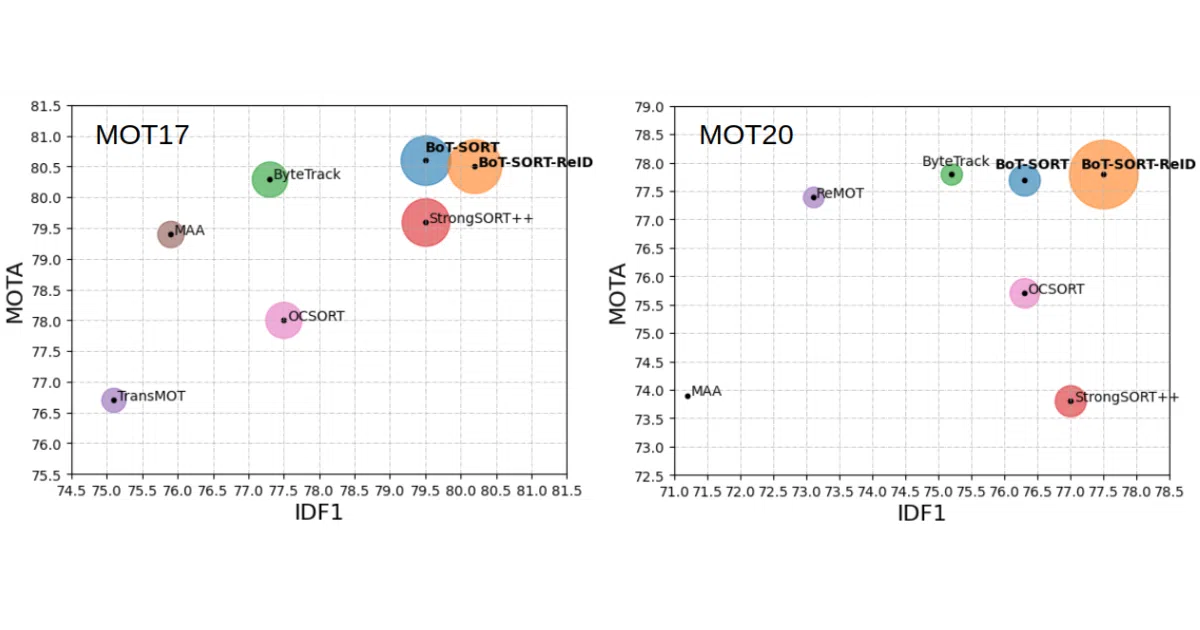
What it does BoT-SORT is a multi-pedestrian tracker that assigns consistent IDs to people in video. It builds on ByteTrack and FastReID, pairing motion prediction with appearance re-identification, and adds camera-motion compensation so that a shaking or panning camera doesn’t throw off its Kalman filter. The authors report that both BoT-SORT and BoT-SORT-ReID ranked first on the MOT17 and MOT20 challenge test sets across MOTA, IDF1, and HOTA metrics.
The interesting bit Most trackers assume a fixed camera; BoT-SORT explicitly models global camera motion using OpenCV’s VideoStab (with Python fallbacks like ORB or ECC) and refines the Kalman state vector to account for drift. An optional ReID branch trades a little compute for tighter identity association when pedestrians overlap or briefly disappear.
Key highlights
- Claims top ranking on MOT17 and MOT20 test sets, hitting up to 80.6 MOTA and 65.0 HOTA depending on the variant.
- Supports YOLOX and YOLOv7 detectors, including multi-class tracking beyond pedestrians.
- Camera motion compensation offers a C++ OpenCV VideoStab path or lighter Python alternatives (
--cmc-methodoptions). - Provides FastReID-based appearance models for MOT17 and MOT20.
- Acknowledges that a large part of the code, ideas, and results are borrowed from ByteTrack, StrongSORT, FastReID, YOLOX, and YOLOv7.
Caveats
- The best camera-motion compensation path relies on an OpenCV contrib C++ module that has no official Python binding; Python-based methods are available but may differ in accuracy.
- Trained YOLOv7 models for MOTChallenge and deployment code are still marked “Coming Soon”.
- The codebase has only been tested on Ubuntu 20.04, so cross-platform mileage is unclear.
Verdict Worth a look for computer-vision engineers who need research-grade, leaderboard-topping pedestrian tracking and can tolerate academic code. If you need a polished, cross-platform deployment library today, this isn’t it yet.
Frequently asked
- What is NirAharon/BoT-SORT?
- It fuses motion prediction, appearance matching, and camera-motion compensation to keep consistent IDs on pedestrians even when the footage is shaky or crowded.
- Is BoT-SORT open source?
- Yes — NirAharon/BoT-SORT is open source, released under the MIT license.
- What language is BoT-SORT written in?
- NirAharon/BoT-SORT is primarily written in Jupyter Notebook.
- How popular is BoT-SORT?
- NirAharon/BoT-SORT has 1.6k stars on GitHub.
- Where can I find BoT-SORT?
- NirAharon/BoT-SORT is on GitHub at https://github.com/NirAharon/BoT-SORT.