NVlabs/LongLive
Nvidia's recipe for 45 FPS long-video generation
A training and inference stack that squeezes autoregressive video models onto FP4 weights without making them unwatchable.
Velocity · 7d
+5.1
★ / day
Trend
↘cooling
star history
What it does
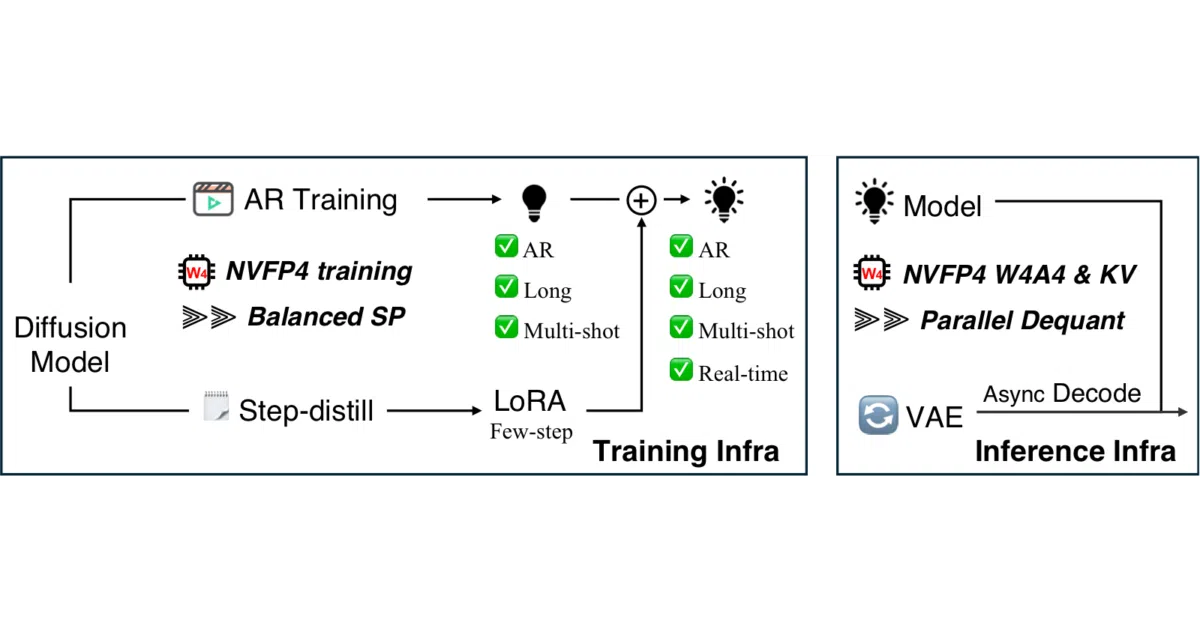
LongLive 2.0 is Nvidia’s open infrastructure for generating long videos autoregressively — think minutes, not seconds — at speeds that approach real-time. It wraps training (teacher-forcing AR, then DMD distillation) and inference in a single stack, with sequence parallelism and NVFP4 quantization wired throughout. The project also preserves the original LongLive 1.0 branch, which handles interactive streaming generation via attention sinks and KV-recache.
The interesting bit
Most quantization stories stop at “we ran quantize() and it was faster.” LongLive actually trains through NVFP4 — both the autoregressive stage and the few-step DMD distillation — and keeps a BF16 fallback path intact. The inference engine then runs W4A4 with a quantized KV cache, fused Triton kernels for RoPE and adaLN, and pinned VAE transfers. A recent optimization pass squeezed another 18.6% throughput out of that pipeline. They also bothered with a safer “LoRA before quantization” setup, which suggests someone learned a hard lesson so you don’t have to.
Key highlights
- Claims 45.7 FPS for the 2-step NVFP4 5B model, 29.7 FPS for the 4-step variant; BF16 5B does 24.8 FPS
- Supports both T2V and I2V training, including multi-shot video sequences
- NVFP4 training and inference with TransformerEngine or FourOverSix backends
- Sequence-parallel inference plus async decoding and multi-shot attention sinks
- VBench scores hold within ~2 points across the quantization ladder (85.06 BF16 → 83.14 2-step NVFP4)
- Apache 2.0 license
Caveats
- The README notes a TODO to replace a placeholder video embed on the project page, so the demo polish is still incoming
- I2V training configs require careful latent-sequence bookkeeping (
96, not96 + 1) and masking the first latent from loss — easy to trip over - NVFP4 setup demands attention to which checkpoint format you downloaded; the wrong
model_quant_use_transformer_engineflag will quietly break things
Verdict
Worth a look if you’re shipping autoregressive video models and need to claw back GPU memory without training a separate tiny model. Skip it if your videos are short enough that standard diffusion sampling already finishes before your coffee does.
Frequently asked
- What is NVlabs/LongLive?
- A training and inference stack that squeezes autoregressive video models onto FP4 weights without making them unwatchable.
- Is LongLive open source?
- Yes — NVlabs/LongLive is open source, released under the Apache-2.0 license.
- What language is LongLive written in?
- NVlabs/LongLive is primarily written in Python.
- How popular is LongLive?
- NVlabs/LongLive has 2.8k stars on GitHub and is currently cooling off.
- Where can I find LongLive?
- NVlabs/LongLive is on GitHub at https://github.com/NVlabs/LongLive.