MrGeDiao/shuorenhua
A skill file that scrubs the AI sheen from Chinese writing
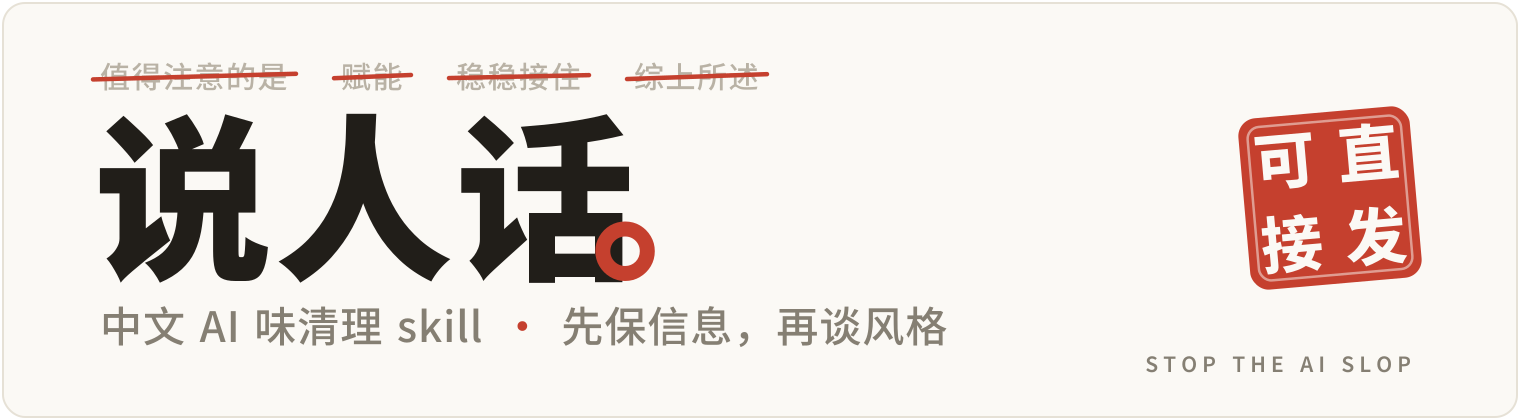
Chinese AI output too often reads like a blend of corporate press release and therapy session; this skill file teaches models to cut the performance and keep the facts.
Velocity · 7d
+6.4
★ / day
Trend
↘cooling
star history
What it does
shuorenhua is essentially a meticulously crafted prompt—packaged as SKILL.md and reference files—that you hand to coding agents like Codex, Claude Code, or Cursor. It rewrites Chinese text to remove what the author calls the “AI taste”: the overly empathetic posturing, engineer-jargon leaking into casual chat, grandiose openers, and translation-ese that models love to generate. The rules are scenario-aware, handling everything from Slack updates to READMEs to forum posts, and they prioritize locking down facts, versions, and commands before touching a single word of style.
The interesting bit
The rigor is what stands out. Instead of a naive find-and-replace list, the skill runs a six-step pipeline: detect the scene, protect factual fragments, choose an intensity level, rewrite, fidelity check, then a second “residual audit” pass. For long-form text, it offers a bounded scope mode that lists whole hollow sentences as “suggested for deletion” rather than silently compressing an 1800-word piece down to 1000. That kind of structural discipline is rare in prompt-engineering repos, which usually just dump a few examples and call it a day.
Key highlights
- Scenario-aware rewriting with distinct “Scene Packs” for READMEs, release notes, forum posts, issue replies, and casual chat
- Explicit fact-protection rules: version numbers, commands, paths, and attribution are locked before any stylistic edits
- Adjustable intensity (
minimaltoaggressive) and scope (structural,bounded,in-place) so long-form pieces don’t accidentally shrink by half - Benchmarked against 73 test cases with dual-model evaluation (Codex and Claude cross-checking results)
- Includes 19 real-world sample rewrites demonstrating specific anti-patterns like “empathy award ceremonies” and debug-tone dinner plans
Caveats
- This is fundamentally a prompt file and reference material, not executable software; you feed it into another AI tool
- English support exists but is secondary; the project is explicitly Chinese-first
- The README notes it cleans template tone, but won’t magically inject a specific human’s personal writing voice
Verdict
Grab this if you publish Chinese technical docs, issue replies, or long-form posts through AI assistants and are tired of the customer-service-announcement-meets-empathy-performance tone. Skip it if you’re looking for a standalone CLI tool or need heavy English-language de-slopping—there are other projects for that.
Frequently asked
- What is MrGeDiao/shuorenhua?
- Chinese AI output too often reads like a blend of corporate press release and therapy session; this skill file teaches models to cut the performance and keep the facts.
- Is shuorenhua open source?
- Yes — MrGeDiao/shuorenhua is open source, released under the MIT license.
- What language is shuorenhua written in?
- MrGeDiao/shuorenhua is primarily written in Python.
- How popular is shuorenhua?
- MrGeDiao/shuorenhua has 2k stars on GitHub and is currently cooling off.
- Where can I find shuorenhua?
- MrGeDiao/shuorenhua is on GitHub at https://github.com/MrGeDiao/shuorenhua.