Mohamedelrefaie/DrivAerNet
39TB of simulated headwind for car-shaped neural nets
A 39-terabyte dataset of simulated cars so neural networks can learn aerodynamics without paying the 3-million-CPU-hour CFD bill.
Not currently ranked — collecting fresh signals.
star history
What it does
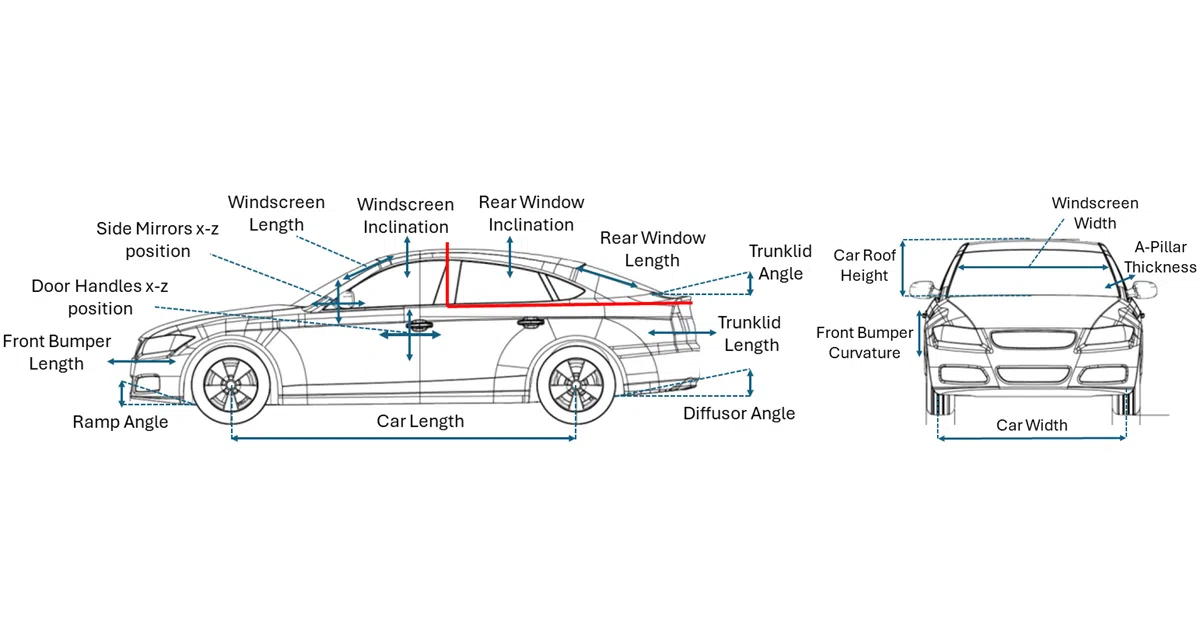
DrivAerNet++ is a dataset of 8,150 car geometries—fastbacks, notchbacks, estatebacks—each annotated with 26 design parameters and high-fidelity CFD results. It ships as 39 TB of multimodal data including surface meshes, volumetric flow fields, pressure coefficients, streamlines, point clouds, and even hand-drawn sketches paired with photorealistic renderings. The goal is to let models learn aerodynamic performance from shape alone, acting as a surrogate for expensive simulations.
The interesting bit
The clever part is the tight coupling of parametric design and physical simulation: every car is defined by exactly 26 parameters, yet the dataset includes per-part semantic labels across 29 component categories and full CFD fields. That structure lets you train models that go from a sketch or a parameter vector to drag coefficients and flow visualizations without touching a wind tunnel.
Key highlights
- 8,150 designs with CFD ground truth generated on MIT Supercloud using roughly 3 × 10⁶ CPU-hours
- Ten data modalities, from parametric tables and dense point clouds to wall shear stress and streamline visualizations
- 29 semantic part labels (wheels, mirrors, doors, etc.) intended for segmentation and automated preprocessing
- Integrated into NVIDIA Modulus and Baidu’s PaddleScience as a standard benchmark
- Non-commercial CC BY-NC 4.0 license; hosted on Harvard Dataverse with Globus transfer support
Caveats
- The dataset is strictly non-commercial (CC BY-NC 4.0), so industry practitioners looking for direct product integration should check the license first
- At 39 TB, this is not a “download and unzip on your laptop” affair; the README points to Globus for transfer, which implies significant storage and bandwidth requirements
- Several advertised modalities (2D slices, SDFs, crash deformations) are marked “Coming Soon” rather than available now
Verdict
Grab this if you are building surrogate models, generative car designs, or benchmarking graph neural networks against physical simulation. Skip it if you need a commercial license or lack the storage to handle 39 TB of fluid dynamics data.
Frequently asked
- What is Mohamedelrefaie/DrivAerNet?
- A 39-terabyte dataset of simulated cars so neural networks can learn aerodynamics without paying the 3-million-CPU-hour CFD bill.
- Is DrivAerNet open source?
- Yes — Mohamedelrefaie/DrivAerNet is an open-source project tracked on heatdrop.
- What language is DrivAerNet written in?
- Mohamedelrefaie/DrivAerNet is primarily written in Python.
- How popular is DrivAerNet?
- Mohamedelrefaie/DrivAerNet has 555 stars on GitHub.
- Where can I find DrivAerNet?
- Mohamedelrefaie/DrivAerNet is on GitHub at https://github.com/Mohamedelrefaie/DrivAerNet.