MarekKowalski/FaceSwap
A math professor's homework assignment became a 3D face-swapper
A Warsaw University of Technology exercise that uses Gauss-Newton optimization and blendshapes to project someone else's face onto yours in real time.
Not currently ranked — collecting fresh signals.
star history
What it does
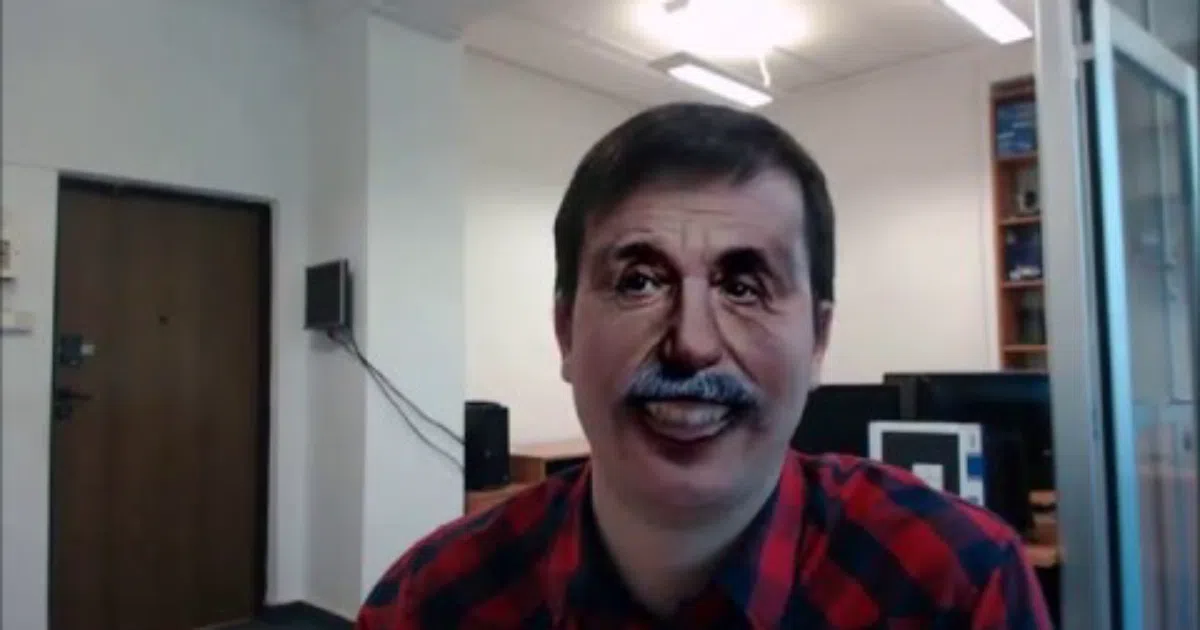
FaceSwap grabs frames from your webcam, detects facial landmarks, fits a 3D morphable face model to them, and renders that model textured with a target face (Brad Pitt and Einstein are bundled as examples). The rendered face is then alpha-blended back over your own. The result: you see yourself wearing someone else’s face in real time.
The interesting bit
The fitting step is the meat. The code minimizes landmark reprojection error using the Gauss-Newton method, solving simultaneously for blendshape weights, scale, rotation, and translation. No deep learning in the main branch — just old-school nonlinear least squares on a Candide-derived mesh with blendshapes for expressions like mouth opening and eyebrow raising. The author later built a faster GPU version using his own Deep Alignment Network, but that lives on Dropbox, not in the repo.
Key highlights
- Pure Python pipeline: dlib landmarks → 3D model fitting → pygame rendering → feathered compositing
- 3D model includes neutral shape, expression blendshapes, and index mappings between dlib’s 68 landmarks and mesh vertices
- Entry point is literally
zad2.py— Polish for “exercise 2” — because this was coursework - MIT licensed; includes a YouTube demo and a requirements.txt for dependencies
- A faster, more stable DAN-based rewrite exists but is not yet merged
Caveats
- The “faster and more stable version” is off-repo on Dropbox; the GitHub code uses the slower dlib-based tracker
- You must manually download and unpack a 68-point dlib shape predictor (~60MB bz2 from SourceForge)
- The code targets Python 3 but the repo hasn’t seen the DAN rewrite integrated despite the author’s stated hope to do so
Verdict
Worth a look if you want to understand how 3D face fitting works under the hood without neural-network opacity, or if you’re teaching computer vision. Skip it if you need production-grade real-time performance out of the box — the Dropbox fork or modern deepfakes tools will serve you better.
Frequently asked
- What is MarekKowalski/FaceSwap?
- A Warsaw University of Technology exercise that uses Gauss-Newton optimization and blendshapes to project someone else's face onto yours in real time.
- Is FaceSwap open source?
- Yes — MarekKowalski/FaceSwap is open source, released under the MIT license.
- What language is FaceSwap written in?
- MarekKowalski/FaceSwap is primarily written in Python.
- How popular is FaceSwap?
- MarekKowalski/FaceSwap has 757 stars on GitHub.
- Where can I find FaceSwap?
- MarekKowalski/FaceSwap is on GitHub at https://github.com/MarekKowalski/FaceSwap.