LykosAI/StabilityMatrix
A package manager for the Stable Diffusion zoo
Because juggling Python environments, Git repos, and 4GB checkpoints across a dozen Stable Diffusion UIs is nobody's idea of fun.
Not currently ranked — collecting fresh signals.
star history
What it does
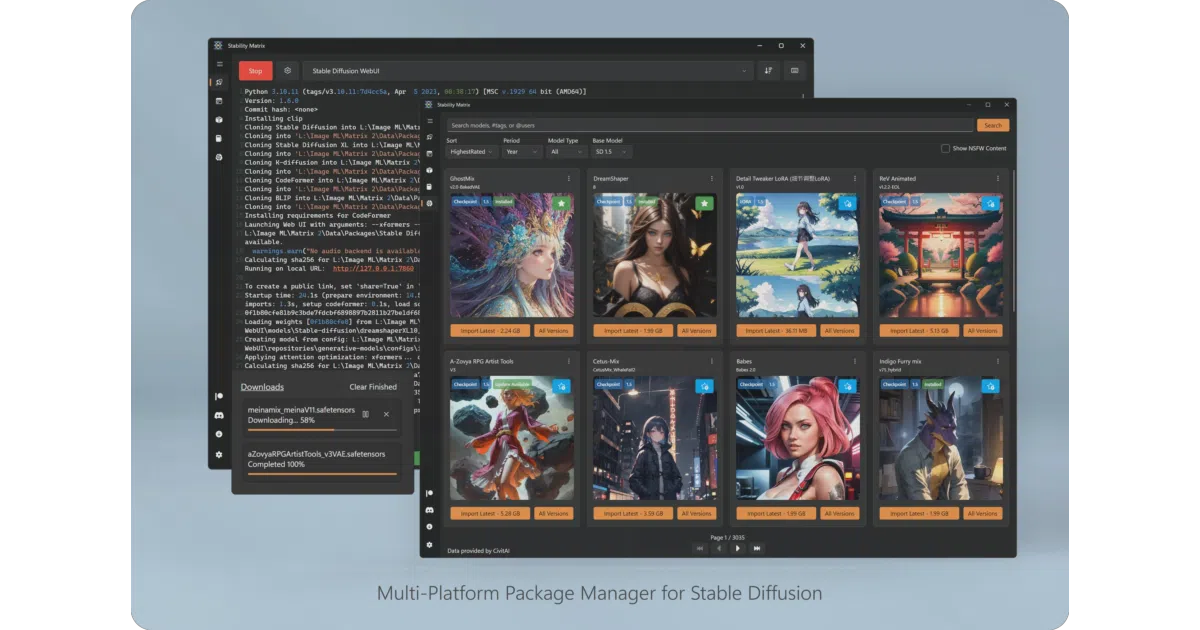
Stability Matrix is a cross-platform desktop app built in C# and Avalonia that acts as a package manager for the fragmented Stable Diffusion ecosystem. It handles one-click installation and updates for more than fifteen front-ends and tools—including Automatic1111, ComfyUI, Fooocus, InvokeAI, Kohya’s GUI, OneTrainer, and FluxGym—while embedding its own Git and Python runtimes so you don’t need them globally installed. Everything lives in a portable data directory that can be moved between drives or machines, and a shared checkpoint manager keeps model files deduplicated across all installed packages.
The interesting bit
The real value is in the plumbing: instead of letting every SD UI maintain its own isolated dependency island, Stability Matrix centralizes model storage, routes GUI prompts through a built-in terminal emulator, and offers its own tabbed Inference workspace with .smproj project files, dockable panels, and metadata that remains compatible with ComfyUI and A1111. It’s essentially an IDE for generative-art tooling.
Key highlights
- One-click installer for 15+ SD packages, from WebUI Forge and reForge to CogVideo and StableSwarmUI
- Embedded Git and Python dependencies—no global system contamination required
- Shared model directory with drag-and-drop imports, plus a browser for CivitAI and HuggingFace that pauses and resumes downloads
- Built-in Inference interface with syntax highlighting, auto-completion, and tabbed workspaces saved as
.smprojfiles - Runs on Windows 10/11, Linux (AppImage/AUR), and macOS on Apple Silicon
Verdict
Worth a look if you’re running multiple Stable Diffusion interfaces and tired of manually reconciling their environments; skip it if you already have a meticulously curated, single-UI setup you never touch.
Frequently asked
- What is LykosAI/StabilityMatrix?
- Because juggling Python environments, Git repos, and 4GB checkpoints across a dozen Stable Diffusion UIs is nobody's idea of fun.
- Is StabilityMatrix open source?
- Yes — LykosAI/StabilityMatrix is open source, released under the AGPL-3.0 license.
- What language is StabilityMatrix written in?
- LykosAI/StabilityMatrix is primarily written in C#.
- How popular is StabilityMatrix?
- LykosAI/StabilityMatrix has 9k stars on GitHub.
- Where can I find StabilityMatrix?
- LykosAI/StabilityMatrix is on GitHub at https://github.com/LykosAI/StabilityMatrix.