LirongWu/awesome-graph-self-supervised-learning
A field guide to teaching graphs without labels
A curated survey and taxonomy of self-supervised learning methods for graph neural networks, organized by how they manufacture supervision signals from the data itself.
Not currently ranked — collecting fresh signals.
star history
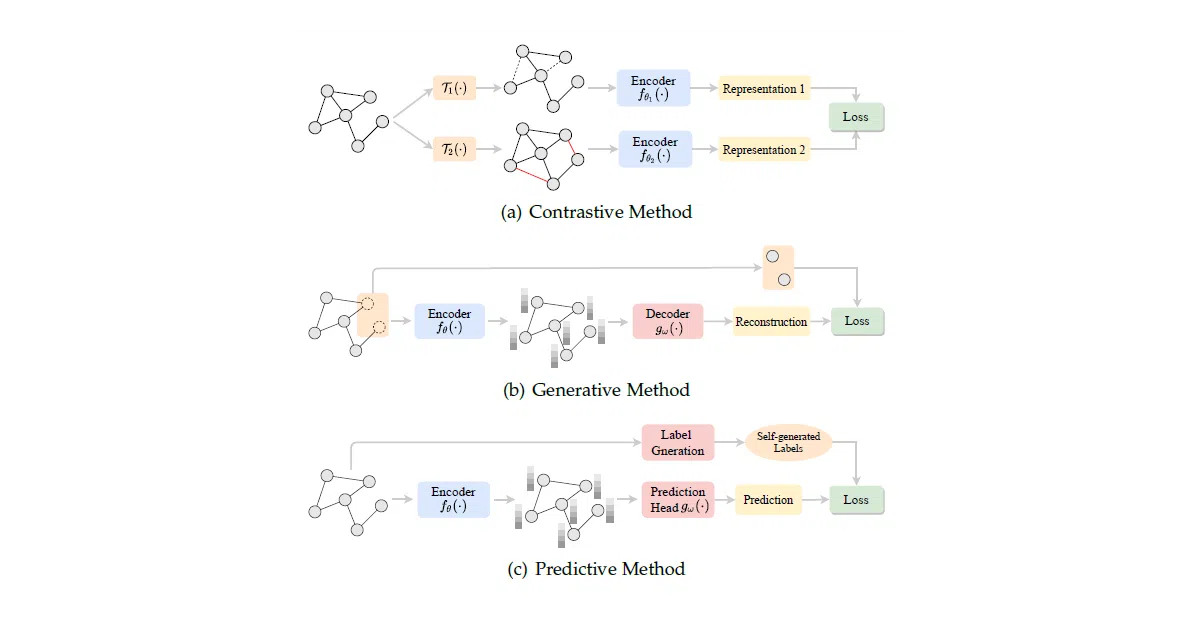
What it does This repository is the companion to a TKDE survey paper that catalogs self-supervised learning techniques for graph data. It sorts the field into three buckets—contrastive, generative, and predictive—and further subdivides by training strategy (pre-train & fine-tune, joint learning, or unsupervised representation learning). The README is essentially a heavily annotated bibliography: dozens of papers with PDF links, code links, and brief taxonomic labels.
The interesting bit The authors impose order on a noisy, fast-moving subfield by mapping every method onto a consistent spatial metaphor—local (node), context (subgraph), and global (graph) scales—and asking whether a method contrasts views at the same scale or across scales. This makes it easier to see that, say, DGI and GraphCL are doing fundamentally different geometry despite both being “contrastive.”
Key highlights
- Three-way taxonomy: contrastive (inter-data), generative (intra-data reconstruction), predictive (self-generated labels)
- Training strategies broken into pre-train & fine-tune, joint learning, and frozen-encoder unsupervised representation learning
- Extensive paper lists with direct PDF and code links, including NeurIPS, ICML, KDD, and ICLR work
- Summary sections for methodology details, implementation details, common datasets, and open-source codes
- Explicit lineage: inspired by prior “awesome-*” lists in vision and general self-supervised learning
Caveats
- The repository contains no actual code or implementations; it is purely a reading list and taxonomy
- Some paper links point to arXiv preprints rather than final versions
- A few code links are truncated or broken in the README (e.g., HDGI, YuxiangRen/…)
Verdict Worth bookmarking if you are entering graph self-supervised learning and need a map of the territory. Skip it if you are looking for a library or benchmark suite you can pip-install and run.
Frequently asked
- What is LirongWu/awesome-graph-self-supervised-learning?
- A curated survey and taxonomy of self-supervised learning methods for graph neural networks, organized by how they manufacture supervision signals from the data itself.
- Is awesome-graph-self-supervised-learning open source?
- Yes — LirongWu/awesome-graph-self-supervised-learning is an open-source project tracked on heatdrop.
- How popular is awesome-graph-self-supervised-learning?
- LirongWu/awesome-graph-self-supervised-learning has 1.4k stars on GitHub.
- Where can I find awesome-graph-self-supervised-learning?
- LirongWu/awesome-graph-self-supervised-learning is on GitHub at https://github.com/LirongWu/awesome-graph-self-supervised-learning.