Leonxlnx/earshot
Giving coding agents ears, and then letting them make noise
AI agents can render a whole launch film in code but can't hear it — earshot turns sound into evidence they can reason about, and critique, and even synthesize.
Collecting fresh signals — velocity needs a few days of history.
collecting data…
star history
What it does
earshot is a CPU-only toolkit that lets an agent actually listen: describe a file in words, score how well it matches a description, find the best moments in a long recording, tell a real recording from a code-synthesized one, and produce a second-by-second listening transcript of a film. It ships as a CLI, a Python API, and an MCP server, so Claude Code and friends can call it directly. The output is deliberately agent-shaped — plain-language summaries first, --json for the full result.
The interesting bit
The loop closes: an agent can synthesize sounds in code (forge, physical modeling with modal resonators, contact excitations, a computed room — no recorded audio inside), then have earshot’s critic score its own renders and iterate. There’s even fit, which reverse-engineers a recording into a parametric recipe module you can vary and morph. The README is also unusually honest about Goodhart: it flatly admits the search optimizes earshot’s own models and that the realness model is easy to fool.
Key highlights
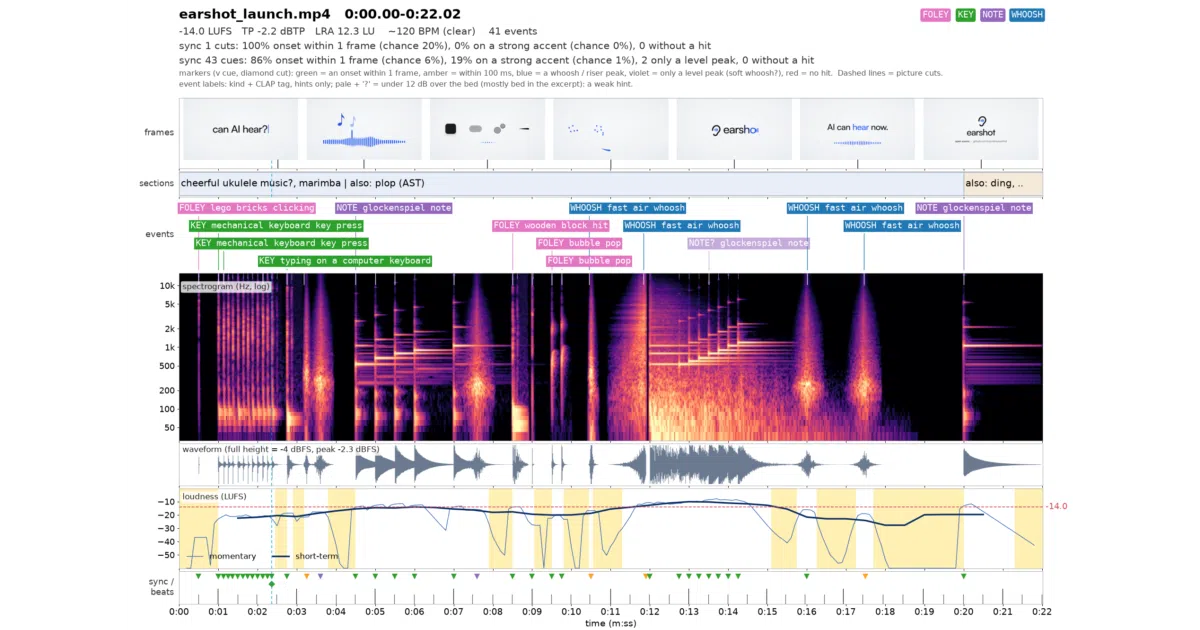
describe,match,find,timeline,critique— sound as structured evidence, not vibesforgemakes sounds from recipes and improves them via an evolutionary search with a model-free pre-screenfittranslates a recording into readable, re-renderable code (median CLAP cosine 0.945 on 12 test recordings)sheetrenders an annotated PNG — spectrogram, events, loudness, sync markers — for agents that read images- Runs fully offline on CPU; the optional Gemini audio-LLM critique requires your own key and explicit consent
Caveats
- Each CLI call reloads the models (~20–40 s); the README itself says use the MCP server or Python API for more than a few calls
- Reference recordings are licensed and not in the repo — you bring your own refs, or the critic runs in a weaker “designed” mode
- Blind tests are tiny (one listener, 15 and 12 trials); the author calls the v1 forge result “a coin flip” and no v2 blind-test score is published yet
Verdict
Anyone building agents that produce audio or video with sound — motion design, game SFX, product demos — should look hard at this. If your agents never touch audio, the DSP rabbit hole here is a spectator sport, albeit a well-documented one.
Frequently asked
- What is Leonxlnx/earshot?
- AI agents can render a whole launch film in code but can't hear it — earshot turns sound into evidence they can reason about, and critique, and even synthesize.
- Is earshot open source?
- Yes — Leonxlnx/earshot is open source, released under the MIT license.
- What language is earshot written in?
- Leonxlnx/earshot is primarily written in Python.
- How popular is earshot?
- Leonxlnx/earshot has 2.1k stars on GitHub.
- Where can I find earshot?
- Leonxlnx/earshot is on GitHub at https://github.com/Leonxlnx/earshot.