LLMQuant/quant-mind
A two-stage pipeline for taming quant research overload
QuantMind turns the daily deluge of quantitative finance papers into a structured, queryable knowledge base so researchers can ask questions instead of reading PDFs.
Not currently ranked — collecting fresh signals.
star history
What it does
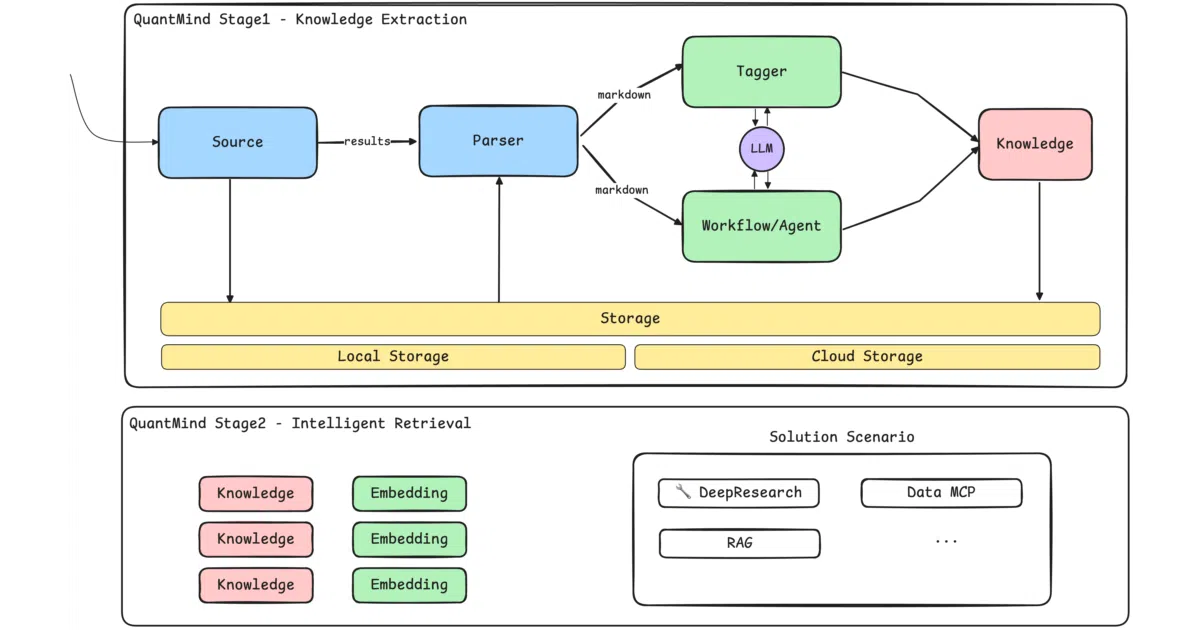
QuantMind is an async Python framework that ingests unstructured financial documents—primarily arXiv papers today—and converts them into a structured knowledge graph. It splits the work into two stages: an extraction pipeline that parses PDFs and HTML, tags topics, and deduplicates content, and a retrieval layer that serves the results through embeddings, RAG, and multi-hop reasoning. The aim is to let quant teams explore factor strategies and risk models via natural language rather than manual review.
The interesting bit
The framework includes a magic resolver that converts free-form strings like “Pull arXiv 2401.12345 about cross-sectional momentum” into structured pipeline inputs, which saves researchers from wrangling configuration objects. More unusual is the README’s candor: the project is mid-migration to the OpenAI Agents SDK, with persistent memory and the store layer still scheduled for future PRs, and the sweeping vision of an all-encompassing financial intelligence layer is explicitly labeled as aspirational, not shipped.
Key highlights
- Decoupled two-stage architecture separating knowledge extraction from intelligent retrieval
- Async batch processing with concurrency controls and error handling via
batch_runandpaper_flow - Domain-specific LLM tuning for finance content and automatic categorization into research topics
- Natural-language intent resolver (
magic) that maps free-form requests to structured inputs - Accepted at NeurIPS 2025 GenAI in Finance Workshop
Caveats
- The agent layer is mid-migration to OpenAI Agents SDK, and the
mind/memory and persistent store layers are not yet implemented - Production examples currently center on arXiv papers; broader sources such as news, blogs, and SEC filings remain on the roadmap
- The README explicitly warns that the “intelligent research agent” vision describes long-term goals, not current capabilities
Verdict
Quant teams drowning in academic literature should evaluate the paper pipeline; developers looking for a finished, general-purpose financial knowledge platform should wait for the remaining roadmap items to land.
Frequently asked
- What is LLMQuant/quant-mind?
- QuantMind turns the daily deluge of quantitative finance papers into a structured, queryable knowledge base so researchers can ask questions instead of reading PDFs.
- Is quant-mind open source?
- Yes — LLMQuant/quant-mind is open source, released under the MIT license.
- What language is quant-mind written in?
- LLMQuant/quant-mind is primarily written in Python.
- How popular is quant-mind?
- LLMQuant/quant-mind has 3.1k stars on GitHub.
- Where can I find quant-mind?
- LLMQuant/quant-mind is on GitHub at https://github.com/LLMQuant/quant-mind.