Kentucky-ai/opentakeoff
A takeoff engine built for AI agents first, estimators second
OpenTakeoff is the first open-source PDF takeoff engine — and the first an autonomous agent can drive natively over MCP, with provenance on every measurement.
Collecting fresh signals — velocity needs a few days of history.
collecting data…
star history
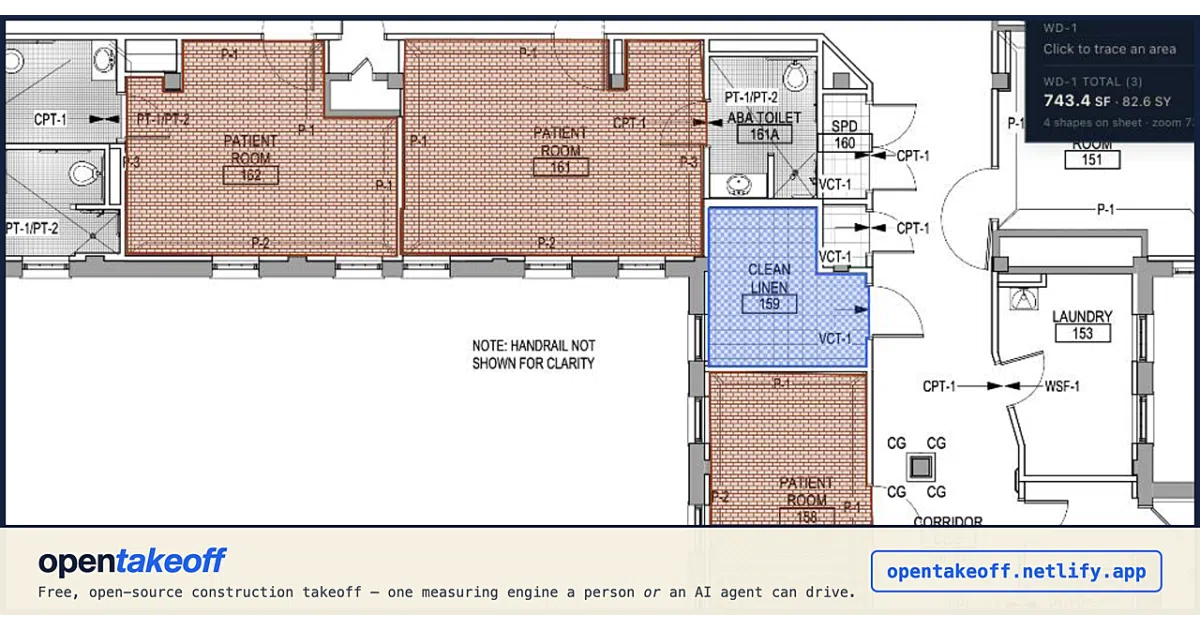
What it does A takeoff is measuring quantities off a construction drawing — square feet of flooring, wall lengths, fixture counts — and it’s the input to every construction bid. OpenTakeoff does it with two front ends over one engine: a browser canvas for a human estimator (no backend, no account, nothing uploads) and a stdio MCP server exposing 53 tools for an AI agent. Both share the same geometry and quantity modules, so an agent’s takeoff and a person’s corrections live in one document.
The interesting bit Provenance is the load-bearing part: every shape records the scale it was measured at, the method that produced it (flood, raster trace, hand-drawn, agent-proposed), and whether a human corrected it — with the machine’s original boundary frozen beside the correction. Downstream that’s an audit trail a PM can read; upstream it’s labeled geometry-to-finish pairs, the training signal takeoff models have never had at scale. The README claims this is the first open-source takeoff engine, period, and nothing here contradicts that.
Key highlights
- Runs entirely in the browser — client-only, works on Windows/macOS/Linux in current Chrome, Edge, Firefox, Safari; nothing installs, nothing uploads
- 53 MCP tools on the official MCP registry; an agent opens a plan, reads the title block, sets the scale, traces rooms to wall faces, and checks its own work on a rendered overlay
- Agent measurements carry an explicit review status; a human can import, correct a ring, and export with review state intact
- Stitched sheets: a floor split across a match line becomes one working surface, and a room crossing the seam traces as one shape
- Tracing conventions (innermost wall face, door openings on the wall centerline) ship inside the server itself, so agents follow estimator rules without prompting
Caveats
- One-Click room detection is temporarily gated while the flood engine is re-validated against a wider plan corpus — the
one_clickanddetect_roomsMCP verbs aren’t registered in a default build; you trace rooms manually instead - Browser and MCP room-detection paths currently differ, so shared code doesn’t guarantee identical boundaries on every plan
- The reference plan set’s estimator traces are v2 and still unreviewed by a person
Verdict If you’re in preconstruction, flooring, or quantity surveying — or building AI agents for AEC — this is worth a long look, especially since the field apparently had zero open-source engines before it. If you never touch a blueprint, move along.
Frequently asked
- What is Kentucky-ai/opentakeoff?
- OpenTakeoff is the first open-source PDF takeoff engine — and the first an autonomous agent can drive natively over MCP, with provenance on every measurement.
- Is opentakeoff open source?
- Yes — Kentucky-ai/opentakeoff is open source, released under the AGPL-3.0 license.
- What language is opentakeoff written in?
- Kentucky-ai/opentakeoff is primarily written in TypeScript.
- How popular is opentakeoff?
- Kentucky-ai/opentakeoff has 542 stars on GitHub.
- Where can I find opentakeoff?
- Kentucky-ai/opentakeoff is on GitHub at https://github.com/Kentucky-ai/opentakeoff.