JustVugg/colibri
A 744B-parameter model, streamed off your NVMe drive
colibri exploits MoE sparsity to run frontier models on ordinary hardware: hot experts on GPU, warm ones in RAM, the rest read from disk on demand.
Collecting fresh signals — velocity needs a few days of history.
star history
What it does
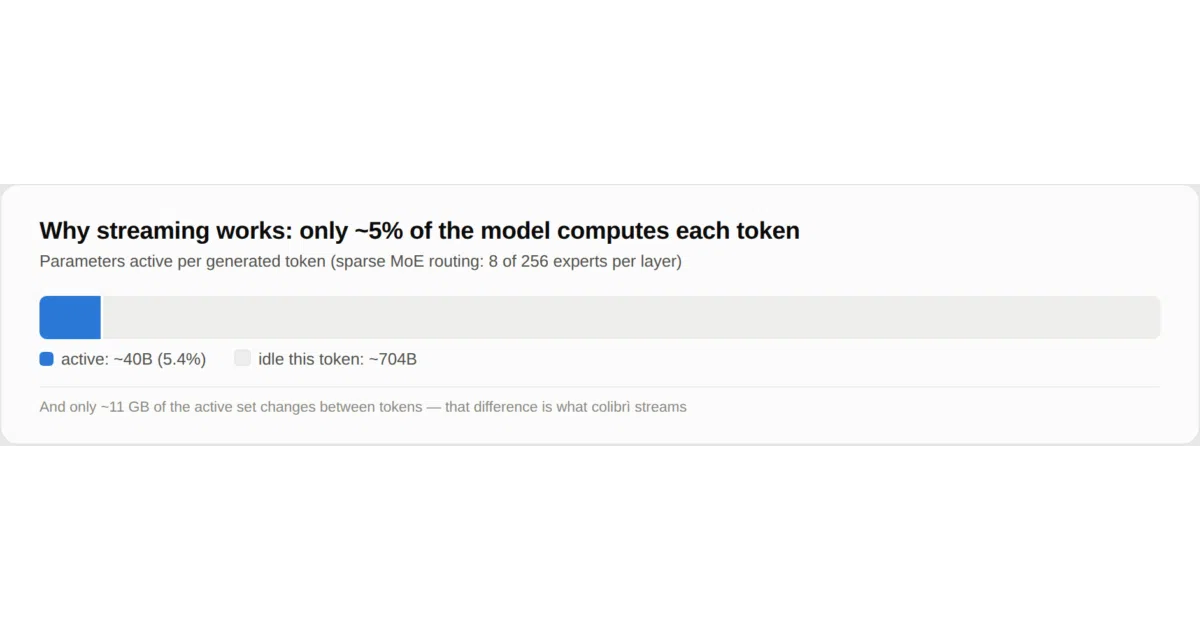
colibri is a pure-C inference engine for very large mixture-of-experts models. The insight it leans on: a 744B-parameter MoE like GLM-5.2 only touches ~40B parameters per token, and only ~11 GB of those actually change token to token. So instead of fitting the model in VRAM, colibri places it — dense layers and shared experts in RAM, routed experts on disk, pulled in through a cache that learns which experts your workload actually uses. A GPU, if you have one, holds the hottest experts.
The interesting bit
The tiering is the whole trick, and the README is refreshingly honest about the trade: where a weight lives changes speed, never the math. The default policy never silently alters precision or router semantics — less fast memory may cost tokens per second, but it won’t quietly redefine the model. Thirteen engines exist today, covering GLM, DeepSeek, Kimi, Qwen (including an image generator), plus decision/classification models, and it reads already-published GGUF files as-is.
Key highlights
- Runs a 744B MoE in ~10 GB of RAM with int4, streaming the rest from NVMe
- CPU, Vulkan (any GPU), and CUDA backends; GPU strictly optional
- Setup inspects your machine and recommends a model that actually fits
- Dashboard shows every expert firing in real time — a research platform, not just a runner
- OpenAI- and Anthropic-compatible local endpoints, plus an MCP server for AI assistants
Caveats
- Disk speed sets the pace for the big models: measured decode for DeepSeek V4 Flash ranges from 0.93 tok/s on CPU to ~1.6 with CUDA and two NVMe drives — usable, not snappy
- Several model entries in the tables have no measurements yet, so expect some unmarked territory
- Qwen-Image-2.1 carries a non-commercial licence
Verdict
If you’ve wanted to poke at frontier-scale MoE models without renting an H100, this is the most credible DIY route going. If you need fast interactive chat on huge models, check the measured tok/s tables first — streaming from disk is physics, not magic.
Frequently asked
- What is JustVugg/colibri?
- colibri exploits MoE sparsity to run frontier models on ordinary hardware: hot experts on GPU, warm ones in RAM, the rest read from disk on demand.
- Is colibri open source?
- Yes — JustVugg/colibri is open source, released under the Apache-2.0 license.
- What language is colibri written in?
- JustVugg/colibri is primarily written in C.
- How popular is colibri?
- JustVugg/colibri has 49.1k stars on GitHub.
- Where can I find colibri?
- JustVugg/colibri is on GitHub at https://github.com/JustVugg/colibri.