JordanCoin/codemap
Architectural Context for LLMs, Minus the Token Burn
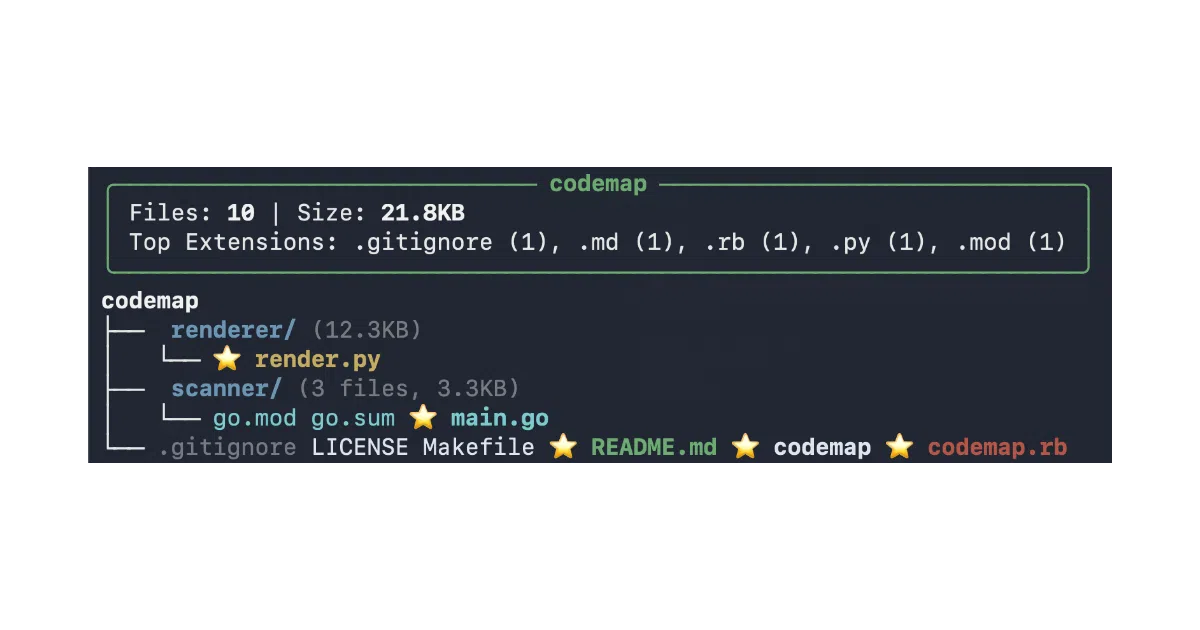
Codemap generates compact, high-signal codebase summaries so AI agents don’t have to chew through entire repositories to understand the architecture.
Not currently ranked — collecting fresh signals.
star history
What it does
Codemap is a Go CLI that scans a codebase and synthesizes architectural context—file trees, dependency graphs, diffs, and change summaries—into compact, LLM-ready payloads. It is designed to give coding agents like Claude or Codex immediate project awareness without stuffing their context windows with irrelevant source code. You can point it at a local repo or a public GitHub/GitLab URL and get structured output in text, JSON, or an HTTP API response.
The interesting bit
The standout idea is the multi-agent handoff artifact: a deterministic, layered snapshot split into stable hub summaries (prefix) and dynamic recent changes (delta), complete with content hashes and cache-reuse metrics. This lets one agent pick up exactly where another left off without re-ingesting the entire repo. The tool also treats context limits as a first-class constraint, offering per-project byte budgets and subsystem routing rules in .codemap/config.json.
Key highlights
- Layered handoffs with deterministic hashes (
prefix_hash,delta_hash) and an append-only metrics log to track cache reuse across agent sessions. - Dependency flow across 18 languages via
ast-grep, surfacing import hubs and blast radius for changed files. - Built-in budgets and routing in
.codemap/config.json, letting projects cap bytes per hook and define keyword-driven subsystems. - Remote repo analysis via shallow clones of public GitHub/GitLab repos without manual cloning.
- MCP server, HTTP API, and Claude hooks for integration beyond the terminal.
Caveats
- The README is truncated mid-sentence during the “Skills” section, so the full scope of that feature is unclear.
- Dependency analysis requires installing
ast-grepseparately unless you use thecodemap-fullrelease artifact; the base tarball is not self-contained. - Several features (drift detection, subsystems, skills) are mentioned but not fully documented in the provided excerpt, leaving some behavior ambiguous.
Verdict
Worth a look if you routinely hit context limits with Claude Code or Codex on large or complex repos. Probably overkill if you just want a pretty tree replacement for human reading.
Frequently asked
- What is JordanCoin/codemap?
- Codemap generates compact, high-signal codebase summaries so AI agents don’t have to chew through entire repositories to understand the architecture.
- Is codemap open source?
- Yes — JordanCoin/codemap is open source, released under the MIT license.
- What language is codemap written in?
- JordanCoin/codemap is primarily written in Go.
- How popular is codemap?
- JordanCoin/codemap has 703 stars on GitHub.
- Where can I find codemap?
- JordanCoin/codemap is on GitHub at https://github.com/JordanCoin/codemap.