Johnson-Durui/Companion-Space
A local-first AI tutor that actually shows its sources
Companion Space turns your own textbooks and exam papers into a verifiable course map, then teaches you over voice with a whiteboard and spaced-repetition review cards.
Too new to rank. Velocity needs a few days of history.
not enough history yet
star history
What it does
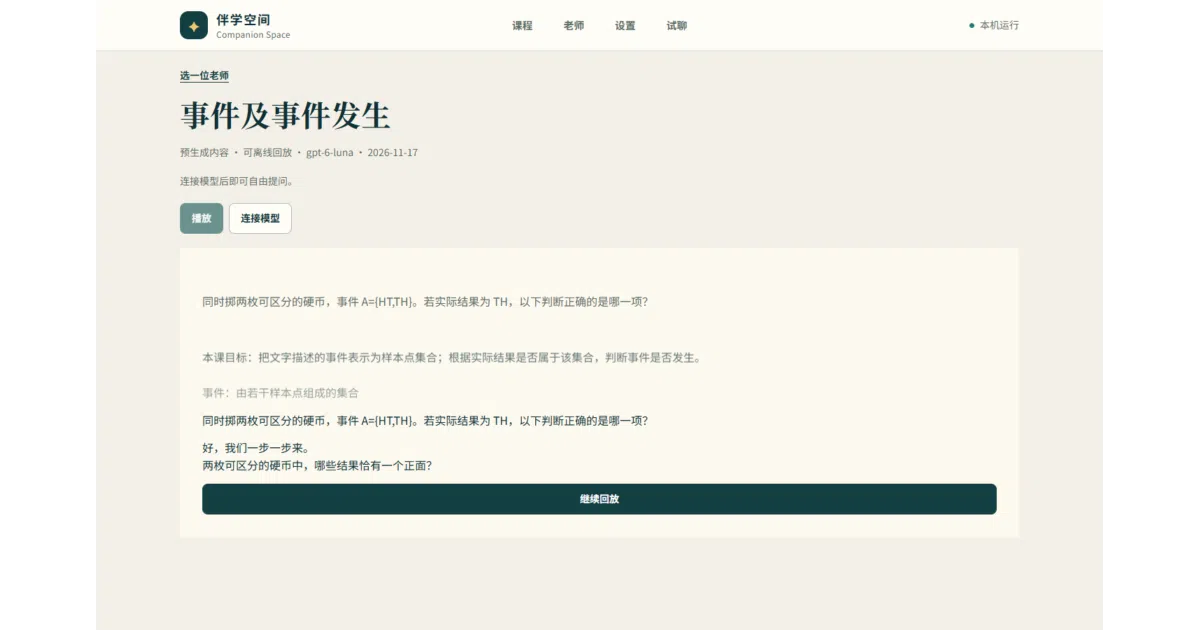
Companion Space is a single-user, local-first AI tutor. You import your own materials — PDF, PPTX, DOCX, images, Markdown, plain text — tag them as textbook, lecture notes, or exam papers, and the app builds a course map with knowledge points, question links, and answer-verification status. Every auto-generated result can be manually corrected, which is a refreshingly honest stance for an AI product. From there it runs learning interviews, placement checks, and live lessons with voice, a synced whiteboard, interruption handling, and reconnect recovery, followed by FSRS review cards and mistake review.
The interesting bit
The “verifiable sources” angle is the real hook: generated content is tied back to your imported materials with a reviewable answer status, rather than being free-floating model output. Also notable is the privacy posture — data stays on your machine by default, and only the text or images needed for the current operation go to your configured model provider. Local Sherpa speech-to-text is optional, and audio is processed in memory only, never written to disk.
Key highlights
- Import PDF, PPTX, DOCX, images, Markdown, and text with material-role tagging
- Course maps, knowledge points, and answer-review status — all human-editable
- Live lessons with voice, whiteboard sync, interruption, and disconnect recovery
- FSRS spaced-repetition review cards and mistake review after class
- Two 2D teachers plus three license-verified VRM sample characters; runs fully offline apart from model calls
Caveats
- This is a
1.0.0-rc.1release candidate, not a signed release — the Windows portable ZIP will trigger SmartScreen, and the maintainers explicitly warn against mirrors - Four character illustrations are excluded from both the repo and the portable package because redistribution licenses are still unverified
- Docker images aren’t published to a public registry, and the Compose setup deliberately binds only to loopback — remote access requires your own reverse proxy with HTTPS and auth
Verdict
Worth a look if you want an AI tutor grounded in your own materials with local-first data handling and unusual amounts of licensing discipline. Skip it if you need a polished signed release, multi-user deployment, or anything other than Windows for the portable path.
Frequently asked
- What is Johnson-Durui/Companion-Space?
- Companion Space turns your own textbooks and exam papers into a verifiable course map, then teaches you over voice with a whiteboard and spaced-repetition review cards.
- Is Companion-Space open source?
- Yes — Johnson-Durui/Companion-Space is open source, released under the Apache-2.0 license.
- What language is Companion-Space written in?
- Johnson-Durui/Companion-Space is primarily written in Python.
- How popular is Companion-Space?
- Johnson-Durui/Companion-Space has 543 stars on GitHub.
- Where can I find Companion-Space?
- Johnson-Durui/Companion-Space is on GitHub at https://github.com/Johnson-Durui/Companion-Space.