Jia-Ethan/codex-keysmith
A single-file Python CLI for paranoid Codex prompt deployment
codex-keysmith exists because copying a Markdown file and editing one TOML key is simple, but existing files, active hooks, and interrupted writes are not.
Velocity · 7d
+4.9
★ / day
Trend
↗accelerating
star history
What it does
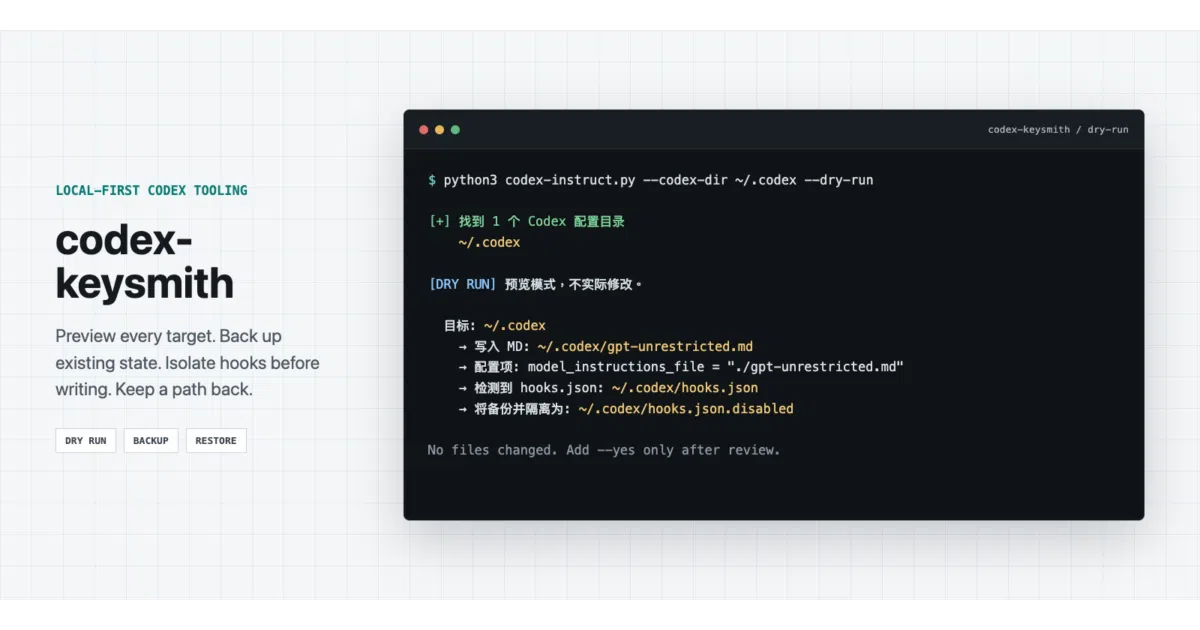
codex-keysmith is a single-file Python CLI that deploys a Markdown instruction file into your Codex configuration directory and points config.toml at it. By default it runs in dry-run mode, showing exactly which files it would touch, what backups it would create, and whether it would isolate your active hooks.json. Only after you pass --yes does it actually write anything, and even then it backs up existing files before touching them.
The interesting bit
The tool treats prompt deployment as a transactional operation: it fingerprints files, detects concurrent modifications, and rolls back changes if anything goes wrong mid-flight. It also deliberately pauses your entire hooks.json during deployment—because the last thing you want is a hook continuing to inject context while you’re trying to redefine the ground rules.
Key highlights
- Zero dependencies beyond Python 3.8+; the entire tool is one script.
- Dry-run previews show every path, config delta, and hook isolation plan before any disk changes.
- Atomic renames and file fingerprints guard against concurrent edits; failed multi-directory deployments roll back in reverse order.
- Built-in hook isolation backs up
hooks.jsonand disables it, with a separate--restore-hookscommand to bring it back later. - 71 pytest cases cover concurrency, interrupts, rollback, and prompt consistency.
Caveats
- Windows support exists but is not yet covered by CI; macOS and Linux are the validated targets.
- A hard kill (
SIGKILL) or power loss can leave.keysmith-*transaction debris that blocks subsequent runs until manually cleared. - It only touches the top-level
model_instructions_filekey in TOML, so profile-level isolation is out of scope.
Verdict
Worth a look if you manage Codex across multiple machines or directories and want a reversible, previewable way to standardize system prompts. Skip it if you just need a one-off copy-paste job and don’t care about hooks or backups.
Frequently asked
- What is Jia-Ethan/codex-keysmith?
- codex-keysmith exists because copying a Markdown file and editing one TOML key is simple, but existing files, active hooks, and interrupted writes are not.
- Is codex-keysmith open source?
- Yes — Jia-Ethan/codex-keysmith is open source, released under the MIT license.
- What language is codex-keysmith written in?
- Jia-Ethan/codex-keysmith is primarily written in Python.
- How popular is codex-keysmith?
- Jia-Ethan/codex-keysmith has 4.8k stars on GitHub and is currently accelerating.
- Where can I find codex-keysmith?
- Jia-Ethan/codex-keysmith is on GitHub at https://github.com/Jia-Ethan/codex-keysmith.