JayPokale/Chisle
The token-trimmer that publishes its own losses
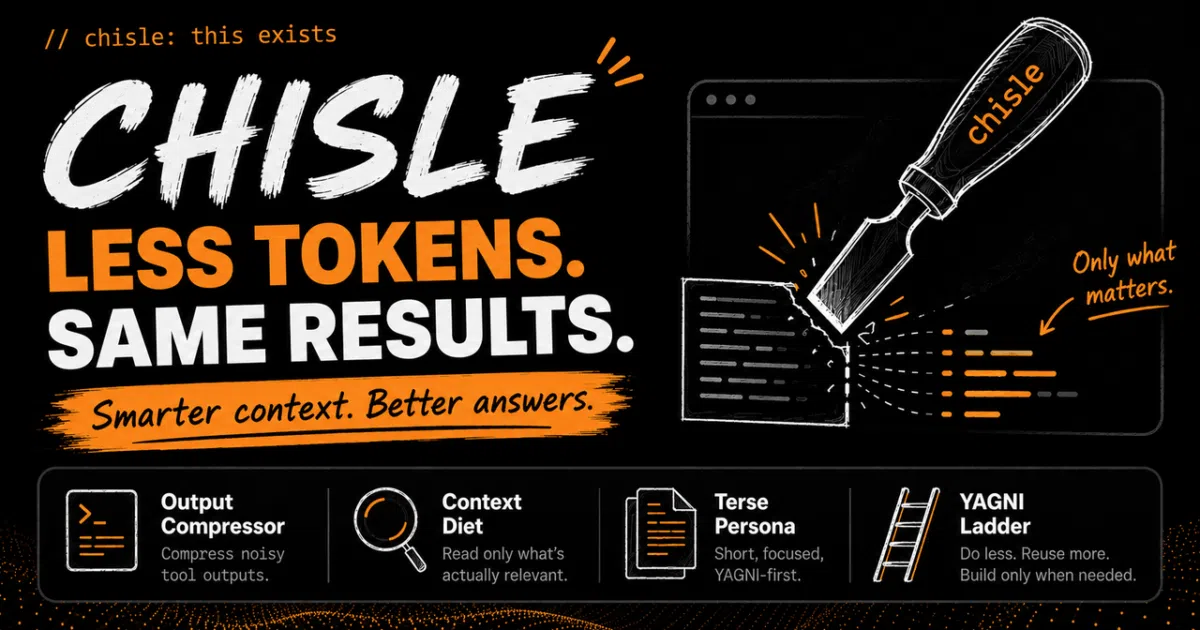
Chisle attacks AI agent token bills on three fronts — prose, code, and tool output — and shows you the benchmark runs where it lost.
Not currently ranked — collecting fresh signals.
star history
What it does
Chisle injects a ruleset into your coding agent’s session that makes it write terser prose and YAGNI-first code, and (for Claude Code and Pi) compresses tool output before it floods your context window. It auto-detects 11 agents — Claude Code, Pi, Cursor, Codex, Gemini, Copilot and friends — and wires each one. Zero dependencies, MIT, and --uninstall puts everything back.
The interesting bit
Most “be concise” tools compress one thing; Chisle compresses three, and the input axis is the sneaky-valuable one: tool output gets billed again on every later request in a session, so shrinking it once pays repeatedly. It also deliberately leaves Read/Edit/Write output untouched, since exact bytes feed later edits. And it’s refreshingly honest about benchmarks — the README openly notes the output-axis suite measures single-turn prompts with no tools, not whole-session cost, and that a tool can win there and still fail to pay for itself end to end.
Key highlights
- Cut the total 20-task output bill to 52% of baseline vs caveman (80%) and ponytail (68%), with the smallest worst case (173% vs 424%)
- Only one backfire run out of 20 — root-caused, fixed, and re-validated at 93%, with the investigation committed
- Input-side savings are measured with a real baseline (the hook knows exactly what it cut); output-side uses A/B benchmark arms because a counter would “invent the interesting half”
- Replay the compressor over your own local transcripts to measure savings on your work
- Dry-run mode prints every file it would touch without changing anything
Caveats
- Input-side compression and
/chisletoggling need Claude Code or Pi; other agents get the always-on ruleset only - The headline output numbers are single-turn, no-tools benchmarks — not a proxy for whole-session savings
- Pi extensions run with your user permissions; the README itself suggests reviewing the source first
Verdict Worth a look if you run Claude Code or Pi daily and your token bill hurts. If you’re on a rules-file-only agent, you’re getting just the output axis — still useful, but the smaller half of the story.
Frequently asked
- What is JayPokale/Chisle?
- Chisle attacks AI agent token bills on three fronts — prose, code, and tool output — and shows you the benchmark runs where it lost.
- Is Chisle open source?
- Yes — JayPokale/Chisle is open source, released under the MIT license.
- What language is Chisle written in?
- JayPokale/Chisle is primarily written in JavaScript.
- How popular is Chisle?
- JayPokale/Chisle has 749 stars on GitHub.
- Where can I find Chisle?
- JayPokale/Chisle is on GitHub at https://github.com/JayPokale/Chisle.