HendrikStrobelt/detecting-fake-text
Spotting synthetic prose before the LLM flood
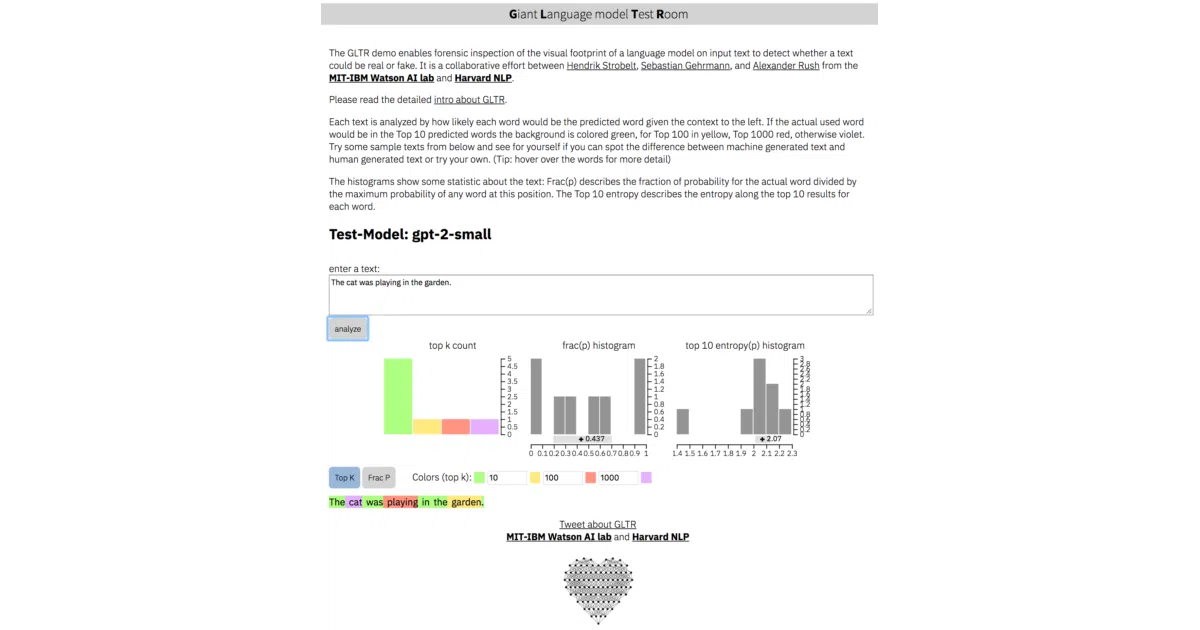
It visualizes how predictably a language model would have written each word, exposing text that sticks too closely to GPT-2’s safest bets.
Not currently ranked — collecting fresh signals.
star history
What it does
GLTR is a web-based forensics tool that scores text against a language model’s own expectations. You paste in prose, and it highlights how predictable each token is to GPT-2 or BERT — the theory being that machine-generated text tends to stick to the model’s safest bets. The result is an interactive visualization that maps suspiciously likely words across a passage.
The interesting bit
Built in 2019 when GPT-2 was still considered alarming, GLTR turns the generative model against itself: instead of sampling likely tokens, it uses the model’s probability distribution to flag them. The frontend renders this analysis visually, making statistical detection feel more like reading a weather map than parsing log probabilities.
Key highlights
- Visualizes per-token probabilities to surface synthetic text patterns.
- Ships with backends for
gpt-2-smallandBERT, swappable via a server flag. - Exposes an extensible
AbstractLanguageCheckerAPI for adding custom models. - Includes a live demo at gltr.io and can run fully offline as a local server.
- Born from a collaboration between MIT-IBM Watson AI Lab and HarvardNLP.
Caveats
- Demo texts are only bundled for the
gpt-2-smallbackend; the BERT mode leaves you to supply your own examples. - The frontend build workflow is manual, and the README offers no guidance on modern model support beyond GPT-2 and BERT.
- The project’s visual and architectural language predates the current LLM era, so its effectiveness against newer models is unclear.
Verdict
Worth a look if you study AI-generated text detection or want a concrete 2019 baseline for model forensics. Skip it if you need a turnkey detector for modern LLMs.
Frequently asked
- What is HendrikStrobelt/detecting-fake-text?
- It visualizes how predictably a language model would have written each word, exposing text that sticks too closely to GPT-2’s safest bets.
- Is detecting-fake-text open source?
- Yes — HendrikStrobelt/detecting-fake-text is open source, released under the Apache-2.0 license.
- What language is detecting-fake-text written in?
- HendrikStrobelt/detecting-fake-text is primarily written in TypeScript.
- How popular is detecting-fake-text?
- HendrikStrobelt/detecting-fake-text has 501 stars on GitHub.
- Where can I find detecting-fake-text?
- HendrikStrobelt/detecting-fake-text is on GitHub at https://github.com/HendrikStrobelt/detecting-fake-text.