HKUDS/LightReasoner
Small models can teach LLMs to reason—using 99% fewer tokens
LightReasoner replaces exhaustive supervised fine-tuning with a small-model teacher that flags only the reasoning steps worth learning, slashing tuned tokens by 99%.
Not currently ranked — collecting fresh signals.
star history
What it does
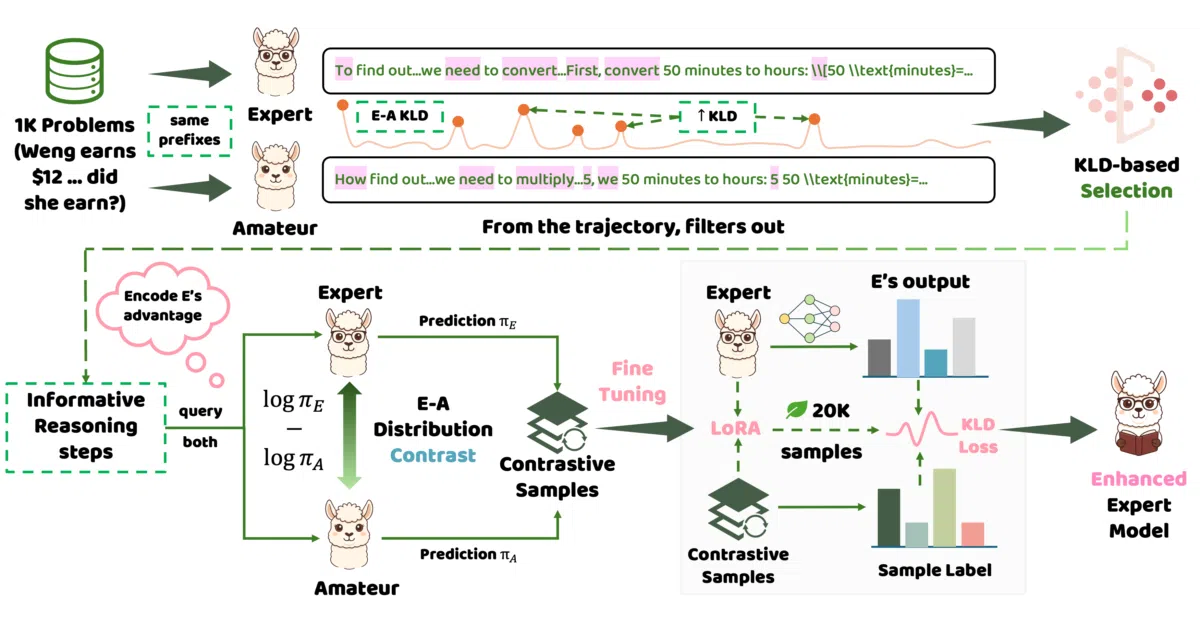
LightReasoner is a post-training framework that uses small language models as diagnostic tools for larger ones. It pairs an “expert” LLM with a weaker “amateur” SLM, measures KL divergence between their outputs to locate high-leverage reasoning steps, and fine-tunes the expert only on those critical moments. The authors report accuracy gains on math benchmarks—such as +28.1% on GSM8K for Qwen2.5-Math-1.5B and +6.0% on MATH for the 7B variant—while claiming a 99% reduction in tuned tokens and 90% less training time versus standard supervised fine-tuning. Pre-built datasets and fine-tuned checkpoints are available on Hugging Face.
The interesting bit
The twist is that the amateur does not learn from the expert; the expert learns from the amateur’s mistakes. By measuring where the small model’s probability distribution diverges most from the large model’s, the system identifies reasoning bottlenecks without ground-truth labels. The README notes there is a “sweet spot” in the capability gap—too weak and the amateur produces incoherent noise, too strong and the contrast disappears.
Key highlights
- Reported efficiency: 99% fewer tuned tokens, 90% less total training time, and 80% fewer sampled problems than traditional SFT for the Qwen2.5-Math-1.5B baseline.
- Label-free supervision: Uses KL divergence between expert and amateur outputs to generate soft contrastive labels, sidestepping human annotations and rejection sampling.
- Three-stage pipeline: Critical step selection via KLD thresholding, contrastive supervision to capture the expert’s advantage, and self-distillation to internalize those strengths.
- Generalization claims: Trained only on GSM8K, the authors report improvements across seven benchmarks including MATH, SVAMP, and OlympiadBench.
- Pre-packaged artifacts: Ships pre-collected training samples (
LRsamples) and ready-to-use fine-tuned models on Hugging Face.
Caveats
- The method depends heavily on expert-amateur pairing; the README warns that the amateur must be “competent enough to produce coherent reasoning” yet weaker than the expert, and that the optimal gap is a “sweet spot” rather than simply a larger divide.
- Default settings and hyperparameters are tuned for GSM8K; adapting to harder datasets like MATH may require upgrading the amateur model and retuning thresholds.
- The specific accuracy and efficiency gains listed vary significantly by model size and benchmark.
Verdict
Worth a look if you are fine-tuning reasoning models and want to experiment with token-efficient alternatives to brute-force SFT. Probably overkill if you are not working with step-by-step reasoning tasks or lack the compute to run paired model inference for sampling.
Frequently asked
- What is HKUDS/LightReasoner?
- LightReasoner replaces exhaustive supervised fine-tuning with a small-model teacher that flags only the reasoning steps worth learning, slashing tuned tokens by 99%.
- Is LightReasoner open source?
- Yes — HKUDS/LightReasoner is open source, released under the MIT license.
- What language is LightReasoner written in?
- HKUDS/LightReasoner is primarily written in Python.
- How popular is LightReasoner?
- HKUDS/LightReasoner has 612 stars on GitHub.
- Where can I find LightReasoner?
- HKUDS/LightReasoner is on GitHub at https://github.com/HKUDS/LightReasoner.