HITsz-TMG/VideoClaw
An AI film crew that actually takes notes between takes
VideoClaw turns a one-sentence prompt into a full production pipeline with editable checkpoints, not just a black-box video dump.
Not currently ranked — collecting fresh signals.
star history
What it does
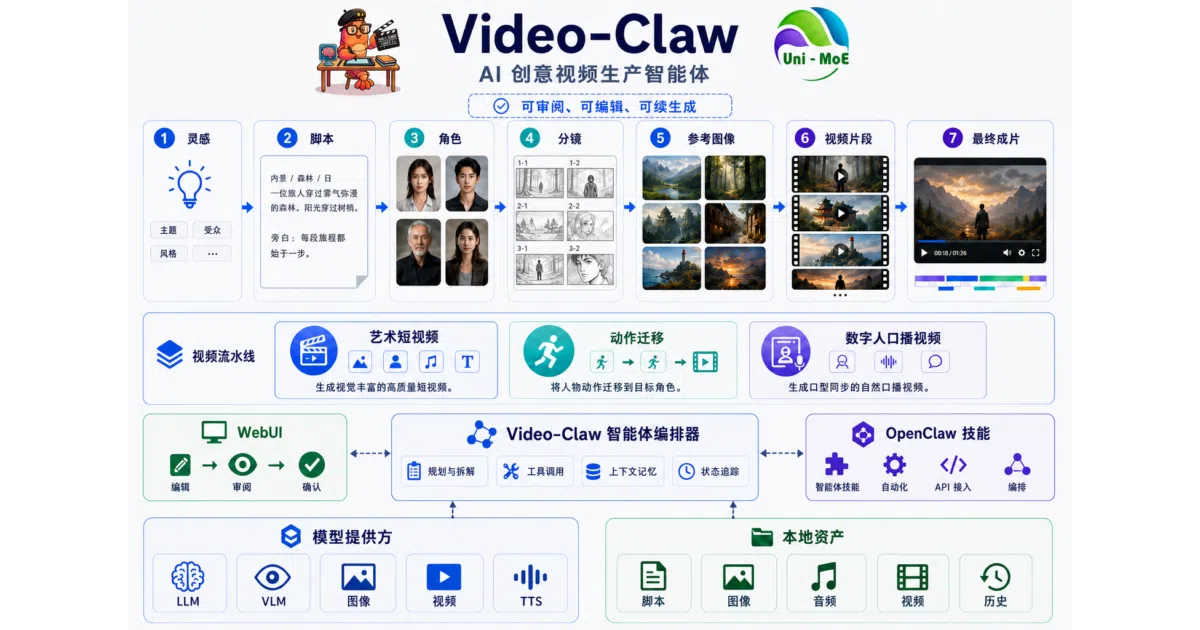
VideoClaw is a multi-agent system that treats video generation like film production rather than a single inference call. You feed it an idea, a logline, or even a vague concept; it expands that into a structured script, designs characters and scenes, storyboards shots, generates reference images, produces video clips via external models like Wan and Kling, and finally edits everything together with TTS narration and subtitles. The whole chain is visible and editable in a WebUI, so you can intervene at any stage rather than praying the end-to-end lottery pays out.
The interesting bit
The project explicitly positions itself against “black box” video generators by exposing every intermediate asset—scripts, character sheets, storyboards, reference images—as reviewable and modifiable artifacts. It also supports “infinite continuation” for serial content, letting you extend a short drama across multiple episodes while maintaining narrative coherence. The README is packed with actual demo series: an 8-episode programmer revenge arc and a 5-episode sci-fi adaptation of Liu Cixin’s “The Village Teacher.”
Key highlights
- Six-stage pipeline: script planning → character/scene design → shot planning → reference image generation → video generation → post-production editing
- Three lighter standalone pipelines for faster tasks: explainer shorts, action transfer, and digital-human talking-head videos
- Integrates with OpenClaw for conversational triggering (“generate a video about X”)
- WebUI for API key configuration, model selection, and project history management
- Local retention of all generated artifacts and history for reuse or deletion
- Action transfer capability using external video references
Caveats
- Heavy reliance on external commercial APIs and models (Wan, Kling, GPT-Image, etc.); not a self-contained system
- The “infinite continuation” and multi-episode coherence claims are demonstrated but not independently benchmarked
- README mixes project names (VideoClaw, Video-Claw, AIGC-Claw) with inconsistent versioning, suggesting rapid iteration and possible documentation drift
Verdict
Worth exploring if you’re building content workflows where human oversight matters more than raw generation speed. Skip it if you need a fully offline, API-free solution or if your use case is single-shot clips where Sora-style end-to-end simplicity wins.
Frequently asked
- What is HITsz-TMG/VideoClaw?
- VideoClaw turns a one-sentence prompt into a full production pipeline with editable checkpoints, not just a black-box video dump.
- Is VideoClaw open source?
- Yes — HITsz-TMG/VideoClaw is open source, released under the MIT license.
- What language is VideoClaw written in?
- HITsz-TMG/VideoClaw is primarily written in Python.
- How popular is VideoClaw?
- HITsz-TMG/VideoClaw has 1.9k stars on GitHub.
- Where can I find VideoClaw?
- HITsz-TMG/VideoClaw is on GitHub at https://github.com/HITsz-TMG/VideoClaw.