Graylab/DL4Proteins-notebooks
From NumPy to AlphaFold: a protein ML crash course
A curated Colab curriculum that walks researchers from basic neural networks to designing proteins with RFDiffusion and AlphaFold.
Not currently ranked — collecting fresh signals.
star history
What it does
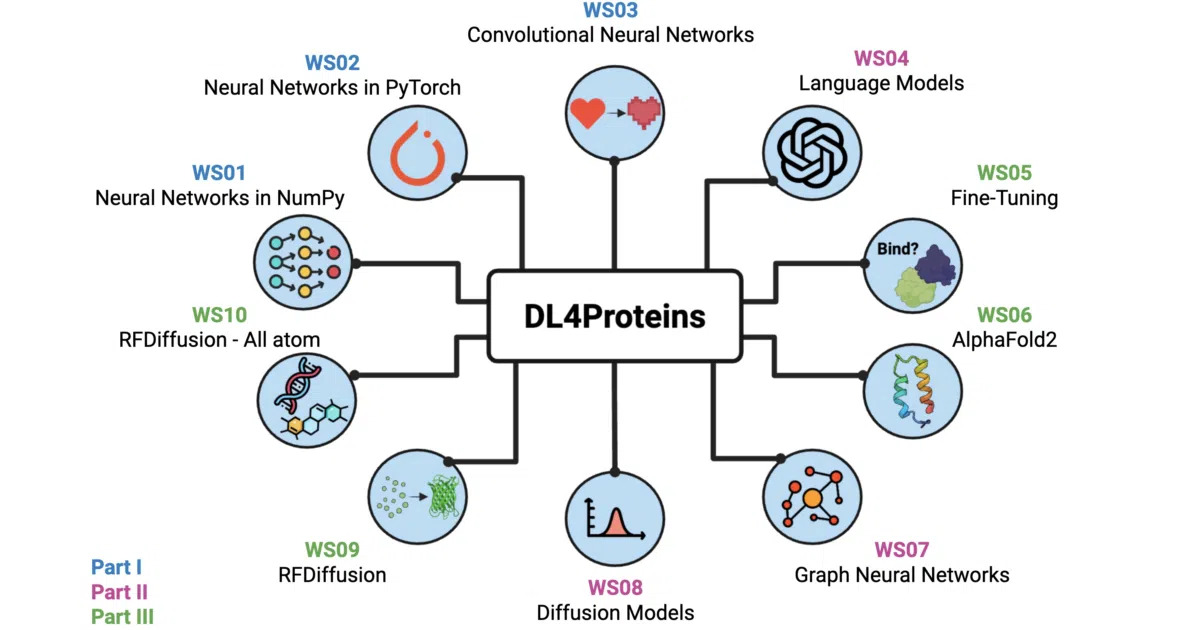
The Gray lab at Johns Hopkins offers ten interactive Jupyter notebooks—runnable in Google Colab—that teach machine learning fundamentals through the specific lens of protein structure prediction and design. The sequence starts with neural networks implemented in NumPy and PyTorch, then marches through CNNs, language models, graph neural networks, and diffusion models. The final chapters assemble a complete design pipeline using RFDiffusion, ProteinMPNN, and AlphaFold.
The interesting bit
Instead of treating AlphaFold as a magic button, the series treats it as a final exam. The notebooks borrow pedagogical DNA from staples like Andrej Karpathy’s tutorials and redirect the examples toward biomolecules, making the ramp from torch.nn to protein backbone design unusually explicit. There is even an associated preprint formalizing the learning outcomes, which is more academic rigor than most notebook collections bother with.
Key highlights
- Ten chapters from NumPy basics to all-atom RFDiffusion
- Runs entirely in Google Colab, so no local GPU cluster is required
- Explicitly designed as classroom material with defined learning outcomes
- Covers transfer learning with protein language model embeddings for downstream tasks
- Actively maintained; the authors call it a “living repository”
Verdict
Ideal for students, educators, or wet-lab biologists who need a guided on-ramp to structural biology ML. If you already train diffusion models in your sleep, the first half will feel like review.
Frequently asked
- What is Graylab/DL4Proteins-notebooks?
- A curated Colab curriculum that walks researchers from basic neural networks to designing proteins with RFDiffusion and AlphaFold.
- Is DL4Proteins-notebooks open source?
- Yes — Graylab/DL4Proteins-notebooks is open source, released under the MIT license.
- What language is DL4Proteins-notebooks written in?
- Graylab/DL4Proteins-notebooks is primarily written in Jupyter Notebook.
- How popular is DL4Proteins-notebooks?
- Graylab/DL4Proteins-notebooks has 731 stars on GitHub.
- Where can I find DL4Proteins-notebooks?
- Graylab/DL4Proteins-notebooks is on GitHub at https://github.com/Graylab/DL4Proteins-notebooks.