GokuMohandas/mlops-course
MLOps course bridges notebook hacking and production systems
It teaches the software engineering practices required to turn a Jupyter prototype into a reliable, scalable ML application.
Not currently ranked — collecting fresh signals.
star history
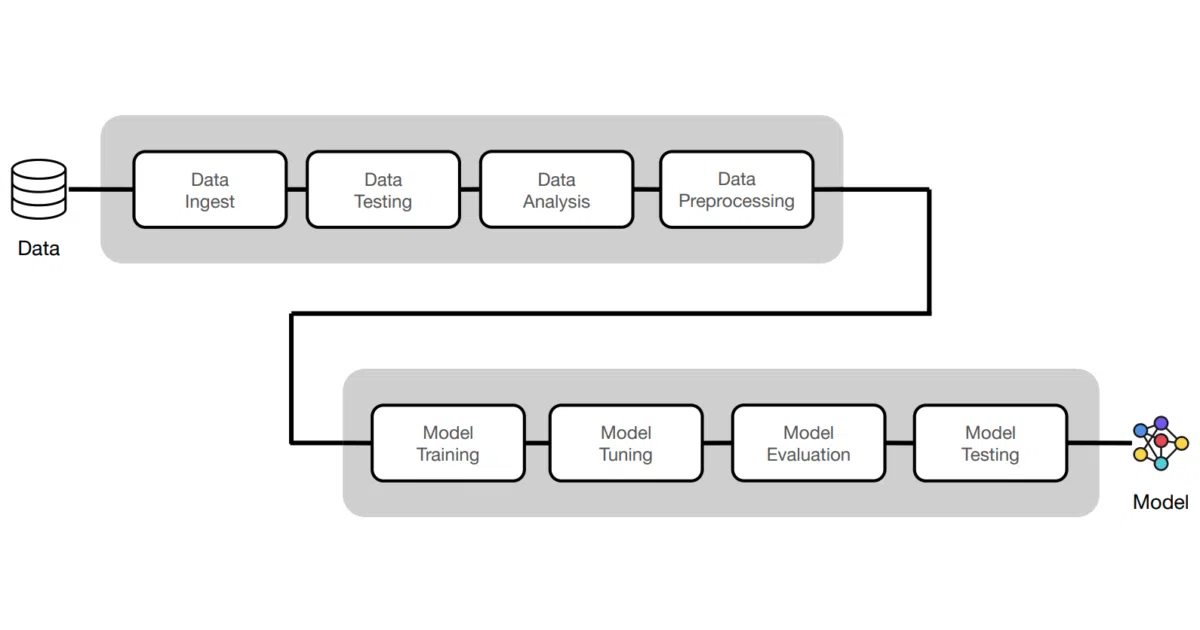
What it does This repository is the companion code for a free MLOps curriculum that walks through building an end-to-end machine learning system. It begins with interactive exploration in a Jupyter notebook, then refactors the same logic into modular Python scripts for training, tuning, evaluation, and serving. The aim is to show how experiment tracking, CI/CD, and orchestration fit together into a single reliable pipeline.
The interesting bit The project is built around the premise that you should not have to rewrite your stack to scale. It uses Ray to distribute workloads across local laptops or cloud clusters, and it emphasizes “dev to prod” continuity—the same Python code is meant to work on your machine and in a managed environment without infrastructure-specific rewrites. That is the rare part; most courses stop at the notebook.
Key highlights
- Covers the full lifecycle: data processing, training, hyperparameter tuning, experiment tracking via MLflow, evaluation, and inference.
- Refactors notebook code into clean scripts (
train.py,serve.py, etc.) with testing, logging, and versioning. - Targets scaling with Ray, allowing workloads to move from a single CPU to GPU clusters without leaving Python.
- Pitched at a broad audience: software engineers, recent graduates, and product leads looking for a technical foundation.
- Tightly coupled with the Made With ML website and optional Anyscale-hosted live cohorts for compute and community.
Caveats
- The README is overwhelmingly a setup guide for local or Anyscale environments; the architectural reasoning lives mostly in the external course lessons.
- Much of the value is tied to the companion website and video content, so the repository alone can feel like a script collection without the surrounding curriculum.
Verdict Worth bookmarking if you are a data scientist or ML engineer trying to close the gap between a working model and a maintainable system. Skip it if you are looking for a standalone library or a deep dive into a specific framework; this is glue and pedagogy, not a tool.
Frequently asked
- What is GokuMohandas/mlops-course?
- It teaches the software engineering practices required to turn a Jupyter prototype into a reliable, scalable ML application.
- Is mlops-course open source?
- Yes — GokuMohandas/mlops-course is open source, released under the MIT license.
- What language is mlops-course written in?
- GokuMohandas/mlops-course is primarily written in Jupyter Notebook.
- How popular is mlops-course?
- GokuMohandas/mlops-course has 3.4k stars on GitHub.
- Where can I find mlops-course?
- GokuMohandas/mlops-course is on GitHub at https://github.com/GokuMohandas/mlops-course.