FoundationVision/ByteTrack
Stop throwing away low-score detections
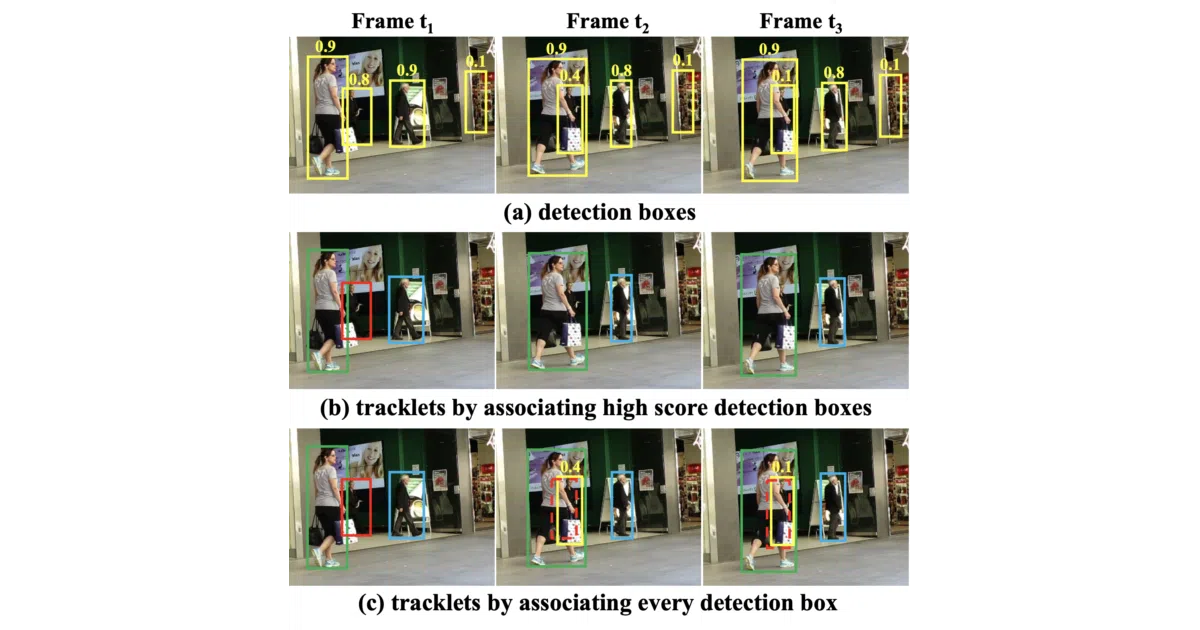
ByteTrack is a real-time multi-object tracker that rescues low-confidence bounding boxes instead of discarding them, recovering occluded objects and reducing fragmented trajectories.
Not currently ranked — collecting fresh signals.
star history
What it does ByteTrack is a multi-object tracking system built on YOLOX that assigns persistent identities to objects in video. Rather than keeping only high-confidence detections and discarding the rest, it associates every bounding box the detector produces. Low-score boxes are compared against existing tracklets to salvage real objects and filter out background clutter.
The interesting bit The method’s central trick is using a second association round for low-confidence detections, turning what most trackers treat as garbage into useful signal. The authors report that grafting this logic onto nine existing state-of-the-art trackers improved IDF1 scores by 1–10 points without swapping the underlying detector.
Key highlights
- Claims 80.3 MOTA and 77.3 IDF1 on MOT17 at roughly 30 FPS on a single V100.
- Model zoo spans nano (0.9 M parameters) up to YOLOX-x, trading accuracy for speed up to 64.5 FPS.
- Training and evaluation pipelines cover MOT17, MOT20, and custom COCO-format datasets.
- Docker support and pretrained weights are provided.
- The association mechanism is generic; the authors tested it on nine other trackers with consistent gains.
Caveats
- The repo is tightly coupled to YOLOX and requires several dataset conversion and mixing scripts before training.
- MOT20 training needs manual bounding-box clipping edits in four source files, per the README.
- Benchmark results are strictly on MOT challenge datasets; cross-domain robustness is not discussed.
Verdict A solid choice if you want strong real-time tracking inside a PyTorch/YOLOX stack. Less appealing if you need a drop-in tracker for a non-YOLOX detector or a lightweight integration.
Frequently asked
- What is FoundationVision/ByteTrack?
- ByteTrack is a real-time multi-object tracker that rescues low-confidence bounding boxes instead of discarding them, recovering occluded objects and reducing fragmented trajectories.
- Is ByteTrack open source?
- Yes — FoundationVision/ByteTrack is open source, released under the MIT license.
- What language is ByteTrack written in?
- FoundationVision/ByteTrack is primarily written in Python.
- How popular is ByteTrack?
- FoundationVision/ByteTrack has 6.8k stars on GitHub.
- Where can I find ByteTrack?
- FoundationVision/ByteTrack is on GitHub at https://github.com/FoundationVision/ByteTrack.