FlashML-org/FreeVideo
MiniMax H3 video generation that fits in 8 GB of VRAM
FreeVideo brings the MiniMax H3 video model to consumer GPUs by streaming weights and picking the right kernels for whatever card you happen to own.
Collecting fresh signals — velocity needs a few days of history.
collecting data…
star history
What it does
FreeVideo is a local inference engine for MiniMax H3, built on OpenVDN’s 8-step VDN-H3 model with Video DeltaNet’s hybrid attention. It runs as a ComfyUI plugin, with a Windows launcher that sets up the whole stack and command-line support on Linux. Inputs go beyond text: first/last frames plus image, video and audio references, and community LoRAs are supported.
The interesting bit
The memory story is the real trick. FreeVideo coordinates VRAM, system memory and disk together — weight streaming, async prefetching and chunked computation keep peak memory down to 8 GB VRAM / 16 GB RAM. It also probes your GPU and picks between native FP8 compute or FP8 storage with BF16 compute depending on architecture, and auto-selects available attention kernels.
Key highlights
- Hardware-adaptive execution: FP8 path chosen per GPU architecture, attention kernels probed automatically
- Low-memory inference via weight streaming, async prefetch and chunked computation
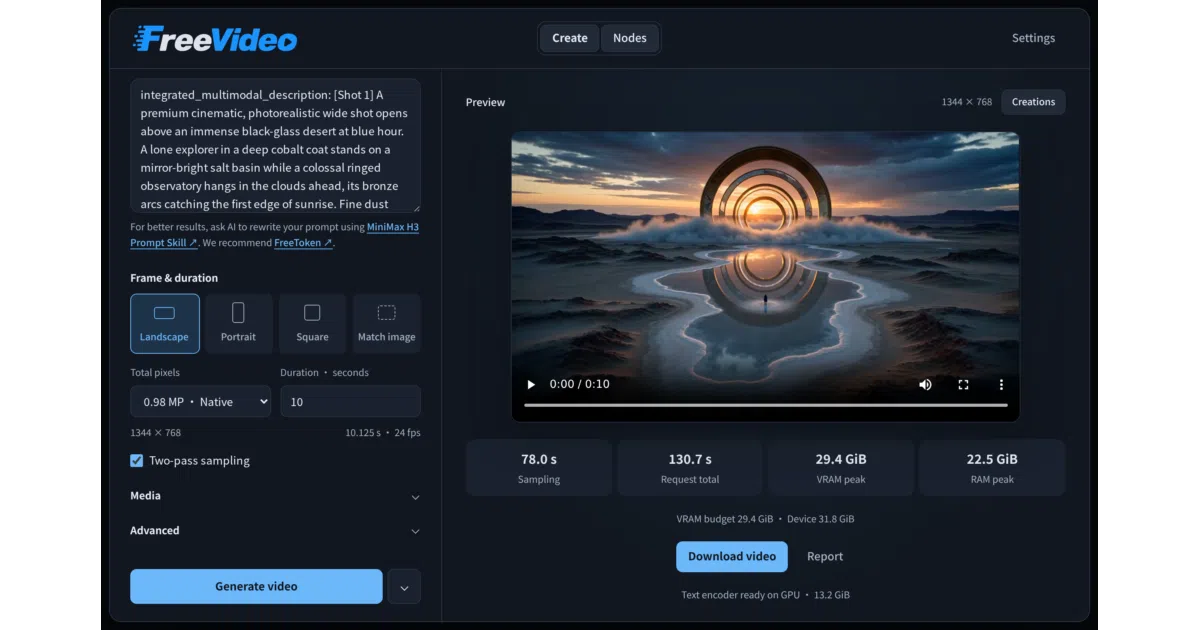
- ComfyUI workspace with two-pass sampling, batch generation, history, and a node view for finer control
- Windows launcher reuses existing ComfyUI installs and model folders; offline installation supported
- Apache 2.0 code; model weights under the MiniMax H3 Community License
Caveats
- The model weights carry territorial and acceptable-use restrictions — check the license before shipping anything commercial
- The Windows launcher is labeled a preview release
- Linux users get the command line only; the polished workspace experience is ComfyUI-centric
Verdict
Worth a look if you’ve got a modest GPU and want to run a serious video model locally without renting an A100. If you need permissive weights or non-ComfyUI workflows, read the license first and look elsewhere.
Frequently asked
- What is FlashML-org/FreeVideo?
- FreeVideo brings the MiniMax H3 video model to consumer GPUs by streaming weights and picking the right kernels for whatever card you happen to own.
- Is FreeVideo open source?
- Yes — FlashML-org/FreeVideo is open source, released under the Apache-2.0 license.
- What language is FreeVideo written in?
- FlashML-org/FreeVideo is primarily written in Python.
- How popular is FreeVideo?
- FlashML-org/FreeVideo has 709 stars on GitHub.
- Where can I find FreeVideo?
- FlashML-org/FreeVideo is on GitHub at https://github.com/FlashML-org/FreeVideo.