F-R-L/forge-film
A build system for AI films, not just another video generator
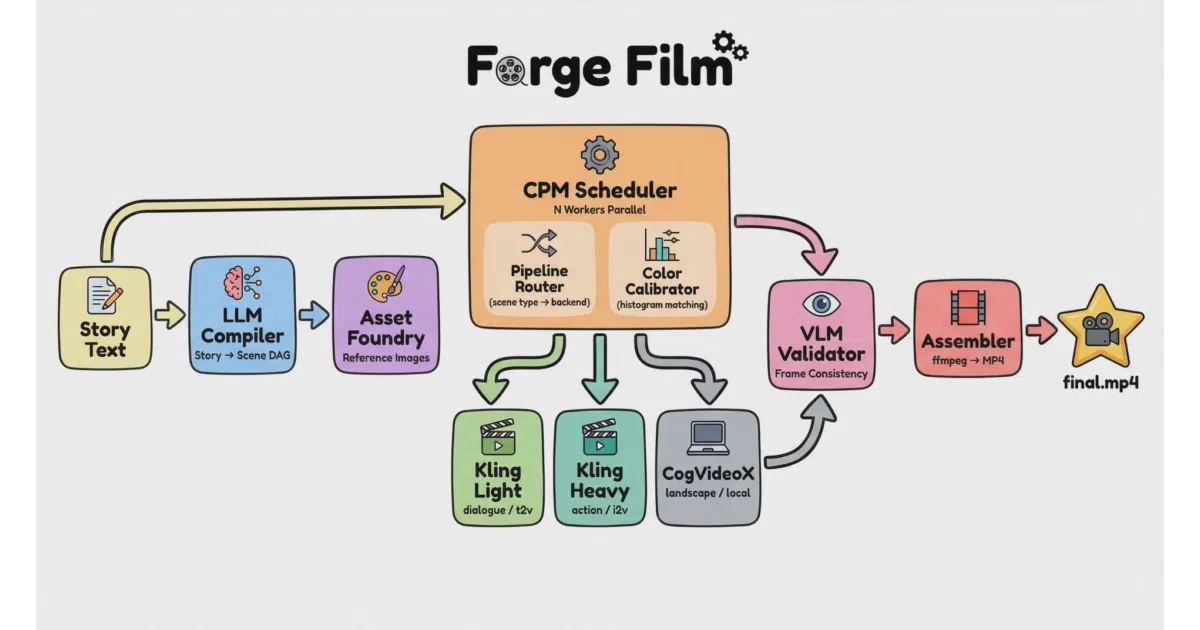
Forge treats multi-scene AI filmmaking as a dependency-graph scheduling problem, using critical-path analysis to parallelize generation across different models.
Not currently ranked — collecting fresh signals.
star history
What it does
Forge turns a text story into a directed acyclic graph of film scenes, routes each scene to the most appropriate video model (Kling for dialogue, CogVideoX for landscapes, etc.), runs independent scenes in parallel, and stitches everything into a single final.mp4. It also handles the tedious part nobody talks about: color-matching the last frame of one model’s output to seed the next model’s input, so cuts between different backends don’t look like channel-surfing.
The interesting bit
The project applies Critical Path Method scheduling — the same technique used in construction project management — to AI video generation. The LLM-compiled DAG identifies which scenes block others; Forge then prioritizes the longest dependency chain and fills gaps with parallel workers. The README claims a 6-scene example drops from 30 minutes serial to 20 minutes parallel, though real-world speedup obviously depends on how interdependent your story is.
Key highlights
- Scene-type routing is fully configurable in
forge.yaml(dialogue → Kling light, action → Kling heavy, landscapes → local CogVideoX) - Cross-model continuity via automatic histogram color matching on last-frame handoff
- Pluggable backend interface (~50 lines to add a new video model)
- Includes a Gradio web UI and a
mockbackend for zero-API-key testing - 20 tests that run without external API keys
Caveats
- Seedance and Wan 2.x backends are listed in the roadmap but not yet implemented
- No actual benchmark results with real Kling API calls are published yet
- GPU only needed for local backends; cloud API workflows are CPU-only but cost per-second
Verdict
Worth a look if you’re stitching together multi-scene AI videos and tired of manual model-hopping and color correction. Skip it if you just need single-clip generation — this is orchestration glue, not a model itself, and the value only appears once your stories have enough scene independence to exploit parallel scheduling.
Frequently asked
- What is F-R-L/forge-film?
- Forge treats multi-scene AI filmmaking as a dependency-graph scheduling problem, using critical-path analysis to parallelize generation across different models.
- Is forge-film open source?
- Yes — F-R-L/forge-film is open source, released under the MIT license.
- What language is forge-film written in?
- F-R-L/forge-film is primarily written in Python.
- How popular is forge-film?
- F-R-L/forge-film has 539 stars on GitHub.
- Where can I find forge-film?
- F-R-L/forge-film is on GitHub at https://github.com/F-R-L/forge-film.