Eladlev/AutoPrompt
Your prompts are brittle. This tool makes them prove it.
It closes the gap between a prompt that works on your first three examples and one that survives real-world edge cases.
Not currently ranked — collecting fresh signals.
star history
What it does
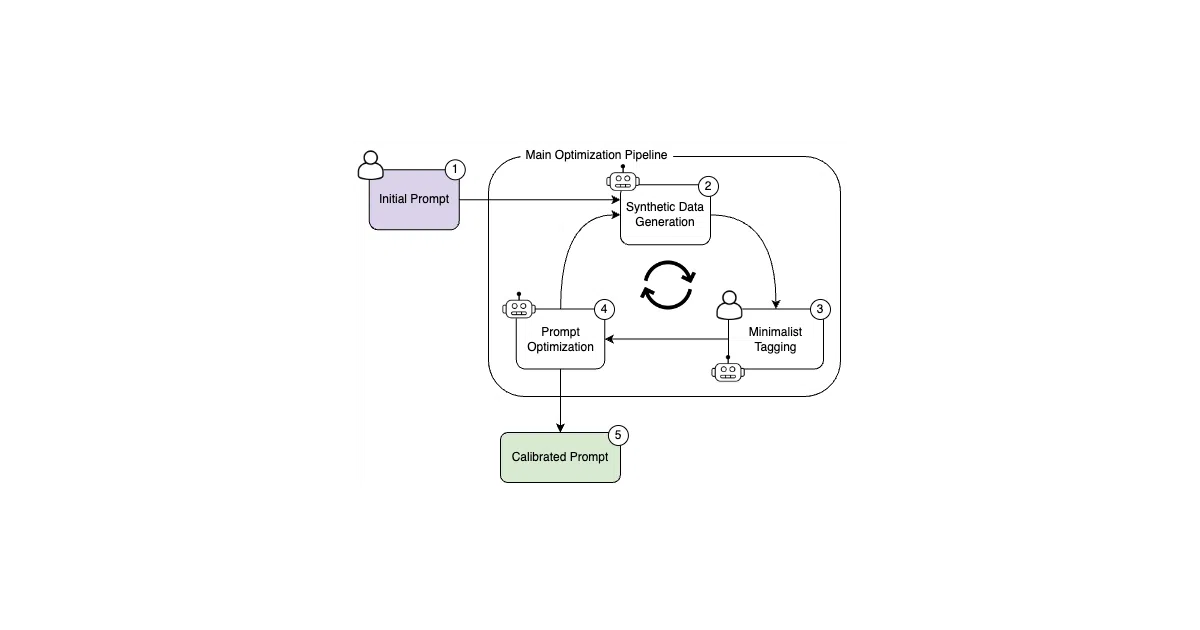
AutoPrompt takes a rough prompt and task description, then iteratively generates synthetic samples designed to expose weaknesses. It evaluates the prompt against these edge cases—annotated by a human or an LLM—and uses the results to rewrite the prompt. The process spits out a calibrated prompt and a benchmark of the boundary cases that broke earlier versions.
The interesting bit
The framework treats prompt engineering as an adversarial game: instead of hoping your prompt generalizes, it forces an LLM to manufacture failure modes—imbalanced moderation scenarios, ambiguous classifications—then closes each hole. For generation tasks, it even learns a ranker prompt first so it can judge its own outputs during optimization.
Key highlights
- Targets production scenarios like moderation and multi-label classification where imbalanced data usually makes benchmarking painful.
- Caps spend in actual dollars or tokens; the authors note a typical run costs under a dollar and finishes in minutes on GPT-4 Turbo.
- Supports an “optimize-only” mode that skips synthetic generation if you already have a labeled CSV dataset.
- Can migrate prompts across different model versions or providers, and squeeze multiple rules into a single efficient prompt.
- Integrates with Argilla for human-in-the-loop review, though it is pinned to Argilla V1.
Caveats
- The Argilla integration is explicitly limited to V1; the README warns that V2 is not supported and suggests restarting the space if the server flakes.
- Prompt accuracy can fluctuate during optimization, so you need to keep iterating rather than trusting the first seemingly good result.
- Each step fires multiple long LLM calls, and the authors warn that generative tasks can take roughly a minute per iteration.
Verdict
Worth a look if you are shipping classification or generation prompts to production and want measured evidence that they handle edge cases. Skip it if you consider prompt engineering a one-and-done creative writing exercise.
Frequently asked
- What is Eladlev/AutoPrompt?
- It closes the gap between a prompt that works on your first three examples and one that survives real-world edge cases.
- Is AutoPrompt open source?
- Yes — Eladlev/AutoPrompt is open source, released under the Apache-2.0 license.
- What language is AutoPrompt written in?
- Eladlev/AutoPrompt is primarily written in Python.
- How popular is AutoPrompt?
- Eladlev/AutoPrompt has 3k stars on GitHub.
- Where can I find AutoPrompt?
- Eladlev/AutoPrompt is on GitHub at https://github.com/Eladlev/AutoPrompt.