DrJonaC/Pensieve
Inspecting the Black Box of LLM Memory, Locally
Pensieve exists because users need to see, edit, and govern the structured memory that steers LLM answers, not just trust a hidden store.
Collecting fresh signals — velocity needs a few days of history.
collecting data…
star history
What it does
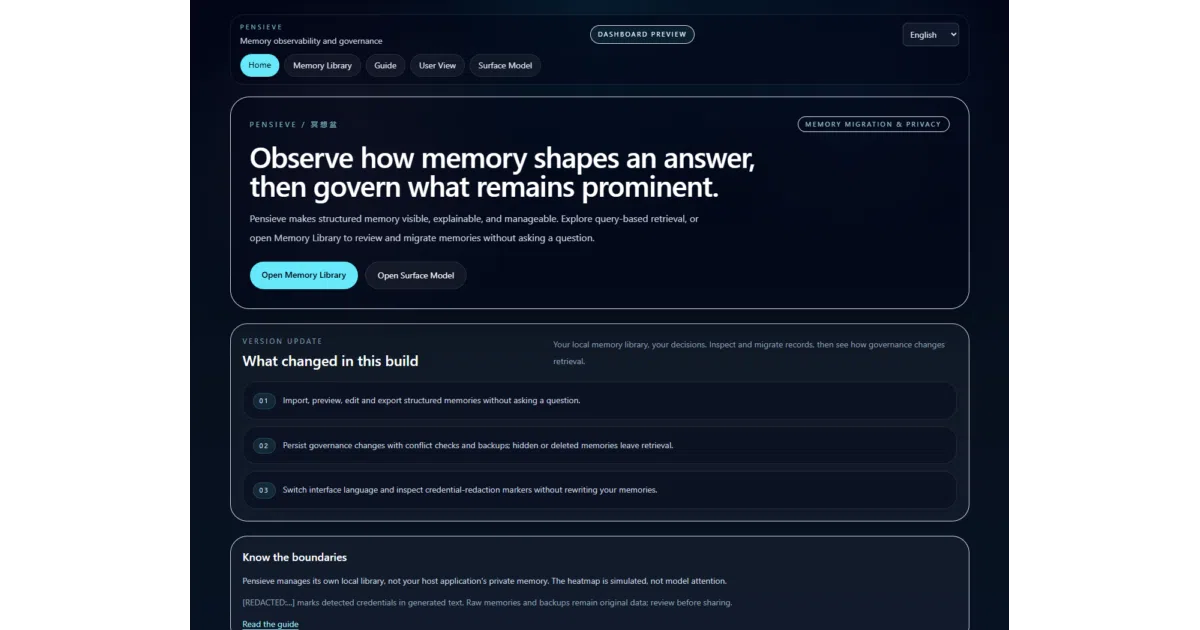
Pensieve is a single-user, local-first Next.js application that acts as a control panel for structured AI memory. You import versioned JSON or plain text into a local file repository, preview conflicts, and manage records through a dashboard. The system then simulates how those memories surface during queries, offering mock answers, request traces, and an illustrative heatmap alongside optional live LLM calls. It is explicitly not a public service and binds to loopback.
The interesting bit
The project treats memory as user-governed data rather than an opaque model byproduct. It uses a local lexical vector index for retrieval, applies ranking modifiers, and lets you pin, soften, hide, or delete records to see how governance affects recall. The twist is that it manages its own external memory store; it does not read or modify private ChatGPT, Claude, or Codex memories, and native host write-back remains future work.
Key highlights
- Local-first architecture: all runtime data lives in a relocatable local JSON file, with atomic writes, revision checks, and pre-change backups.
- Credential redaction: recognized tokens, private keys, and secrets are replaced with
[REDACTED:...]in inputs, outputs, reports, and errors. - Governance controls: edit content and keywords, manage duplicates, and confirm deletions that actually affect retrieval from the local index.
- Portable import/export: JSON roundtrips preserve metadata and governance state; text imports store one line per memory without inferring facts.
- Bilingual interface: switch between English and Chinese without translating the actual memory content.
Caveats
- The simulated heatmap and model-generated explanations are interpretations, not measured attention or causal proof of what the LLM actually used.
- Raw memories and exports remain unencrypted local files; deletion is not secure erasure, and historical backups may persist.
- The shipped adapters operate on Pensieve’s own repository; they do not automatically connect to or modify native host memories from OpenAI, Anthropic, or other providers.
Verdict
Worth a look if you’re researching LLM memory interpretability or need a sandbox to test how structured context affects retrieval. Skip it if you want a plug-in that directly edits ChatGPT’s or Claude’s native memory banks—this is a local research preview, not a host hack.
Frequently asked
- What is DrJonaC/Pensieve?
- Pensieve exists because users need to see, edit, and govern the structured memory that steers LLM answers, not just trust a hidden store.
- Is Pensieve open source?
- Yes — DrJonaC/Pensieve is open source, released under the MIT license.
- What language is Pensieve written in?
- DrJonaC/Pensieve is primarily written in TypeScript.
- How popular is Pensieve?
- DrJonaC/Pensieve has 1.3k stars on GitHub.
- Where can I find Pensieve?
- DrJonaC/Pensieve is on GitHub at https://github.com/DrJonaC/Pensieve.