Dodaios/ste80-humanizer
Karpathy's aerospace-English trick, packaged as an agent skill
A two-pass humanizer that strips the 26 known AI tells, then rewrites your text 80% of the way to ASD-STE100 — the controlled English of aircraft maintenance manuals.
Too new to rank. Velocity needs a few days of history.
not enough history yet
star history
What it does
STE80 Humanizer is an agent skill (Claude Code, Codex, Cursor, and others via the skills CLI) that rewrites AI-generated text so it reads like a careful person wrote it. It runs two passes: first it removes the 26 tells catalogued in Wikipedia’s “Signs of AI writing” and blader/humanizer — the “not just X, it’s Y”, the “Great question!”, the stacked hedges. Then it rebuilds the sentences 80% of the way to ASD-STE100, the controlled English invented in the 1980s for aerospace mechanics whose first language wasn’t English, where a misread step can kill someone.
The interesting bit
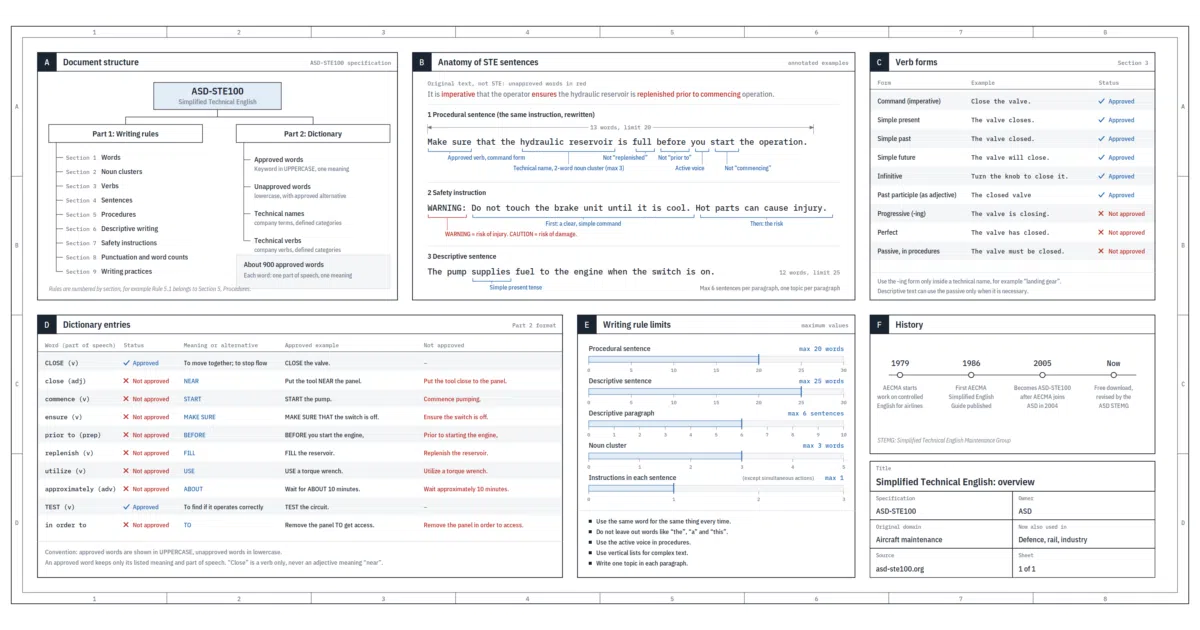
The insight is that most humanizers only swap vocabulary. The text loses “seamless” but keeps 40-word sentences carrying three ideas in passive voice — it still smells like AI. Pass 2 attacks structure instead: one idea per sentence, active voice, condition first, 20–25 word limits. The “80%” matters because full STE is stiff — at 100%, “check” and “test” are nouns only and “may” is banned. At 80% you keep the sentence discipline and lose the vocabulary straitjacket.
Key highlights
- Two numbered rule sets in
SKILL.md: §1–§26 for AI tells, S1–S15 for STE80 structure, each with before/after examples - Three modes: default humanize, light touch (tells only), and strict STE for procedures and safety notes
- Fidelity-first: keeps every fact, preserves “may” as “may”, flags contradictions in the source instead of smoothing them over
- Can match your own voice if you supply a writing sample
- Reports edits by rule number ("§1, §8, S2") so you can audit what changed
- The README even fact-checks the STE overview graphic from Karpathy’s post against Issue 9 of the spec
Caveats
- Explicitly not aimed at beating AI detectors — the goal is readability, and the README says so twice
- The “clearest difference from a plain prompt” claim rests on the authors’ own tests; no external benchmark is given
- Karpathy’s post is dated 2 October 2026, which is either a typo or a time traveller — the README doesn’t flag it
Verdict
Worth installing if you regularly clean up model output for docs, runbooks, or replies to humans. If you were hoping for a detector-evasion tool, this is politely not that.
Frequently asked
- What is Dodaios/ste80-humanizer?
- A two-pass humanizer that strips the 26 known AI tells, then rewrites your text 80% of the way to ASD-STE100 — the controlled English of aircraft maintenance manuals.
- Is ste80-humanizer open source?
- Yes — Dodaios/ste80-humanizer is open source, released under the MIT license.
- What language is ste80-humanizer written in?
- Dodaios/ste80-humanizer is primarily written in Python.
- How popular is ste80-humanizer?
- Dodaios/ste80-humanizer has 1.1k stars on GitHub.
- Where can I find ste80-humanizer?
- Dodaios/ste80-humanizer is on GitHub at https://github.com/Dodaios/ste80-humanizer.