DimiMikadze/orca
LinkedIn stalking, but make it autonomous
An AI agent that scrapes and reasons over LinkedIn profiles so you don't have to read six months of posts manually.
Not currently ranked — collecting fresh signals.
star history
What it does
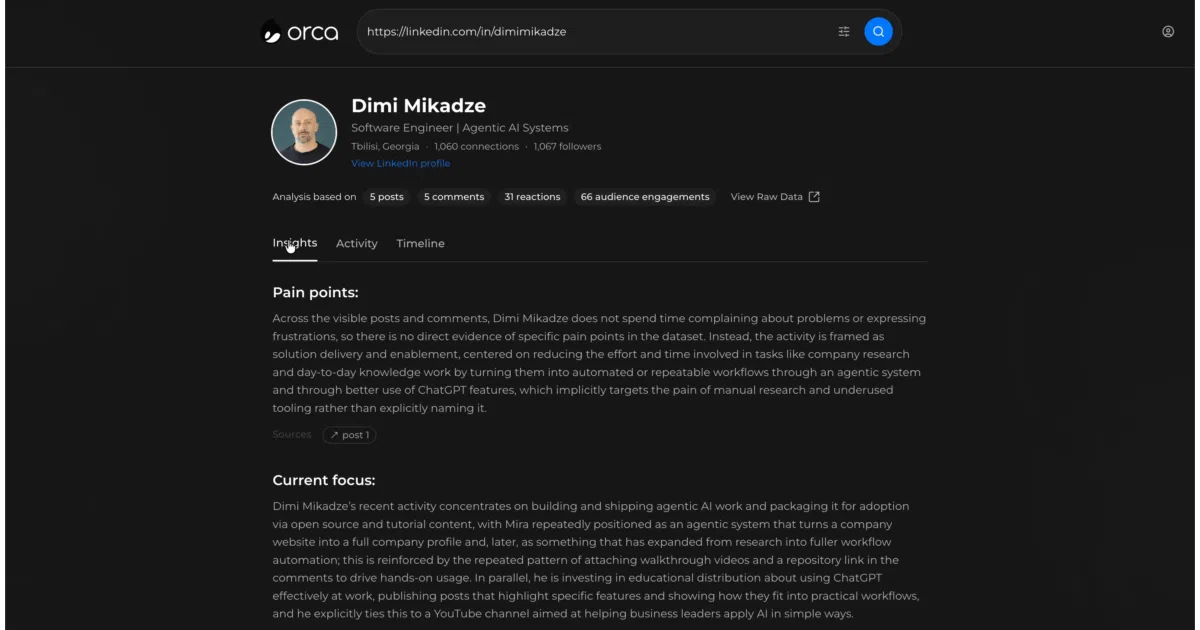
Orca takes a LinkedIn profile URL and a list of insights you want—pain points, expertise, communication style, how interests shift over time—and goes to work. It scrapes posts, comments, reactions, and engagement networks, then uses an LLM to extract structured findings. If the agent decides it needs more data mid-analysis, it calls additional scraping tools on its own. Results stream back in real time.
The core orca-ai/ library is standalone; the rest is a Next.js 16 UI wrapper with optional Supabase auth.
The interesting bit
The agentic loop is the hook: this isn’t a one-shot prompt. Orca reasons over initial data, identifies gaps, and autonomously dispatches more scrapers. That’s the difference between “summarize this profile” and “figure out what this person actually cares about.”
Key highlights
- Scrapes profile, posts, comments, reactions, and top post engagement via RapidAPI
- Supports OpenAI, Anthropic, and other LLM providers through LangChain
- Core analysis engine is a portable Node.js library, not locked to the web UI
- Tests run against recorded fixtures by default; flip a flag for live LinkedIn data
- Auth is optional—runs open by default, or lock it down with Supabase credentials
Caveats
- Requires a paid RapidAPI key for LinkedIn data; no free tier mentioned
- Only 1,275 stars and no listed topics—still early, rough edges likely
- “Deep analysis” quality depends heavily on how much the target actually posts
Verdict
Worth a look for sales, recruiting, or investor teams doing high-volume outreach research. Skip it if you need guaranteed accuracy on quiet profiles, or if scraping-adjacent tooling makes your legal team nervous.
Frequently asked
- What is DimiMikadze/orca?
- An AI agent that scrapes and reasons over LinkedIn profiles so you don't have to read six months of posts manually.
- Is orca open source?
- Yes — DimiMikadze/orca is open source, released under the MIT license.
- What language is orca written in?
- DimiMikadze/orca is primarily written in TypeScript.
- How popular is orca?
- DimiMikadze/orca has 1.3k stars on GitHub.
- Where can I find orca?
- DimiMikadze/orca is on GitHub at https://github.com/DimiMikadze/orca.