Dicklesworthstone/pi_agent_rust
A Rust AI CLI that audits its own benchmark claims
A Rust rewrite of the Pi coding assistant that replaces runtime bloat with a single binary and treats every performance claim as a CI-gated evidence obligation.
Velocity · 7d
+29
★ / day
Trend
↗accelerating
star history
What it does
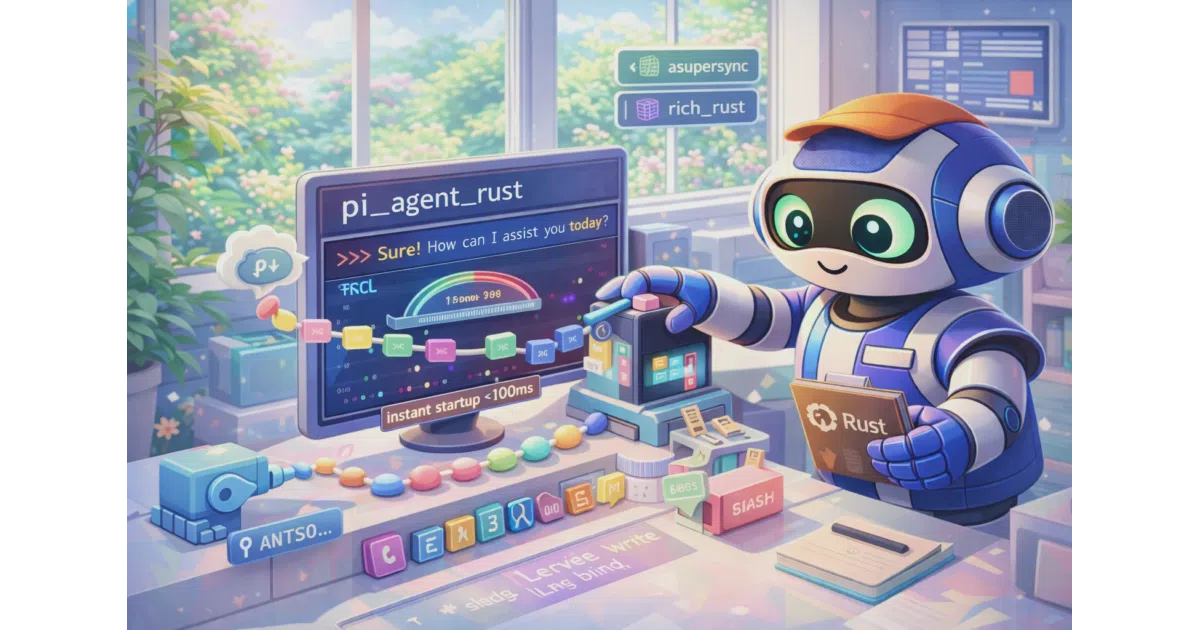
pi_agent_rust is a Rust port of Mario Zechner’s Pi Agent coding assistant, built with his blessing as a single static binary with zero unsafe code. It gives you an AI coding agent in the terminal with streaming responses, session branching, and eight built-in tools. Instead of a standard async runtime and terminal libraries, it ships with its own structured-concurrency runtime (asupersync) and a Rust port of Rich (rich_rust) for markup.
The interesting bit
The project’s most unusual feature is its evidentiary paranoia: every numeric performance claim is supposed to carry an inline citation to a checked-in artifact, and CI blocks stale evidence from backing README claims. The security model is similarly thorough—extensions live through a trust lifecycle from pending to killed, dangerous shell patterns are blocked by a two-stage exec guard before spawn, and benchmark disclosures explicitly note when legacy reruns failed due to missing dependencies.
Key highlights
- Advertised footprint is roughly a ~21.1 MiB binary, sub-100 ms startup, and <50 MB idle memory, though the README stresses that current claims must pass a fresh CI evidence gate
- Zero unsafe code, with capability-gated hostcalls and two-stage extension execution enforcement that blocks destructive shell patterns by default
- Custom
asupersyncruntime for structured concurrency and a from-scratch Rust port of Rich for terminal markup - Per-extension trust lifecycle (
pending→acknowledged→trusted→killed) with kill switches and tamper-evident runtime risk ledgers - Benchmark methodology keeps security controls on during measurements and discloses blockers rather than fabricating rerun data
Caveats
- The README states that release-facing performance numbers are only valid when checked-in evidence artifacts are current; some visible figures may be historical snapshots awaiting regeneration
- The project depends on two companion libraries (
asupersyncandrich_rust) maintained by the same author, so you are buying into a small, tightly coupled ecosystem - The architecture is explicitly designed for large-session, multi-agent, extension-heavy workloads; if you only need occasional single-shot queries, the machinery may be overkill
Verdict
Worth evaluating if you run long-lived AI coding sessions with extensions and want a self-contained binary that treats shell execution as a mediated, audited operation. Skip it if your current CLI starts fast enough and you do not need extension kill switches or session branching.
Frequently asked
- What is Dicklesworthstone/pi_agent_rust?
- A Rust rewrite of the Pi coding assistant that replaces runtime bloat with a single binary and treats every performance claim as a CI-gated evidence obligation.
- Is pi_agent_rust open source?
- Yes — Dicklesworthstone/pi_agent_rust is an open-source project tracked on heatdrop.
- What language is pi_agent_rust written in?
- Dicklesworthstone/pi_agent_rust is primarily written in Rust.
- How popular is pi_agent_rust?
- Dicklesworthstone/pi_agent_rust has 1.9k stars on GitHub and is currently accelerating.
- Where can I find pi_agent_rust?
- Dicklesworthstone/pi_agent_rust is on GitHub at https://github.com/Dicklesworthstone/pi_agent_rust.