DevashishPrasad/CascadeTabNet
One CNN that finds tables and maps their cell geometry
It exists because most table detectors stop at bounding boxes, leaving you to reconstruct rows and columns yourself.
Not currently ranked — collecting fresh signals.
star history
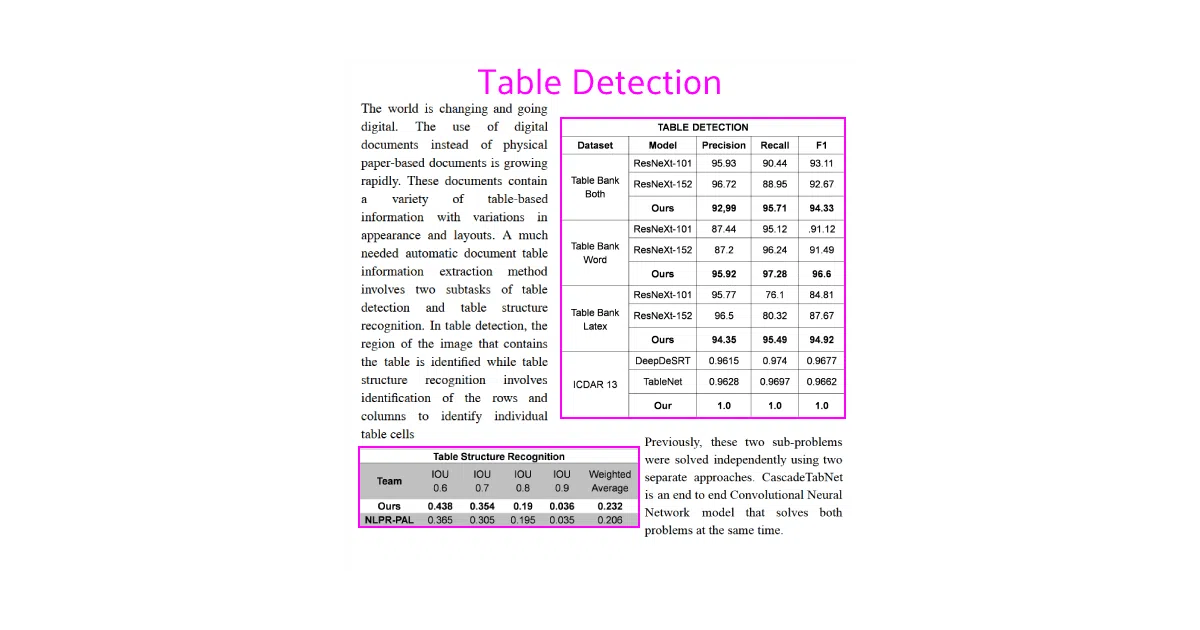
What it does CascadeTabNet is a single convolutional network built on MMdetection that simultaneously draws bounding boxes around tables in document images and identifies the individual structural cells inside them. Instead of chaining separate detection and recognition pipelines, it handles both tasks in one pass using a Cascade mask R-CNN HRNet backbone. The authors trained and released separate checkpoints for specific benchmarks—ICDAR 2013, ICDAR 2019, TableBank, and a general-purpose model—plus a dedicated checkpoint for table structure recognition on ICDAR 19 Track B2.
The interesting bit The project bundles manually corrected datasets—merging ICDAR 19, Marmot, and a GitHub table corpus into a general detection set, and annotating borderless table cells for structure recognition—so the models are trained on cleaner ground truth than raw competition data. It is also unapologetically tied to older PyTorch 1.4 and MMdetection v1.2, which pins it to a very specific 2020-era stack.
Key highlights
- Joint table detection and structure recognition in a single model architecture
- Achieved top accuracy on ICDAR 2013, TableBank, and ICDAR 2019 structure recognition according to the README’s benchmarking claims
- Provides seven distinct pretrained checkpoints, including domain-specific models for Word and LaTeX TableBank splits
- Includes a Docker image and a Colab demo notebook for inference without local setup
- MIT licensed with no commercial restrictions stated
Caveats
- Hard-coded
cv2.imshowcalls require manual patching to run in Colab or headless environments, suggesting the inference code is not server-ready out of the box - Dependency stack is explicitly pinned to PyTorch 1.4, CUDA 10.0, and MMdetection v1.2, so modern environments will need version archaeology
- The README does not mention inference latency, memory footprint, or whether the models run on CPU
Verdict Worth a look if you are extracting tables from scanned documents or PDF renders and need both location and cell structure without building a two-stage pipeline. Skip it if you need a maintained, modern object-detection stack or real-time processing guarantees.
Frequently asked
- What is DevashishPrasad/CascadeTabNet?
- It exists because most table detectors stop at bounding boxes, leaving you to reconstruct rows and columns yourself.
- Is CascadeTabNet open source?
- Yes — DevashishPrasad/CascadeTabNet is open source, released under the MIT license.
- What language is CascadeTabNet written in?
- DevashishPrasad/CascadeTabNet is primarily written in Python.
- How popular is CascadeTabNet?
- DevashishPrasad/CascadeTabNet has 1.5k stars on GitHub.
- Where can I find CascadeTabNet?
- DevashishPrasad/CascadeTabNet is on GitHub at https://github.com/DevashishPrasad/CascadeTabNet.