DetectionTeamUCAS/R2CNN_Faster-RCNN_Tensorflow
Faster-RCNN learns to tilt: detecting objects that refuse to stay straight
A TensorFlow re-implementation that adds rotated bounding boxes to the classic two-stage detector, aimed at aerial imagery and scene text where horizontal boxes miss most of the target.
Not currently ranked — collecting fresh signals.
star history
What it does
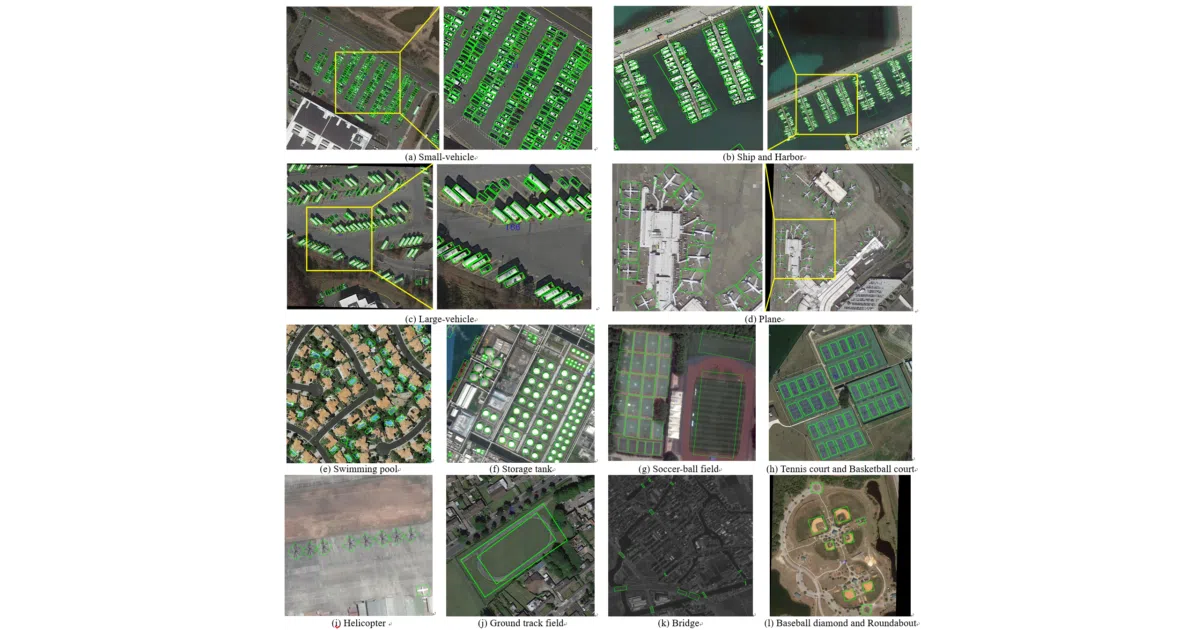
This repo is a TensorFlow re-implementation of R²CNN, grafting rotational region detection onto a standard Faster-RCNN backbone. It predicts oriented bounding boxes instead of axis-aligned ones, which matters when your objects—ships, text blocks, storage tanks—sit at arbitrary angles. The authors note they adopted the paper’s idea rather than replicating it exactly.
The interesting bit
The project targets the DOTA aerial-image dataset, where horizontal detectors famously struggle. The leaderboard tables show R²CNN hitting 60.67 mAP on oriented detection versus Faster-RCNN’s 52.93—a meaningful but not dominant gap, with later methods (ICN, R²CNN++) pulling further ahead. The code also runs face detection and ICDAR2015 text benchmarks, suggesting the rotational head generalizes across domains.
Key highlights
- Supports ResNet-50/101 and MobileNet v2 backbones via ImageNet pre-training
- Includes trained model weights and demo scripts for DOTA, FDDB, and live camera input
- Requires TensorFlow ≥ 1.2, CUDA 8.0, and Python 2.7 (Anaconda recommended)
- Data pipeline expects VOC-style XML annotations; includes cropping utilities for DOTA’s oversized images
- Cython extensions for box utilities need manual compilation before training or inference
Caveats
- Python 2.7 and TensorFlow 1.x in 2024: expect dependency archaeology
- Setup is manual and scattered across multiple scripts (compile, convert to TFRecord, edit config files, copy config contents into
cfgs.py) - The authors explicitly state this is not an exact re-implementation; reproducibility versus the original paper is unclear
Verdict
Worth a look if you need a working oriented-detection baseline in TensorFlow 1.x and can tolerate legacy tooling. Everyone else should probably chase the R²CNN++ paper or newer PyTorch implementations instead.
Frequently asked
- What is DetectionTeamUCAS/R2CNN_Faster-RCNN_Tensorflow?
- A TensorFlow re-implementation that adds rotated bounding boxes to the classic two-stage detector, aimed at aerial imagery and scene text where horizontal boxes miss most of the target.
- Is R2CNN_Faster-RCNN_Tensorflow open source?
- Yes — DetectionTeamUCAS/R2CNN_Faster-RCNN_Tensorflow is open source, released under the MIT license.
- What language is R2CNN_Faster-RCNN_Tensorflow written in?
- DetectionTeamUCAS/R2CNN_Faster-RCNN_Tensorflow is primarily written in Python.
- How popular is R2CNN_Faster-RCNN_Tensorflow?
- DetectionTeamUCAS/R2CNN_Faster-RCNN_Tensorflow has 582 stars on GitHub.
- Where can I find R2CNN_Faster-RCNN_Tensorflow?
- DetectionTeamUCAS/R2CNN_Faster-RCNN_Tensorflow is on GitHub at https://github.com/DetectionTeamUCAS/R2CNN_Faster-RCNN_Tensorflow.