DemonDamon/FinnewsHunter
When your trading bot needs a committee meeting first
A multi-agent system that crawls Chinese financial news, debates sentiment, and spits out alpha signals—assuming you can keep all the services running.
Not currently ranked — collecting fresh signals.
star history
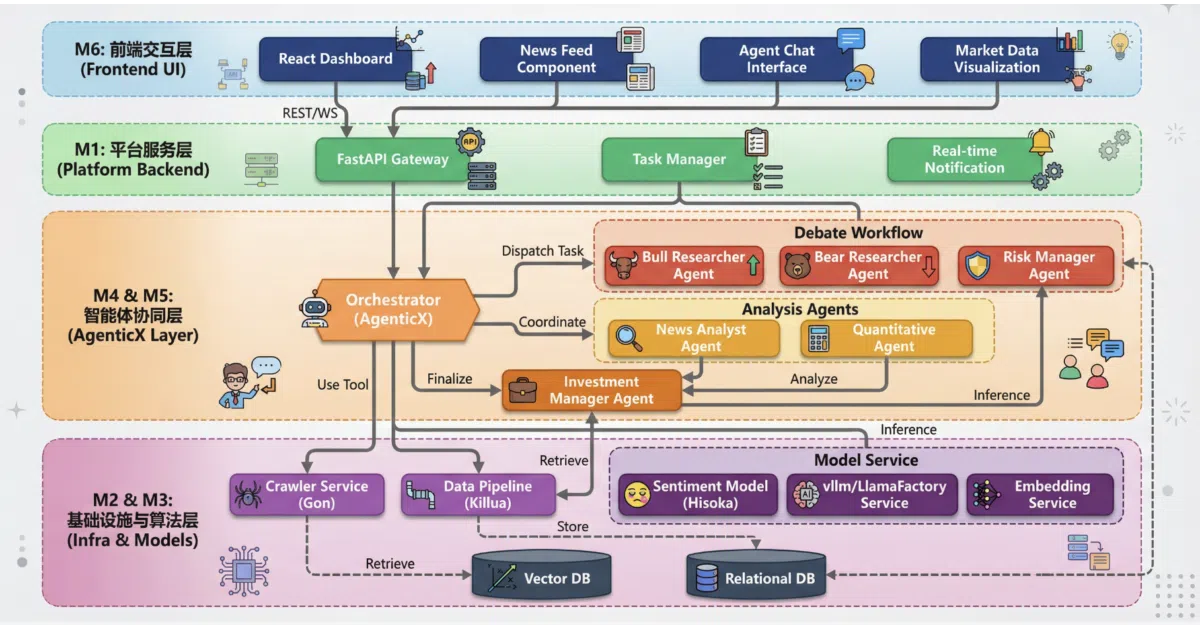
What it does FinnewsHunter is a full-stack platform that scrapes real-time financial news from Chinese sources (Sina Finance, Securities Times, etc.), vectorizes articles, and routes them through LLM-powered agents for sentiment analysis and market-impact scoring. It bundles a React frontend, FastAPI backend, PostgreSQL/Milvus/Redis storage, and Celery workers into Docker Compose. There’s also K-line charting via akshare and fuzzy search across 5,000+ A-share stocks.
The interesting bit The “multi-agent” angle isn’t just branding. The system explicitly orchestrates agent roles—NewsAnalyst, Researcher, etc.—through the author’s own AgenticX framework, with a “debate workflow” layer. It’s essentially a quant shop’s research pipeline rebuilt as opinionated infrastructure, complete with one-click LLM provider switching between Bailian, DeepSeek, Kimi, OpenAI, and Zhipu.
Key highlights
- Built on the author’s AgenticX framework; reuses its
BailianEmbeddingProviderandMilvusStoragerather than rolling custom vector plumbing - Supports 5 LLM providers with frontend toggle; defaults to Alibaba Cloud’s Bailian for China latency
- Async vectorization pipeline: articles get embedded in background without blocking analysis
- Docker Compose deployment with explicit service dependency chain (Postgres → Redis → Milvus → Celery)
- Includes 4 different database reset methods, which tells you something about iteration velocity
Caveats
- README install path hardcodes
/Users/damon/myWork/AgenticXfor the framework dependency; you’ll need to adapt this - The “knowledge graphs” and “alpha factor mining” mentioned in the intro aren’t detailed in the visible README sections—actual signal generation logic is unclear
- Frontend cache invalidation requires manual hard-refresh; the docs spend surprising length explaining browser DevTools
Verdict Worth a look if you’re building quant-adjacent NLP pipelines for Chinese equities and want a reference architecture rather than a library. Skip it if you need a clean, minimal API or aren’t prepared to babysit a 6-service Docker fleet.
Frequently asked
- What is DemonDamon/FinnewsHunter?
- A multi-agent system that crawls Chinese financial news, debates sentiment, and spits out alpha signals—assuming you can keep all the services running.
- Is FinnewsHunter open source?
- Yes — DemonDamon/FinnewsHunter is open source, released under the Apache-2.0 license.
- What language is FinnewsHunter written in?
- DemonDamon/FinnewsHunter is primarily written in Python.
- How popular is FinnewsHunter?
- DemonDamon/FinnewsHunter has 1.5k stars on GitHub.
- Where can I find FinnewsHunter?
- DemonDamon/FinnewsHunter is on GitHub at https://github.com/DemonDamon/FinnewsHunter.