DeepWisdom/AutoDL
The AutoML framework that won NeurIPS by making humans obsolete
A competition-winning pipeline that claims to handle any data modality without a single hyperparameter tweak.
Not currently ranked — collecting fresh signals.
star history
What it does AutoDL is an end-to-end automated classification system that ingests image, video, audio, text, or tabular data and spits out trained models with zero human configuration. It bundles feature engineering, model selection, architecture search, and hyperparameter tuning into a single black-box pipeline. The project emerged from the NeurIPS 2019 AutoDL Challenge, where it reportedly took first place across most datasets.
The interesting bit The framework treats modality as interchangeable: the same control loop runs whether you’re classifying aerial photos or speech accents. It maintains a living model zoo that spans classical ML (LR, SVM, LightGBM) to heavy deep learning (ResNet variants, BERT, MC3), selecting and stacking candidates on the fly. The “10 seconds to competitive accuracy” claim is bold even by AutoML standards.
Key highlights
- Won NeurIPS AutoDL 2019 with average rankings of 1.2 (feedback phase) and 1.8 (final phase)
- Supports binary, multi-class, and multi-label classification across five data modalities
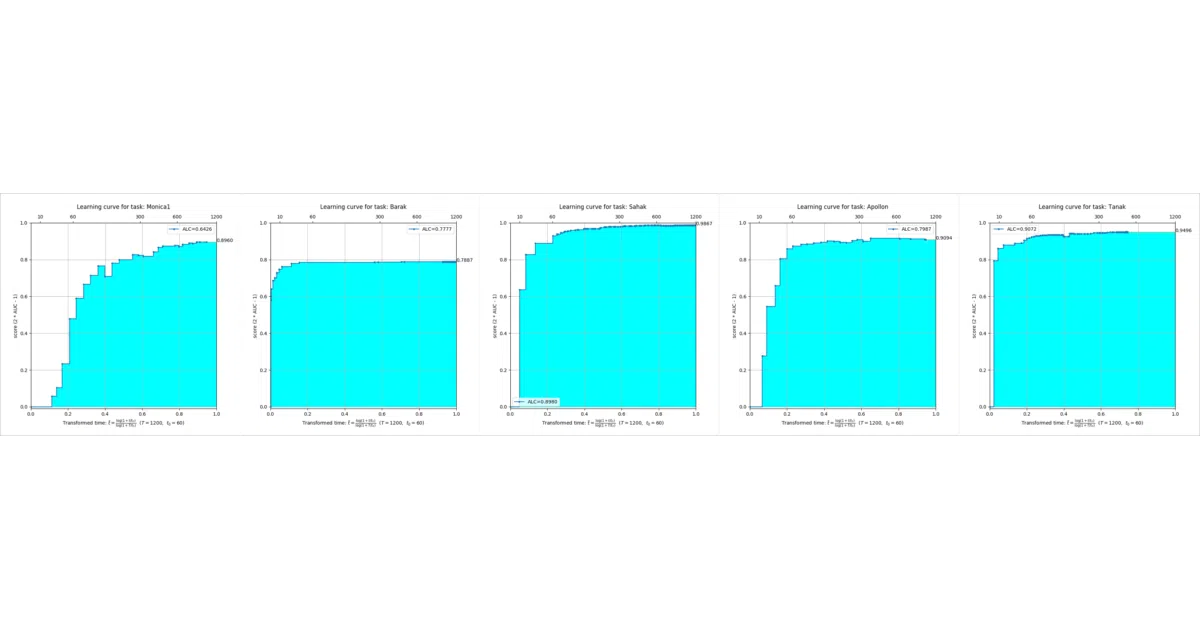
- Real-time HTML learning curves during training via
AutoDL_scoring_output/ - Model inventory includes ThinResNet, TextCNN, RCNN, GRU, and gradient-boosted trees
- Ships with 24 public benchmark datasets and Docker images matching competition hardware
Caveats
- Documentation and primary README are in Chinese; English translation exists but may lag
- Locked to older dependency stack: Python 3.5+, PyTorch 1.3.1, TensorFlow 1.15, CUDA 10
- Pretrained speech model must be manually downloaded and placed in the correct subdirectory
Verdict Worth a spin if you need a fire-and-forget baseline generator for heterogeneous data, especially in resource-constrained or competition settings. Skip it if you require interpretable pipelines, modern framework versions, or fine-grained control over model architecture.
Frequently asked
- What is DeepWisdom/AutoDL?
- A competition-winning pipeline that claims to handle any data modality without a single hyperparameter tweak.
- Is AutoDL open source?
- Yes — DeepWisdom/AutoDL is open source, released under the Apache-2.0 license.
- What language is AutoDL written in?
- DeepWisdom/AutoDL is primarily written in Python.
- How popular is AutoDL?
- DeepWisdom/AutoDL has 1.2k stars on GitHub.
- Where can I find AutoDL?
- DeepWisdom/AutoDL is on GitHub at https://github.com/DeepWisdom/AutoDL.