Code-Amadeus/Amadeus
A desktop agent that talks, emotes, and delegates — on purpose
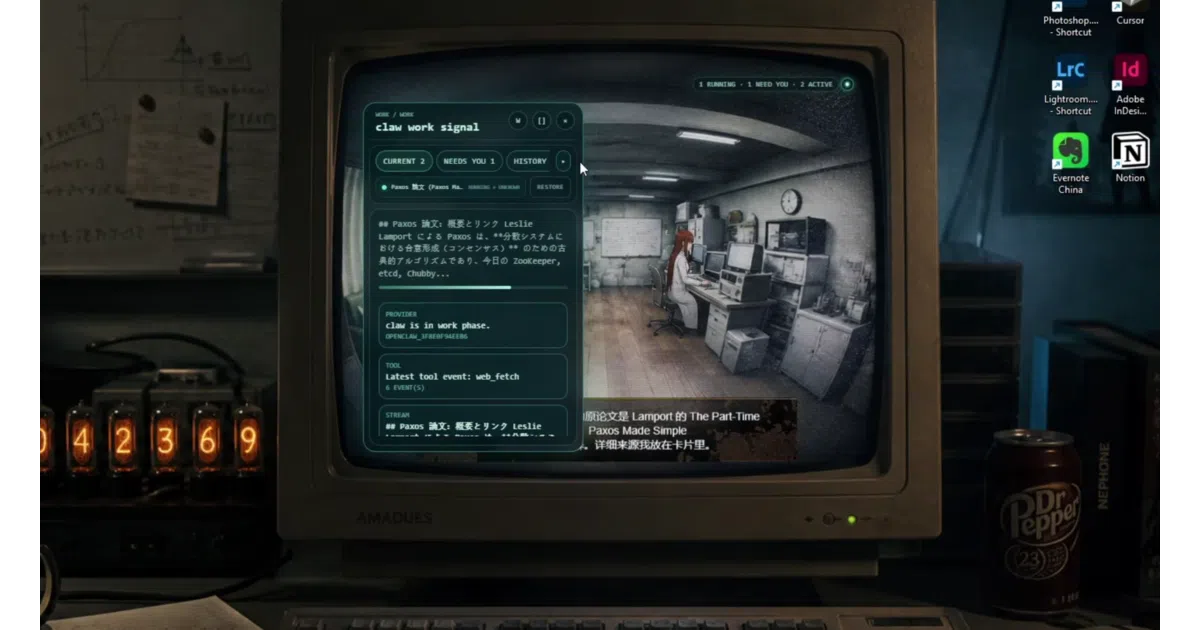
Amadeus merges voice assistant, anime-style character, and execution agent into one supervised loop, with the Host keeping the receipts.
Collecting fresh signals — velocity needs a few days of history.
collecting data…
star history
What it does
Amadeus is a real-time multimodal desktop agent: you speak or type, an animated character talks back with synced subtitles and lip movement, and long-running work gets delegated to specialized Providers (Pi for daily tasks, Codex for coding, a managed Browser, optional OpenClaw). The interesting architectural bet is that the character never executes anything itself — it narrates, while a Host layer owns identity, permissions, state, and recovery. Progress, diffs, permission requests, and results stay visible and resumable.
The interesting bit
AUIP, the cooperative application protocol: once a Work task produces a runnable Artifact, the Host issues a short-lived attach ticket binding the session, an immutable Artifact reference, and a TTL. The app can only publish declared state and events — so collaboration with generated apps doesn’t become an execution-authority loophole. Also notable: interruption works across LLM, TTS, and physical playback, which is rarer than it sounds.
Key highlights
- Interruptible real-time voice: two-stage endpointing, AEC/barge-in, local ASR (Qwen3/SenseVoice) and embedded GPT-SoVITS streaming synthesis
- Durable work control plane: Projects, Drafts, WorkItems/Attempts, Continue/Retry, restart recovery, structured diffs
- Per-call approval by default; Main Chat cannot invoke MCP tools directly — a deliberate authority boundary
- Character packs are optional; Chat and Work function without them
- Runs locally with Windows as reference platform; macOS (MPS) and Linux verified, plus experimental AMD ROCm on Windows
Caveats
- This is a 0.17.1 Alpha 1 candidate — buildable source, not a packaged desktop release; the demo video is explicitly “a product slice, not a pixel-exact preview”
- Main Chat defaults to remote DeepSeek; fully local voice is there, but the README is vague on how local-first the chat side can get
- No character packs, model weights, or reference audio in the public source (licensing), so the flagship look requires sourcing your own assets
- AGPL-3.0, which narrows who can build on it commercially
Verdict
Worth a look if you’re interested in agent architecture where authority, permissions, and auditability are first-class — the Host/Provider/AUIP separation is genuinely thoughtful. Skip it if you wanted a turnkey waifu assistant you can install tonight.
Frequently asked
- What is Code-Amadeus/Amadeus?
- Amadeus merges voice assistant, anime-style character, and execution agent into one supervised loop, with the Host keeping the receipts.
- Is Amadeus open source?
- Yes — Code-Amadeus/Amadeus is open source, released under the AGPL-3.0 license.
- What language is Amadeus written in?
- Code-Amadeus/Amadeus is primarily written in Python.
- How popular is Amadeus?
- Code-Amadeus/Amadeus has 510 stars on GitHub.
- Where can I find Amadeus?
- Code-Amadeus/Amadeus is on GitHub at https://github.com/Code-Amadeus/Amadeus.