Chorus-AIDLC/Chorus
Let AI Draft the Roadmap, You Keep the Red Pen
Chorus provides the infrastructure to manage LLM agents through a full development lifecycle, forcing a 'reversed conversation' where AI proposes and humans verify.
Velocity · 7d
+22
★ / day
Trend
↗accelerating
star history
What it does
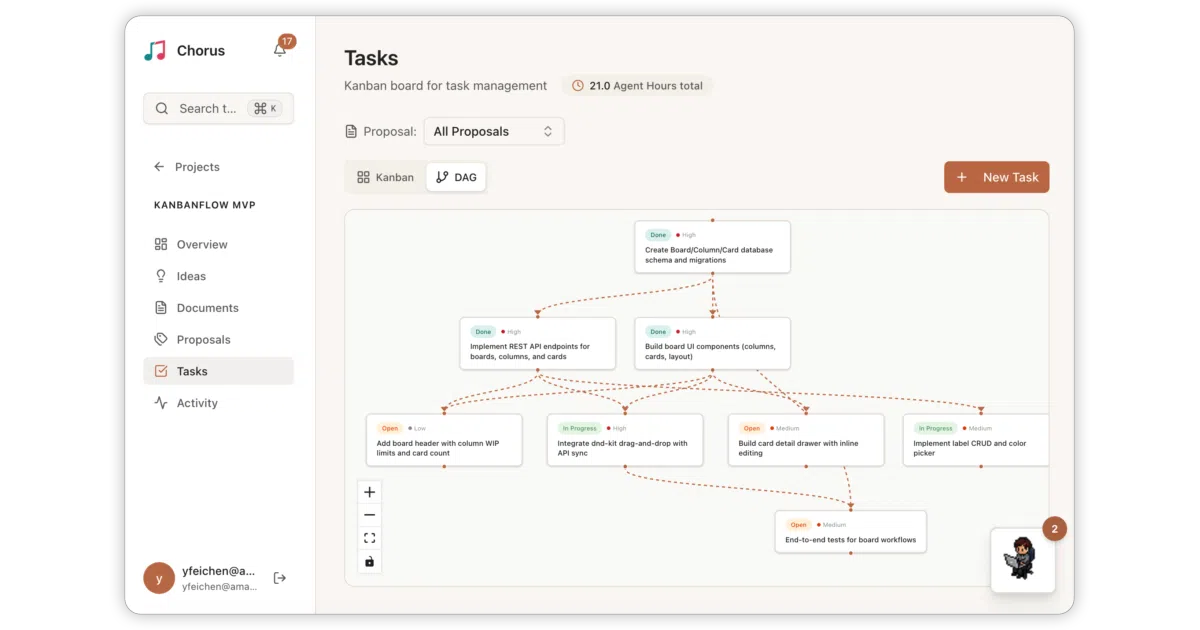
Chorus is an agent harness — infrastructure that wraps around LLM agents to manage session lifecycle, task state, sub-agent orchestration, and failure recovery. It pushes collaboration through a structured AI-DLC workflow: raw ideas become elaborated requirements, then agent-drafted proposals with task DAGs, then executed tasks, then human-verified acceptance criteria. A React-based web UI provides Kanban boards, dependency visualization, real-time agent presence, and a universal Cmd+K search across all entities.
The interesting bit The core philosophy is “Reversed Conversation”: AI agents drive the paperwork and planning, humans only step in to approve or reject. A fine-grained permission matrix (5 resources × 3 actions) lets you treat agents as semi-autonomous coworkers rather than all-powerful admins or glorified autocomplete, and an embedded PGlite mode means you can run the entire stack locally without Docker or a separate database.
Key highlights
- Structured AI-DLC workflow — Idea → Proposal → Task DAG → Execute → Verify, with mandatory human approval gates before work materializes.
- Fine-grained agent permissions — Configurable 5×3 grid of resources and actions, replacing coarse PM/Dev/Admin presets with custom capability boundaries.
- Real-time observability — Pixel-art workspace characters, live Kanban updates, SSE push notifications, and session heartbeats so you know what every agent is doing.
- Zero-config local deployment — Embedded in-process PostgreSQL (PGlite) with automatic migrations; external database only needed for concurrent multi-agent loads.
- MCP tool server — 50+ permission-gated tools exposed via streaming MCP endpoint, letting external agents like Claude Code plug into the harness.
Caveats
- Embedded PGlite mode has explicit connection-handling limits; running multiple agents or users simultaneously requires an external PostgreSQL instance.
Verdict Best for teams already experimenting with agentic coding who need guardrails, audit trails, and a Kanban view of what their AI “employees” are doing. If your workflow is a single chat window, this is organizational overkill.
Frequently asked
- What is Chorus-AIDLC/Chorus?
- Chorus provides the infrastructure to manage LLM agents through a full development lifecycle, forcing a 'reversed conversation' where AI proposes and humans verify.
- Is Chorus open source?
- Yes — Chorus-AIDLC/Chorus is open source, released under the AGPL-3.0 license.
- What language is Chorus written in?
- Chorus-AIDLC/Chorus is primarily written in TypeScript.
- How popular is Chorus?
- Chorus-AIDLC/Chorus has 1.2k stars on GitHub and is currently accelerating.
- Where can I find Chorus?
- Chorus-AIDLC/Chorus is on GitHub at https://github.com/Chorus-AIDLC/Chorus.