Ceruleanacg/Personae
A job-hunt deadline saved this quant-RL repo from eternal refactoring
Personae bundles seven paper implementations and a toy market simulator for developers who want to test DDPG on stock prices without building the plumbing from scratch.
Not currently ranked — collecting fresh signals.
star history
What it does Personae is a Python toolkit that implements seven academic papers—four reinforcement learning algorithms (DDPG, Double DQN, Dueling DQN, Policy Gradient) and three supervised models (DA-RNN, TreNet, naive LSTM)—then drops them into a bare-bones simulated market for stocks and futures. It also includes data spiders, MongoDB storage, and Docker images so you can run the whole pipeline without manually installing TensorFlow 1.4-era dependencies.
The interesting bit The author was brutally honest: reconstruction was supposed to end by September 2018, or whenever they landed a job. That deadline passed, and the repo still warns that its input features are “naive” and day-frequency data is “clearly not enough.” Refreshing candor in a field that usually promises alpha.
Key highlights
- Ships with a gym-like market environment (
Market,Trader,Positions) that works without OpenAI Gym installed - Docker image inherits from CUDA 8.0 / cuDNN 6 runtime for GPU training
- Includes spiders to crawl Chinese stock and futures data via tushare into MongoDB
- All TensorFlow models support checkpoint persistence and TensorBoard summaries
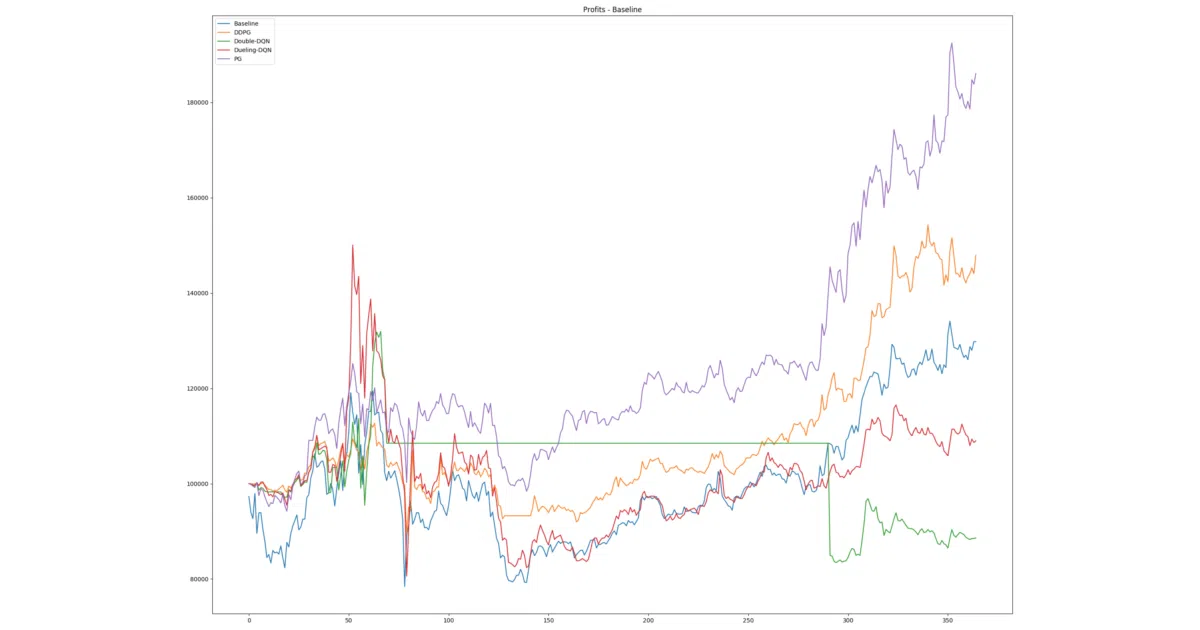
- Experiments include profit curves against baseline and price-prediction plots on four bank stocks
Caveats
- Explicitly frozen in a 2018 dependency stack: Python 3.5, TensorFlow 1.4, CUDA 8.0
- Author warns features are naive and daily data is insufficient for serious trading
- Short selling is noted as “still implementing”
- README contains broken links (e.g., DDPG experiment points to
algorithm/SL/DualAttnRNN.py)
Verdict Useful if you need a quick, opinionated scaffold to swap your own features into established RL/SL algorithms. Skip it if you want production-grade backtesting or modern PyTorch/TensorFlow 2.x code; the value here is the wiring, not the models themselves.
Frequently asked
- What is Ceruleanacg/Personae?
- Personae bundles seven paper implementations and a toy market simulator for developers who want to test DDPG on stock prices without building the plumbing from scratch.
- Is Personae open source?
- Yes — Ceruleanacg/Personae is open source, released under the MIT license.
- What language is Personae written in?
- Ceruleanacg/Personae is primarily written in Python.
- How popular is Personae?
- Ceruleanacg/Personae has 1.4k stars on GitHub.
- Where can I find Personae?
- Ceruleanacg/Personae is on GitHub at https://github.com/Ceruleanacg/Personae.