ByteDance-Seed/SeedVR
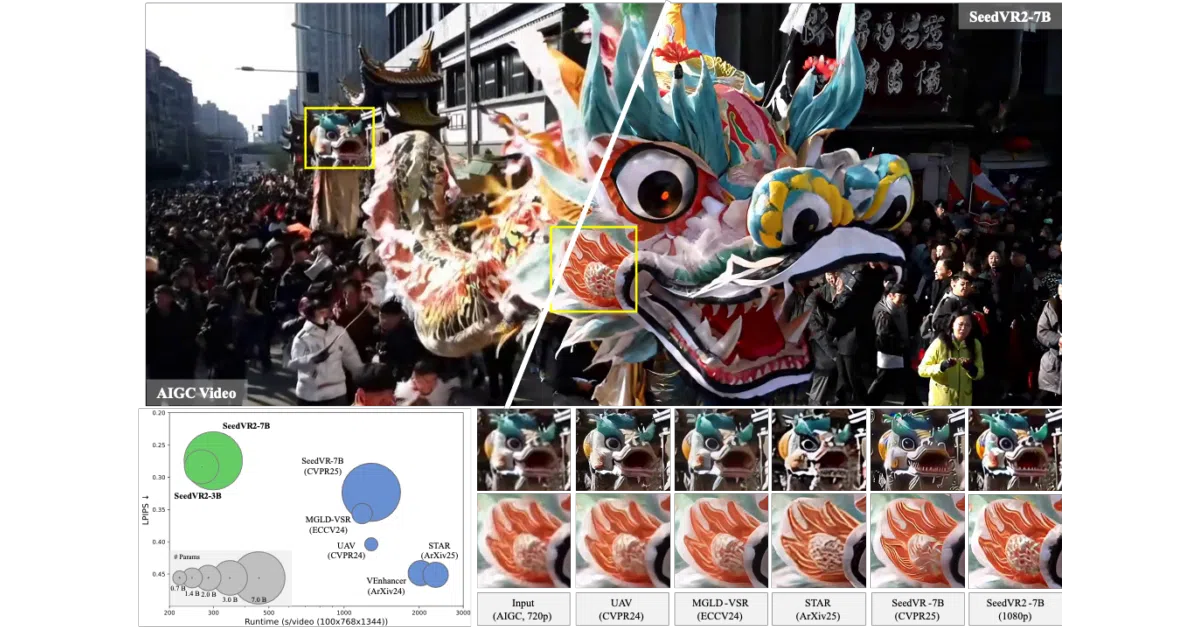
SeedVR2 shrinks video restoration from many diffusion steps to one
It exists because tiling overlapping video patches at every diffusion step is unbearably slow, and pretrained priors choke on arbitrary resolutions and small text.
Not currently ranked — collecting fresh signals.
star history
What it does SeedVR is a diffusion-transformer model for generic video restoration trained without a pretrained diffusion prior, so it can handle arbitrary resolutions instead of being locked to 512×512 or 1024×1024. Its successor, SeedVR2, distills the same idea into a one-step generator via adversarial post-training, trading the usual multi-step diffusion slog for a single forward pass. Both models target real-world and AIGC video degradation, from blur to low resolution.
The interesting bit Instead of chopping video into overlapping spatial-temporal patches and fusing them with a Gaussian kernel at every step—a process so inefficient that overlap can eat 50% of the patch size—SeedVR processes whole frames. SeedVR2 adds an adaptive window attention mechanism that resizes its own windows on the fly to match the output resolution, dodging the inconsistency you usually get when fixed-size windows meet high-res video.
Key highlights
- Arbitrary-resolution restoration without a pretrained diffusion prior or patch-based sampling.
- SeedVR2 performs adversarial training against real data to achieve one-step inference.
- Adaptive window attention dynamically adjusts to output resolution for high-res consistency.
- Sequence-parallel multi-GPU inference: one H100-80G handles 720p, four handle 1080p/2K.
- Apache 2.0 license with Hugging Face checkpoints and a community ComfyUI node.
Caveats
- The authors label these as prototype models, and performance may not perfectly match the papers.
- Heavy degradations, very large motion, and lightly degraded inputs (e.g., 720p AIGC) can trigger oversharpened or unpleasing details.
- Inference is H100-class hardware; this is not a casual CPU or consumer-GPU toy.
Verdict Video restoration researchers and production teams with serious GPU clusters should take a look, especially if they are tired of tiling artifacts and multi-step diffusion latency. Everyone else should admire the results from afar until the hardware requirements drop.
Frequently asked
- What is ByteDance-Seed/SeedVR?
- It exists because tiling overlapping video patches at every diffusion step is unbearably slow, and pretrained priors choke on arbitrary resolutions and small text.
- Is SeedVR open source?
- Yes — ByteDance-Seed/SeedVR is open source, released under the Apache-2.0 license.
- What language is SeedVR written in?
- ByteDance-Seed/SeedVR is primarily written in Python.
- How popular is SeedVR?
- ByteDance-Seed/SeedVR has 1.3k stars on GitHub.
- Where can I find SeedVR?
- ByteDance-Seed/SeedVR is on GitHub at https://github.com/ByteDance-Seed/SeedVR.